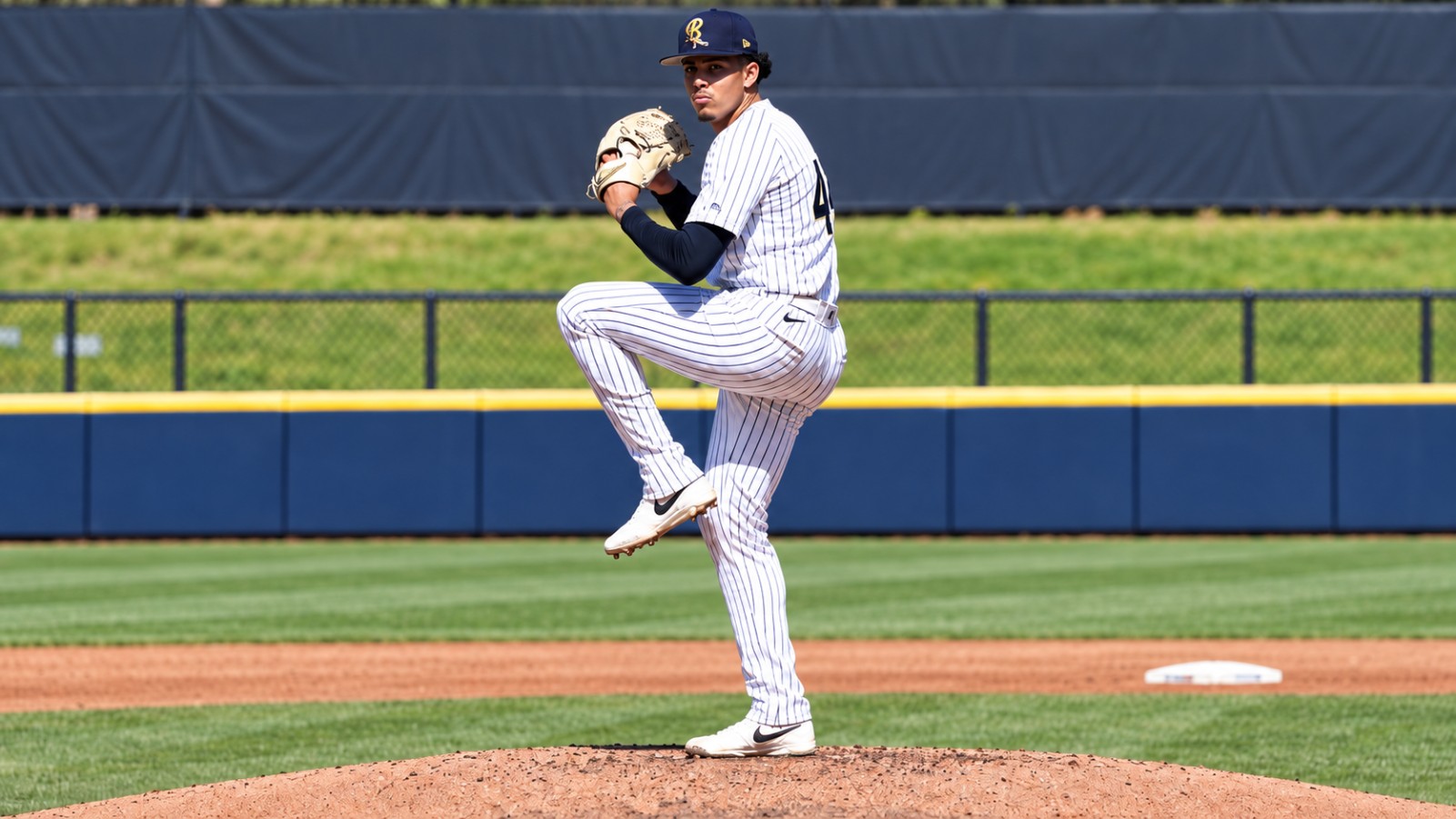
MOOSIC, Pa. — The Yankees did not need Carlos Lagrange to prove everything in one inning Wednesday. They needed the first reliable answer after a shoulder injury erased most of his summer and interrupted a bullpen experiment that had put one of the organization’s hardest throwers on a faster track toward the Bronx.
That made his return for Triple-A Scranton/Wilkes-Barre more important than the final score. The RailRiders lost 9-6 to Jacksonville at PNC Field, but Lagrange’s sixth inning served as a controlled test of the traits that made him a legitimate late-season option before he went down.
The Yankees had shifted the 23-year-old from the rotation to relief in early June, not because they had abandoned his future as a starter, but because shorter outings offered a possible route to the major league bullpen. That plan stopped after his June 28 appearance, when he allowed five runs in two-thirds of an inning and later landed on the injured list with a capsular sprain in his right shoulder.
Before Wednesday, the right-hander had not appeared in a game for more than two months. His return came with the Yankees already deep into September, leaving little time to judge whether he could again become part of the club’s immediate pitching conversation or whether the rest of 2026 would be about finishing healthy and carrying momentum into next spring.
Scranton/Wilkes-Barre was down 5-3 when Lagrange entered in the top of the sixth. He faced the middle of Jacksonville’s order, allowed a one-out double, then finished the inning with consecutive strikeouts. The RailRiders tied the game in the bottom half before Jacksonville pulled away later. Matt Pushard earned the win, while Eli Morgan took the loss.
The result dropped Scranton/Wilkes-Barre to 76-67 with four regular-season games left. For the Yankees, however, the late-season value of the afternoon centered on evaluating a pitcher whose timetable had been compressed by an injury at the worst stage of the calendar.
The fastball was back, but the slider told a different story
Then came the detail the Yankees wanted most. Lagrange’s first pitch registered 101.2 mph, and four of his seven four-seam fastballs reached at least 100 mph. The pitch averaged 100.3 mph and topped out at 102.1, giving the Yankees immediate evidence that the shoulder injury had not erased his premium velocity.
He struck out two in a scoreless inning and generated three whiffs on nine total swings. Yet none of those misses came against his slider. That was the only piece of the outing that kept the return from being a complete showcase of his pre-injury arsenal.
The distinction matters, but only as an early checkpoint. Lagrange still used the high-80s slider to freeze Brandon Compton for strike three on the inside corner. A pitch can remain effective without producing a whiff, and one inning is far too small a sample to treat zero slider misses as evidence of a larger problem.
One inning creates a sharp contrast with his pre-injury slider
The more useful comparison comes from what the slider had been doing before the injury. In late May, MLB Pipeline reported a 35.4% whiff rate against Triple-A hitters on the pitch. In the same outing, Lagrange’s fastball sat in the upper 90s deep into his start, showing that both velocity and a bat-missing breaking ball were central to his profile.
Wednesday flipped that balance for one night. The fastball was overwhelming from the first pitch, while the slider produced a called strikeout but no swing-and-miss. Four of seven four-seamers reaching triple digits means 57.1% of the fastballs in the inning cleared 100 mph. That is the encouraging part of the snapshot. The slider response is simply the next item for the Yankees to monitor.
Yankees still view Lagrange as a starter, but 2026 changed the route
The Yankees have not changed their long-term view of Lagrange. When the Yankees moved him into relief in June, manager Aaron Boone made that clear while explaining why the club was willing to alter his 2026 workload.
“We definitely view him long term as a starter,” Boone said in June.
The shorter role had produced encouraging results before the shoulder issue. After Wednesday’s inning, Lagrange’s Triple-A season line stands at a 4.48 ERA with 85 strikeouts in 64 1/3 innings across 19 appearances, including 11 starts. MLB Pipeline currently ranks him as the Yankees’ No. 4 prospect.
The Yankees also have a roster decision attached to any immediate promotion. Lagrange was not listed on New York’s 40-man roster as of Thursday, so a major league call-up would require the club to create a spot and add him.
Scranton/Wilkes-Barre had four regular-season games remaining after Wednesday. That leaves Lagrange only a narrow window to show that the slider’s empty whiff column was a one-inning quirk rather than something that needs more rebuilding after the layoff. For the Yankees, the most important first answer already arrived: the velocity came back immediately. The next answer is whether the rest of the arsenal follows just as quickly.
What do you think? Leave your comment below.