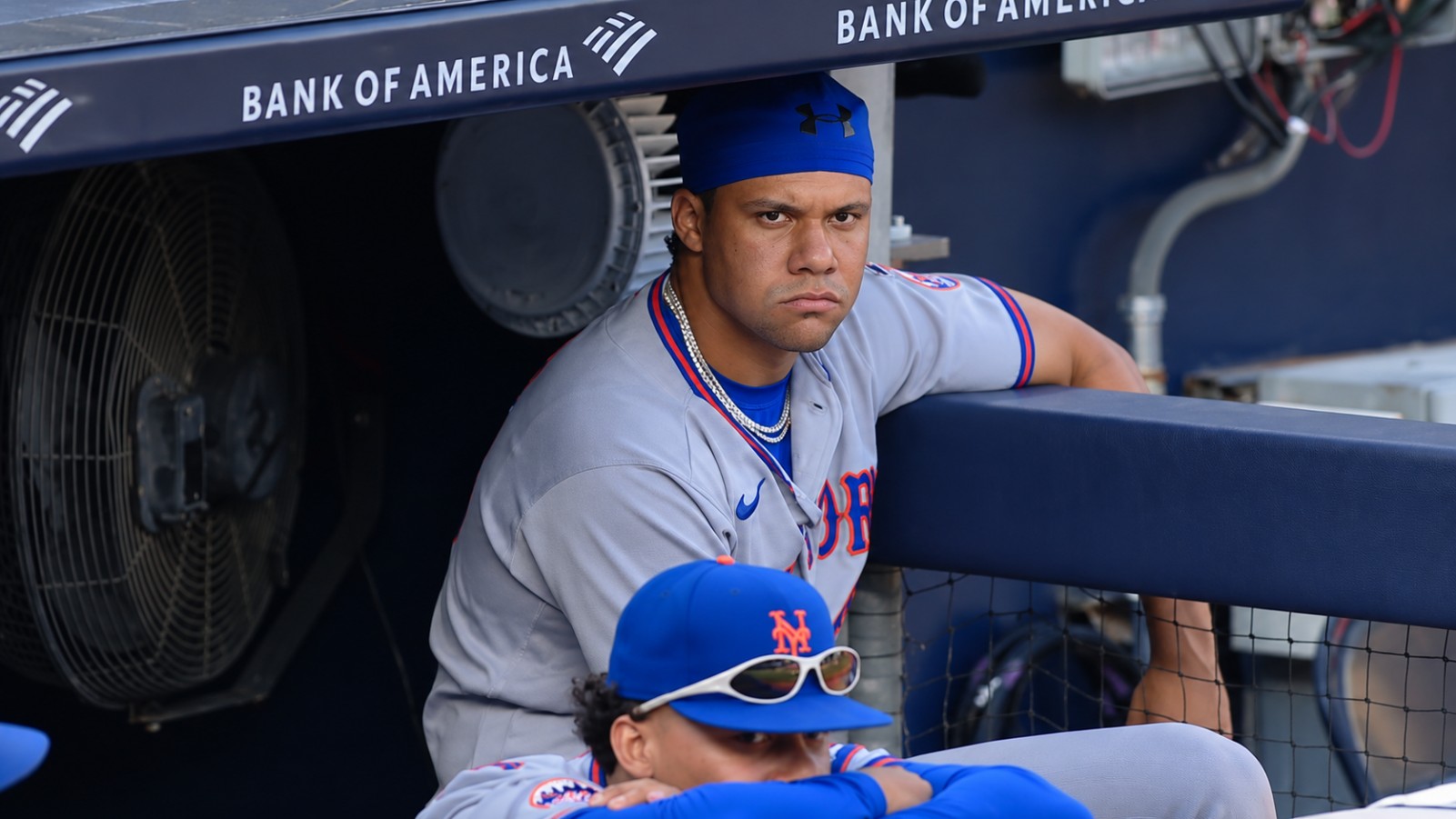
NEW YORK — Juan Soto walked back into Yankee Stadium braced for the boos. They came, loud and on cue, every time his name was announced. That part he expected. The sound that stung more came from a different direction entirely.
Soto returned to the Bronx this weekend for the first Subway Series here since he left the Yankees for the Mets. The reunion was always going to be charged. He spent one season in pinstripes, helped push the Yankees to the 2024 World Series, then signed a record 15-year, $765 million contract across town.
Yankees fans have not forgotten. Every at-bat drew a chorus of jeers, the predictable soundtrack for a departed star who chose the other New York team. Soto has heard it before and shrugged it off.
What he could not shrug off was where the sharper criticism originated. It did not come from the stands or from a Yankees broadcast. It came from his own side of the series, and it turned a routine ground ball into the talking point of the weekend.
The context made the timing worse. Soto’s exit from the Bronx still rankles Yankees fans, who watched him post a monster 2024 and then leave for a division rival at a price no team had ever paid a position player. His every return was destined to be theater. He knew that walking in.
What he could not script was the storyline that greeted him. Instead of the boos becoming the headline, his own effort did, and it did so through a voice that carried no Yankees bias at all.
A rebuke from his own broadcast booth
The moment arrived Saturday afternoon in the first inning. Soto followed Francisco Lindor’s leadoff home run with a grounder toward Anthony Volpe at second base. Volpe, still adjusting to a position he only recently took up, bobbled the ball.
For a runner sprinting out of the box, the bobble was an opening. Soto was not sprinting. He accelerated late, and Volpe recovered in time to throw him out. The hesitation, not the bobble, decided the play.
SNY analyst Ron Darling did not wait to address it. A former Mets pitcher calling a Mets broadcast, Darling flagged the lack of effort the moment the out was recorded, giving the criticism a weight it would not have carried from a Yankees partisan.
“If you’re not going to run, things like that are going to happen,” Darling said. “Bobbled. If you don’t run out of the box, then you end up being embarrassed.”
The rebuke landed harder because of what had happened the night before. This was not a single lapse. It was the second straight day that Soto’s hustle became the story in his own return.
A game-ending double play the night before
On Friday, Soto came to the plate in the ninth inning with the Mets trailing the Yankees 6-4. He represented the tying run. Facing Yankees closer David Bednar, he hit a grounder that turned into a game-ending 3-6-3 double play.
Soto did not sprint from the box, and fans watching the play pounced. On a ball that close, a faster start might have beaten the relay. Instead the Yankees escaped with the win, and the replay spread quickly.
An earlier moment that night had already raised eyebrows. In the eighth, Ryan McMahon singled to left, and Soto looked slow to the ball as a Yankees run scored. SNY’s Gary Cohen wondered aloud the next day whether several balls falling in front of Soto had shaped the game.
Two days, three questionable moments. The pattern is what made Saturday’s grounder impossible to wave away as a one-time lapse.
Calf injuries complicate the hustle debate
There is real context behind Soto’s caution. He has fought leg problems all season. A right calf strain in April cost him about two and a half weeks. A more serious Grade 2 strain of his left calf in July kept him out more than a month before the Mets activated him Aug. 29.
The two injuries limited Soto to 96 games and gave the Mets reason to manage his running. He also started Saturday at designated hitter rather than in left field, a sign the club is still protecting him. On its face, that explains a cautious start down the line.
Soto then undercut the explanation himself. In the fourth inning, he laced a double and ran hard into second, later tagging up to third and scoring on Carson Benge’s single. His speed on that sequence looked nothing like his jog on the grounder.
Broadcasters noticed the contrast. Keith Hernandez, working the SNY booth, saw no sign of a compromised calf on the double.
“He showed no issues with his calf,” Hernandez said. “He ran like the devil on that double.”
The number that keeps the Soto debate alive
Here is the detail that keeps this from being a simple hustle story. In the same game, Soto went from a late-breaking grounder to an all-out double to a 25th home run in the seventh inning. He finished 2-for-5 with a double, the homer and two runs scored in a 12-2 Mets rout.
That is the contradiction driving the criticism. No one questioned whether Soto can still change a game. His OPS remains north of .900, and he is one of the sport’s most dangerous hitters. The question was narrower and more pointed. If he could run like that in the fourth, why not from the box in the first?
The debate is not new to him. During his first Mets season in 2025, manager Carlos Mendoza said he would speak with Soto after the slugger admired a drive off Fenway Park’s Green Monster and ended up with only a single. That episode, too, came shortly after a slow effort on a grounder against the Yankees.
Soto defended himself then, saying he believed he had been hustling. More than a year later, the same question has resurfaced in nearly the same setting, only now with two calf injuries in his medical file and a Mets season that has disappointed.
The criticism that now travels with Soto. Against the Yankees, of all opponents, every move he makes already draws a magnified look. Two straight days of effort questions guarantee the next one will be watched even more closely, whatever his calf says.
What do you think? Leave your comment below.