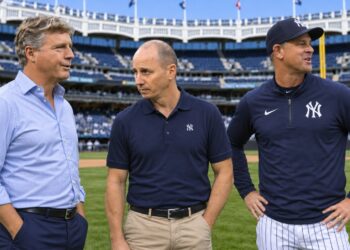
LAS VEGAS — The Yankees are entering another offseason with the future of their most important hitter intertwined with decisions that reach beyond the roster. A lost season for their captain has left questions about who determines his workload and how those decisions are explained.
New York spent much of 2026 without Aaron Judge, then watched his anticipated September return end almost as quickly as it began. He was not available when the Yankees faced Boston in the Wild Card Series or Tampa Bay in the Division Series.
The uncertainty had consequences beyond the batting order. Judge and manager Aaron Boone offered different public signals about his calf injury, creating confusion over whether the captain could return before the Yankees’ postseason run ended.
Now, as the club prepares for 2027, general manager Brian Cashman is confronting two related problems: how to protect Judge from another lengthy absence and how to avoid a repeat of the public disagreement that accompanied his latest setback.
Cashman acknowledges a different role for Judge
At the general managers meetings Tuesday, Cashman said the Yankees expect to use Judge as a designated hitter at times next season. He also acknowledged that the idea may not appeal to the captain, who prefers to play the field every day.
Cashman framed the adjustment as a way to preserve one of baseball’s most valuable bats rather than a permanent move away from right field.
“I’m sure he’s going to need some DH time. I’m sure he doesn’t want to hear that. He’s an alpha, wants to play every day,” Cashman said.
Judge, 34, played only 66 regular-season games in 2026. He finished with 18 home runs, 41 RBIs and a .241 batting average. His absence left the Yankees managing a lineup without the hitter around whom their offense is built.
Cashman’s proposal also touches a roster constraint. Giancarlo Stanton, who spent most of 2026 injured, has frequently occupied the DH spot. Giving Judge more opportunities there would require the Yankees to distribute those at-bats differently.
Cashman concedes Yankees mishandled communication
The more immediate acknowledgment concerned the Yankees’ handling of information during the season. Cashman said the club needed to improve its public communication after Judge and Boone appeared at odds over the calf injury’s severity and recovery timetable.
Cashman addressed those exchanges directly, saying the Yankees could avoid creating problems for themselves through uncertain or conflicting explanations.
“Just externally, how we communicate with you guys, I think we’ll be better at that as we move forward than we were as this 2026 campaign went. I don’t think that’ll be as much of an issue as we move forward,” Cashman said.
He also revealed that he had discussed the issue with the captain rather than leaving it to be resolved through media appearances.
“I’ve had conversations with Judgey. I think we’re going to be in a better spot than that because we try to avoid the self-inflicted wounds of trying to do all that. Sometimes it can get you tongue-tied. But I don’t disagree with you that it does not reflect well, even though it’s not intended to do it that way. It’s like a balancing act and sometimes you get tied up,” Cashman said.
Those remarks identify a breakdown in messaging, not a declaration that Judge and the front office are personally estranged. They also represent Cashman’s acknowledgment that the mixed public accounts reflected poorly on the Yankees.
Seven weeks that exposed Yankees’ information problem
Judge was sidelined for more than three months with a fractured right rib before returning Sept. 8 against Colorado. On Sept. 16 at Minnesota, discomfort in his right calf forced him out of a game. An MRI confirmed a soleus strain, and the Yankees placed him on the injured list Sept. 19.
Aaron Judge wanted to remain a possibility for the postseason, even as Boone indicated that a return for the opening playoff round was unlikely. The distinction mattered because the captain’s optimism and the manager’s caution reached fans at nearly the same time.
There was a measurable difference between injury management and injury messaging. The Yankees had to determine when Judge could safely run, swing and play. They also had to tell the public what was known without disclosing more medical detail than the captain wanted shared.
Judge ultimately did not play in the postseason. The Yankees advanced past Boston before Tampa Bay swept them in three Division Series games. The lineup scored five runs in that series.
DH plan leaves another Yankees lineup decision unsettled
Cashman’s remarks came as the Yankees considered how to build a healthier roster for 2027. The proposed DH rotation is not a finalized game-by-game plan, and it does not settle how many starts Stanton, Judge or other hitters would receive there.
At the same meetings, Cashman said Judge had completed a follow-up medical evaluation and required no additional procedure. The Yankees expect him to use the winter to recover and be ready for spring training.
The club therefore enters the offseason with two clear commitments but no detailed schedule: it intends to manage Judge’s physical workload more carefully and to communicate injury information more consistently. Whether those adjustments can coexist with the captain’s desire to remain in right field will become clearer when the Yankees report to camp.
What do you think? Leave your comment below.