MOOSIC, Pa. — The pitch-tracking websites cannot agree on what to call it. Some say sinker. The man who coached Carlos Lagrange through Double-A and Triple-A says otherwise.
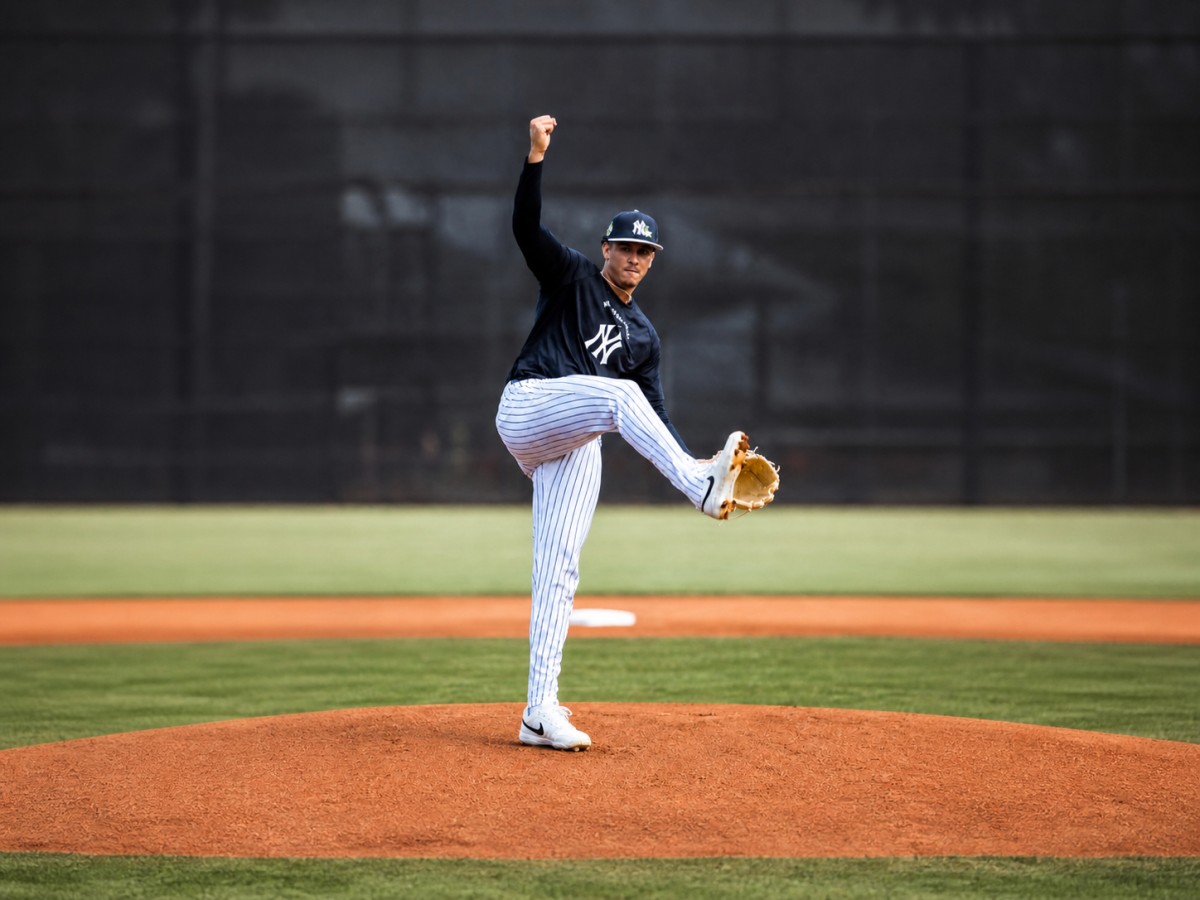
It is a two-seamer. Lagrange’s pitch sits between 99 and 101 mph. It is the newest Yankees weapon in a prospect arsenal already earning attention at Triple-A.
Lagrange is the Yankees’ No. 2 prospect and MLB Pipeline’s No. 76 overall. He has been adding a two-seam fastball to his mix since Opening Day 2026. His Yankees Triple-A pitching coach, Peter Larson, confirmed it this week. The pitch has been there all along. Most people missed it.
Why unnoticed? Because the technology watching Lagrange throw it cannot categorize it cleanly.
The pitch the data cannot name
Pitch-tracking systems rely on movement, spin and velocity to classify offerings. Lagrange’s new two-seamer travels at triple-digit speeds, averaging 100.2 mph in an April start against the Durham Bulls. Its horizontal movement profile falls close enough to a sinker that automated classification systems have been labeling it as one.
Larson drew the line there. He was asked this week whether the pitch is what the tracking sites say it is. He was direct.
“It’s a traditional two-seamer,” Larson said. “Not a sinker.”
The distinction matters to anyone who tracks pitch design closely. A sinker typically produces more vertical drop. A two-seamer generates more lateral, arm-side run. Both can generate groundballs. Both can miss bats at higher velocities. But they do different things to different hitters and set up differently in sequence.
At 100-plus mph by Lagrange, the distinction becomes even harder for hitters to process. By the time a batter reads the grip and judges the movement, the pitch is already in the catcher’s mitt.
Why Lagrange added it now
Lagrange already had four pitches in his Yankees repertoire before this season. His four-seam fastball averages 100 mph and peaked at 102.5 mph in his fifth Triple-A start. His sweeper, slider and changeup round out the group, and each grades above average by Stuff+ modeling. Lagrange’s sweeper checks in at 117 Stuff+, his changeup at 116, his four-seamer at 110 and his slider at 106. Every pitch above 100 means above average at generating whiffs.
The two-seamer is not a new concept for Lagrange. He threw it earlier in his development. He then shelved it deliberately.
Larson, who also coached Lagrange at Double-A Somerset last year, explained the sequence that led to its return. The goal over the past two seasons had been simplification. The Yankees wanted Lagrange focused on throwing strikes with his core pitches before expanding. Once that foundation settled, the two-seamer came back.
“It’s something he did throw previously, but in an effort to kind of condense the focus on strike-throwing, he worked on those other pitches the last couple years and then brought it back this season,” Larson said.
The two-seamer gives the Yankees’ top arm something he did not have before in terms of in-zone shape. It complements the ride on his four-seamer. The four-seamer carries up in the zone. Lagrange’s two-seamer dives toward the inner half against right-handed hitters. Both start from similar release points and carry similar velocity.
Larson described the addition simply.
“I think that’s a nice complement,” Larson said.
What Lagrange’s 2026 line actually shows
The Yankees surface numbers at Triple-A are easy to misread. Through five starts, Lagrange has a 3.66 ERA across 19 and two-thirds innings. He has struck out 26 and walked 11. A walk rate of roughly five per nine innings is high. The Yankees know it.
The deeper Yankees numbers tell a different story. Lagrange’s fifth start was his best. Eight strikeouts. 102 mph three times. A 43.2 percent whiff rate. Seventy-seven pitches, 53 for strikes. First-pitch strikes to 15 of 21 batters. Opening fastball: 99.3 mph. Final fastball: 100 mph.
Lagrange finished his strikeouts with four different pitches: fastball, changeup, slider and sweeper. Different counts, different angles.
Hitting 102 mph three times in a single start is historically rare. Three MLB pitchers have done it since 2015: Hunter Greene in 2022, Jordan Hicks in 2022 and Jacob Misiorowski in 2025. The last minor leaguer to hit that mark? Lagrange himself. Twelve days before.
For all the star power, the Yankees’ focus remains the same. Larson was asked what the organization is most locked in on as Lagrange builds toward a potential big league role.
“It’s what’s going to make him consistently a mainstay in the rotation,” Larson said about Lagrange. “He knows that. And it’s not just with one pitch. He’s going to have to throw off-speed for strikes.”
The Betances blueprint and what comes next
The Betances comparison is not forced. It is structural. Betances struggled as a Yankees Triple-A starter at Scranton/Wilkes-Barre in 2013. The Yankees moved him to the bullpen. Command was the obstacle. The Yankees narrowed his focus to two pitches and watched him become one of the most dominant relievers in baseball.
Lagrange signed with the Yankees out of Bayaguana, Dominican Republic for just $10,000. He has grown into a 6-foot-7, 248-pound pitcher with a five-pitch arsenal where every offering grades above average. Lagrange’s 168 strikeouts in 120 innings in 2025 ranked third in all of minor league baseball.
Whether the Yankees deploy him as a starter or eventually follow the Betances path into a high-leverage bullpen role is a decision still ahead. What is clear is that the weapon cache keeps growing. The two-seamer is the latest addition in Lagrange’s arsenal. Tracking systems are still trying to figure out what to call it. Aaron Boone already knows what it does.
He said it before the season started.
“He’s definitely got everyone’s attention,” Boone said on Lagrange. “I love where he’s at. I would not be surprised if he is impacting us early, middle, later part of the season.”
What do you think? Leave your comment below.