NEW YORK — A pitcher acquired at a considerable prospect cost has become an unexpected offseason question for the Yankees. The club entered October expecting its rotation to drive another postseason run. Instead, an early exit left general manager Brian Cashman with decisions about how to build a more complete pitching staff.
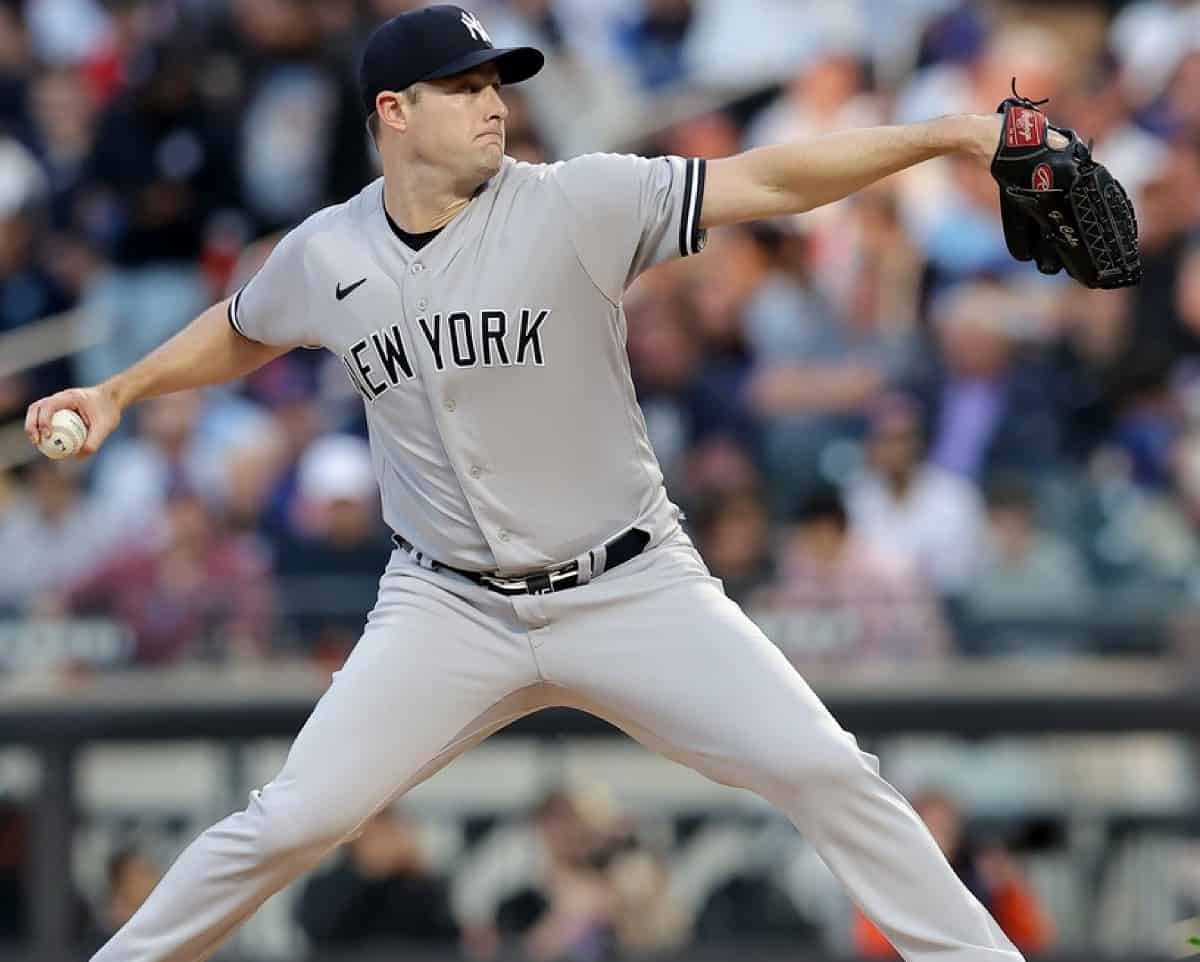
New York’s starting depth is better on paper than it was when the season began. Gerrit Cole, Max Fried, Carlos Rodon, Cam Schlittler and Will Warren give manager Aaron Boone a possible five-man group. But a list of available names is not the same as proof that five starters will stay healthy over six months.
The Yankees also have a bullpen to reconstruct. Several veteran relief options face free agency, and the club cannot simply assume the same collection of arms will return. That creates pressure to search internally for pitching help while preserving enough innings to withstand injuries.
The central question is whether New York should use one of its better starting options in shorter appearances, even though it invested heavily to acquire him. The answer could shape both its 2027 rotation competition and its winter pursuit of relievers.
A January investment faces October reassessment
Ryan Weathers has surfaced as a possible trade candidate or bullpen option, a striking reversal of the Yankees’ January decision to acquire him from the Miami Marlins for four prospects. The proposals are outside assessments, not an announced club plan or evidence that New York is shopping him.
On Jan. 13, the Yankees sent outfielder Brendan Jones, outfielder Dillon Lewis, first baseman Dylan Jasso and shortstop Juan Matheus to Miami. The deal gave New York a controllable, left-handed starter who had flashed upside but also carried an injury history.
Weathers supplied tangible production. He went 5-8 with a 3.60 ERA across 25 starts and 137 1/3 innings in 2026, with 143 strikeouts and 38 walks. His 1.22 WHIP and roughly 9.4 strikeouts per nine innings suggest that the club received more than emergency depth.
A left forearm flexor strain interrupted his season Aug. 22. He returned for the playoffs and worked 1 2/3 scoreless innings across two relief appearances against Tampa Bay. That small sample establishes he could handle an October relief assignment, not that he would automatically thrive in a permanent bullpen job.
The numbers complicate permanent bullpen switch
An analysis of Weathers’ full-season workload illustrates the opportunity cost. At 137 1/3 innings in 25 starts, he averaged approximately 5.49 innings per start. A full-time one-inning role would replace proven bulk innings with a new assignment whose workload and performance remain unknown.
His 143 strikeouts against 38 walks produced a 3.76 strikeout-to-walk ratio. That is a useful starting-pitcher profile, not merely the raw velocity projection that sometimes drives conversions to relief.
The difference matters because the Yankees have already paid the acquisition cost. Trading Weathers now would require New York to value the return above his remaining rotation utility. Moving him to the bullpen would keep him in the organization but could make a four-prospect acquisition into a short-inning solution.
The Yankees also cannot ignore injury risk. Cole and Rodon have required medical management, while Weathers himself ended the regular season on the injured list. An offseason depth chart cannot settle how many healthy starters Boone will have next summer.
October offered a glimpse, not complete relief forecast
Weathers delivered a clean inning in the Yankees’ 1-0 loss at Tampa Bay in Game 1 of the AL Division Series on Oct. 3. He followed with two-thirds of a scoreless inning in the 5-2 Game 2 loss on Oct. 5, allowing no hits in either appearance. He walked one batter across the two outings.
Those performances came in a three-game sweep by the Rays. They were too brief to determine whether Weathers could pitch on consecutive days, absorb late-inning leverage or recover as a full-time reliever. Those are different demands from starting every fifth or sixth day.
There is also an intermediate option. The Yankees could prepare Weathers as a starter through spring training, then use him for multi-inning relief if their rotation remains healthy. That would preserve a path back to the starting staff, although workload adjustments would still have to be managed.
A trade proposal is not a Yankees decision
The outside trade discussion rests partly on the projected rotation of Cole, Fried, Rodon, Schlittler and Warren. But even if all five enter camp healthy, the Yankees would need a sixth starter at some point. Weathers’ ability to fill that assignment carries value independent of his trade market.
A competing bullpen proposal reflects a genuine organizational need. David Bednar and multiple other relievers face offseason decisions, leaving Cashman with a familiar choice between spending on established relief help and reallocating pitchers already under club control.
Weathers’ improved 2026 results could also strengthen a hypothetical trade return. The Yankees’ decision remains open: keep a productive starter, test his relief upside or explore what another club would pay.
As of Oct. 17, Weathers remains a Yankees pitcher, and neither a trade nor a permanent bullpen conversion has been announced. What do you think? Leave your comment below.