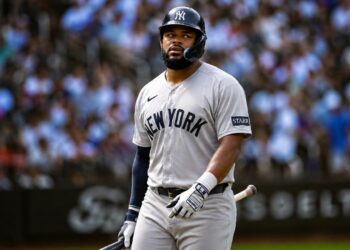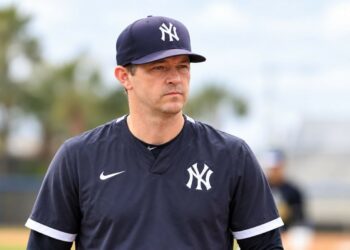
NEW YORK — The Yankees’ search for more contact comes with an expensive complication: A hitter who changes the lineup’s style does not necessarily improve its overall production enough to justify a major trade.
That distinction matters after New York’s offense collapsed against Tampa Bay in the American League Division Series. The Yankees managed 12 hits and five runs across three losses, striking out 31 times after scoring 18 runs in their two-game wild-card sweep of Boston.
The contrast sharpened an offseason question for general manager Brian Cashman. Adding another power bat would leave the contact problem unresolved. Paying heavily for a singles hitter, however, could consume prospects needed to address other positions without delivering a comparable increase in scoring.
Second base sits at the center of that calculation. Jazz Chisholm Jr. is approaching free agency, while Anthony Volpe offers an internal option after moving across the diamond. The Yankees must weigh the value of an outside addition against the cost of replacing production already available within their roster.
Second base carries more than an offensive decision
Chisholm’s season illustrates the difficulty. Even with uneven offensive production, he contributed 3.5 wins above replacement by FanGraphs’ measure. His 13 outs above average ranked fourth among MLB second basemen, giving the Yankees considerable defensive value alongside his speed.
Replacing him therefore involves more than finding someone who strikes out less. Aaron Boone’s lineup would benefit from another reliable on-base threat in front of Aaron Judge and Ben Rice. The pitching staff would also feel any deterioration in the middle-infield defense.
The Yankees have already demonstrated their willingness to spend prospect capital with Miami, acquiring Chisholm and later Ryan Weathers in separate deals. Another transaction would require evaluating both the incoming player and the opportunities surrendered elsewhere.
That is the financial distinction driving this particular market: An affordable annual salary can accompany a substantial acquisition cost. Years of team control strengthen the seller’s position even when the player’s performance contains clear weaknesses.
Miami is willing to consider substantial offers for second baseman Xavier Edwards and shortstop Otto Lopez, according to reporting by Barry Jackson. Both remain under team control through 2029. The Marlins retained them at the Aug. 3 deadline and can keep their double-play combination intact.
Edwards brings contact and a significant price
Edwards, 27, has drawn longstanding interest from the Yankees, according to Joel Sherman. Discussing a potential second-base and leadoff fit on his podcast, Sherman paired that appeal with the expected acquisition cost.
“I think that would be a great help, but he would cost a significant amount,” Sherman said.
Sherman identified Volpe as a possible component of a package in his assessment of the trade fit. He also expects Volpe to receive an opportunity at second base next season, making the internal alternative central to the Yankees’ decision.
Edwards hit .280 with a .360 on-base percentage and .371 slugging percentage in 142 games. He drew 68 walks against 83 strikeouts in 595 plate appearances and stole 21 bases in 26 attempts. Those skills explain the attraction for a lineup seeking more traffic ahead of its biggest bats.
His six home runs and 103 weighted runs created plus present a more restrained offensive picture. That park-adjusted measure placed his production just 3% above league average. A high on-base percentage did not translate into a large overall advantage at the plate.
The switch-hitter’s career OPS also separates sharply by matchup: .762 against right-handers and .650 against left-handers. His .321 average with runners in scoring position in 2026 strengthens the case for his bat, but the Yankees would still inherit that imbalance.
Most of his season came after the power disappeared
An additional calculation from Edwards’ reported season splits puts the decline in perspective. His 340 plate appearances from June 1 onward represented 57.1% of his season, making the weaker stretch the larger portion of his workload.
He hit .314/.398/.480 through May, then .254/.331/.288 afterward without another home run. Adding on-base and slugging percentages produces an OPS decline from .878 to .619, a 259-point drop. The Yankees would be buying the full season, including that prolonged loss of impact.
Baseball Savant’s contact measurements reinforce the concern. Edwards posted a 28.4% hard-hit rate, with a .258 expected batting average and .356 expected slugging percentage. His ability to avoid strikeouts remained valuable, but the quality of his contact limited the damage.
The defensive record adds another complication. Edwards moved from shortstop to second base in 2025 and recorded nine outs above average and 12 defensive runs saved. Both figures fell to minus-2 in 2026. His recent performance offers less certainty than his position change initially suggested.
Miami retains control of the market
Lopez gives Miami another valuable trade option after a .305/.349/.437 season with 34 steals and 14 outs above average. His presence does not force the Marlins to move Edwards, whose first arbitration season approaches.
Matt Swartz’s arbitration projections put Edwards at $3.5 million and Lopez at $5.4 million. Those projected salaries make both attractive, but the Yankees would pay separately in talent. Sherman has also discussed Sam Antonacci and Michael Massey as possible second-base alternatives, widening the comparison beyond Miami.
Miami finished 80-82 and retains both infielders for three more seasons. For the Yankees, the available opening therefore remains tied to a substantial return. Edwards’ contact and speed are established attractions; the price must also account for his limited power, extended offensive decline and uneven defense.
What do you think? Leave your comment below.