


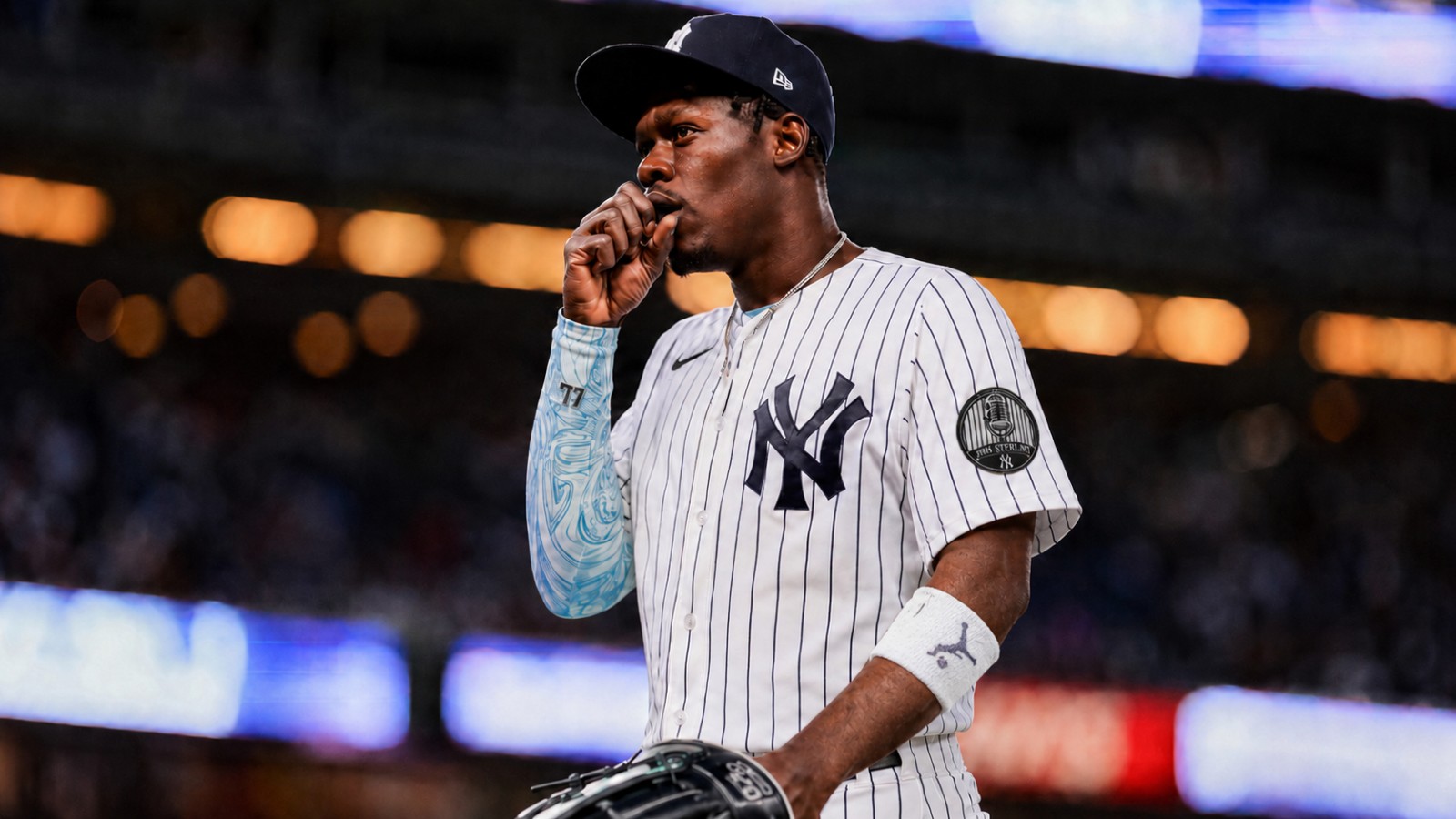
BRONX, N.Y. — Jazz Chisholm Jr. has reached the stage of a contract year where every development carries two meanings for the Yankees. New York needs its second baseman for October, but every day he spends away from the lineup also shortens the final evaluation period before his first trip to free agency.
Chisholm is on the 10-day injured list with a sprained right thumb, retroactive to Sept. 9. The injury arrived just as his bat had begun to heat up and while the Yankees were trying to close ground in the AL East. Entering Sunday, New York was 85-63 and four games behind Tampa Bay after a 12-2 loss to the Mets at Yankee Stadium.
The financial clock is running at the same time. Chisholm is earning $10.2 million in his final arbitration season and can become a free agent after the World Series. At 28, he is young enough to command a multiyear deal, but his platform year has been less straightforward than the 30-30 season that made his future one of the Yankees’ biggest offseason questions.
His current numbers explain why. Chisholm has hit .232/.312/.403 with 19 home runs, 55 RBIs and 40 stolen bases in 134 games. The speed remains elite. The power has fallen. A year ago, he hit 31 homers, stole 31 bases and won a Silver Slugger while producing an .813 OPS.
That contrast has changed the stakes for both sides. Chisholm no longer enters the winter with uninterrupted upward momentum, yet the Yankees also risk letting a rare power-speed player reach the open market without ever testing whether a long-term agreement could work. The unresolved question is not simply what Chisholm is worth now. It is whether New York ever seriously opened the door to keeping him off the market in the first place.
What Chisholm says happened with Cashman
The player himself told that Brian Cashman rejected an extension. What Chisholm has described is an informal exchange that appears to have stopped the subject before it reached a negotiation.
Chisholm said there were no meaningful extension talks after spring training. He later described the message he received from the Yankees general manager in four words.
“It was just like, ‘We don’t do extensions.'”
“I would not say I reached out,” he added. “It was more of a mutual thing. It was me walking around saying something to Cash. He walked past me.”
That is significant, but it is different from a formal refusal. No term, salary figure, written offer, counteroffer or sit-down negotiation has been publicly disclosed.
Cashman’s own winter comments fit that description of the Yankees’ approach. He said then that the organization historically has preferred to let these situations reach their natural endpoint before deciding what comes next. The Yankees agreed with Chisholm on a one-year, $10.2 million contract in January to avoid arbitration, leaving him on schedule for free agency after 2026.
So the accurate answer is narrower than the headline question. Cashman appears to have discouraged an extension discussion as a matter of club policy. There is no public evidence that he rejected a specific Chisholm offer.
The power-speed split changes the leverage
Chisholm’s 2026 season has made that policy more consequential, not less.
Compared with 2025, his home-run total has fallen by 12 while his stolen-base total has increased by nine. His OPS has dropped 98 points, from .813 to .715, and his slugging percentage has fallen 78 points.
That works out to roughly a 39% decline in home runs and a 29% increase in steals. It gives the Yankees evidence to argue for caution on a long-term price, while Chisholm can point to age, athleticism, premium baserunning and his 2025 Silver Slugger season.
The thumb injury now compresses the evaluation further. The Yankees said Chisholm would have no baseball activity for seven to 10 days before another assessment. Anthony Volpe was recalled from Triple-A to help cover second base, with José Caballero and Amed Rosario also available.
Labor uncertainty adds another deadline
The contract decision also sits beside a larger MLB issue. The current collective bargaining agreement expires Dec. 1, 2026, and negotiations on a new deal are already underway.
That could complicate the normal free-agent calendar. Under the current system, the Yankees also could have a qualifying-offer decision after the World Series if Chisholm remains eligible. The 2026 qualifying offer was $22.025 million, and an industry estimate for the next one is about $23.1 million.
Those mechanisms do not change what happened earlier. They do, however, give the Yankees more than one way to manage the risk of Chisholm reaching the market.
What the Yankees have to decide now
The question has shifted from whether New York should have extended Chisholm after his 30-30 season to whether the Yankees still see him as their best long-term answer at second base.
His case remains unusual. He supplies left-handed power, stolen-base pressure and athletic range. His 2026 regression, strikeout volume and current thumb injury make a major commitment harder to price.
For now, the strongest conclusion supported by the available record is this: Cashman did not publicly reject a formal Jazz Chisholm Jr. extension offer. Chisholm says the Yankees instead communicated that they do not generally operate through extensions, effectively preventing talks from becoming a real negotiation.
That distinction matters. The next decision may determine whether the Yankees keep Chisholm, make him a qualifying offer, or watch the market set his value without ever having tried to lock him up early.
What do you think? Leave your comment below.










For the Yankees, there is no ”risk” in letting Chaz out into the free market. This would be addition by subtraction. As talented as he may be, he’s a net negative to any team he’s on. He acts more like a hood ornament than any part of any team’s drive train.