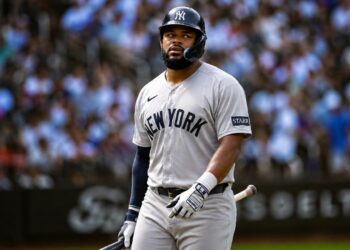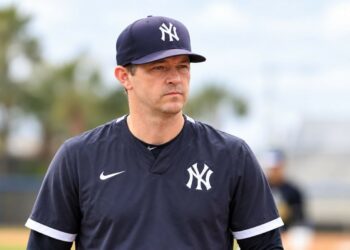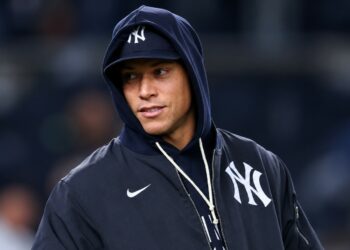
NEW YORK — The Yankees enter another winter with a championship-sized demand for change and an expensive roster that still needs repairs. Their latest postseason exit has made the distinction between spending money and building a better team increasingly difficult to ignore.
Tampa Bay ended New York’s season with a 4-3 victory at Yankee Stadium on Oct. 7. Victor Mesa Jr.’s two-run homer off Max Fried in the sixth inning supplied the decisive runs, completing an American League Division Series sweep and extending the Yankees’ championship drought to 17 years.
Aaron Judge subsequently urged the Yankees to commit fully to winning. Hal Steinbrenner said the two had a positive conversation, while defending the scale of the investment already made. The Yankees’ payroll for luxury-tax purposes approached $340 million, according to the owner’s account reported after his Oct. 21 briefing.
That spending has left the organization with a particularly difficult offseason question. Improving the lineup requires more than preserving its strongest bats. The Yankees also need defensive assignments that support the pitching staff and a roster that does not create another weakness each time one position changes.
An expensive roster still needs answers
Second base and third base sit at the intersection of those concerns. Jazz Chisholm Jr. is approaching free agency, Anthony Volpe remains an internal second-base option, and Ryan McMahon occupies third. Ben Rice and Giancarlo Stanton also figure into the first-base and designated-hitter alignment.
The Yankees have made dramatic winter pivots before. Brian Cashman once presented Bubba Crosby as his center fielder before signing Johnny Damon to a four-year, $52 million contract. That history explains why an October roster discussion can leave room for a much bigger move.
This winter also brings a deadline beyond baseball operations. MLB’s collective bargaining agreement expires Dec. 1. Negotiations over the sport’s economic system will run alongside free agency, making ownership’s priorities relevant to every discussion about how aggressively the Yankees will address their needs.
Two disclosures from the Oct. 21 media session now temper expectations of a sweeping overhaul: Steinbrenner backed the owners’ bargaining proposals, which include a salary cap, and Aaron Boone raised the possibility of moving Luis Garcia Jr. to second base, with third not ruled out.
Steinbrenner supports proposals but sidesteps benefit
Steinbrenner’s response went beyond declining to discuss negotiations. As a member of MLB’s labor policy committee, he helped shape the proposals and supported them in full. Those proposals include a payroll ceiling and a floor.
Asked how a cap would benefit the Yankees, Steinbrenner redirected attention to the approaching World Series between Tampa Bay and Milwaukee. He then explained why he would not expand on labor matters.
“Now’s not the time I’m going to start labor conversations. It just is not,” Steinbrenner said.
He also expressed optimism about reaching an agreement favorable to owners and players. The union’s opposition to a hard cap leaves a central disagreement unresolved as the current agreement nears expiration.
The Yankees already face substantial costs under the luxury-tax system. Commissioner’s office figures put their 2025 tax bill at $61,774,820. In 2026, it was projected to cross $83 million. That was a charge for exceeding spending thresholds, a different mechanism from the payroll ceiling owners are seeking.
Boone’s infield option comes with a defensive cost
Boone’s comments outlined a way to use an existing hitter at a position of need. Garcia played first base in 2026 after previously handling second for Washington. SNY’s account described Boone as less enthusiastic about third base, although he left it open.
Garcia’s career defensive totals at second are minus-18 outs above average and minus-17 defensive runs saved. At shortstop, he recorded minus-14 OAA and minus-17 DRS. He has no major-league experience at third base.
Those numbers make the proposed flexibility consequential. Returning Garcia to second would put his bat at a more demanding defensive position. Trying third would introduce a new assignment for a player whose previous work elsewhere in the infield produced negative defensive results.
The offensive attraction is clear. Baseball Savant lists Garcia’s 2026 line at .277/.309/.521 with 30 home runs and 92 RBIs. The Yankees acquired a productive hitter; deciding where he plays determines how much of that offensive value survives the defensive trade-off.
The Bronx portion changes the calculation
An additional comparison using Baseball Savant’s team splits shows that Garcia produced seven of his 30 homers, or 23.3%, in New York while receiving 31.1% of his season’s plate appearances there. His OPS fell from .873 with Washington to .736 with the Yankees, a 137-point difference.
That smaller Yankees sample adds context to his full-season breakout. Changing his defensive position would redistribute an existing bat rather than add another hitter to the lineup. Any improvement would depend partly on who fills the spot he vacates.
FanGraphs lists Garcia as eligible for arbitration in 2027 before free agency in 2028. His 2026 salary was $6.875 million. Keeping him offers another season of team control, but his next salary remains part of the Yankees’ offseason budget calculation.
Why a big infield splash now looks unlikely
Read together, the two disclosures point in one direction.
Steinbrenner did not stop at a no-comment on the cap. He made clear the owners’ package carries his fingerprints.
“I helped craft the proposals that we have given at the bargaining table and I support those proposals in their entirety,” Steinbrenner said.
An owner pushing for a payroll ceiling has little incentive to commit nine figures to a free agent weeks before the sport’s financial rules could change. Steinbrenner also noted the Yankees just carried the highest payroll in franchise history.
Boone’s Garcia plan covers the other side. If Garcia moves to second or third, the Yankees fill one open infield spot from within, at an arbitration salary rather than a market price.
Together, the cap push and the Garcia change effectively rule out a big infield addition this winter.
That reshapes how the outside market looks. Bo Bichette’s availability depends on his opt-out decision after a 96 wRC+ season. Other free-agent infield options include Luis Arraez, Isiah Kiner-Falefa, Brandon Lowe, Eugenio Suarez and Yoan Moncada.
As of Oct. 26, Boone has identified Garcia as an internal possibility while Steinbrenner helps steer bargaining over future spending limits. Both point the Yankees toward internal fixes, not a headline infield signing, as the Dec. 1 labor deadline approaches.
What do you think? Leave your comment below.