PHILADELPHIA — Thirty-four names came off the board before the Yankees made their first pick in the 2026 MLB Draft. One by one, other clubs looked at a tall left-hander from Arkansas and looked away.
The slot value was $2,826,700.
The reasons were easy to list. He had thrown just 1 2/3 college innings across his first two seasons. He had two elbow procedures behind him. He had missed 13 months. For teams picking near the top, that was a risk not worth taking.
So the arm kept sliding. Front offices that pick high tend to guard those slots, and a pitcher with that medical file made them flinch. The caution was understandable, and it was widespread.
Then the pick landed in the Bronx, and the calculus changed. What looked like a gamble to the rest of the league looked like a bargain to a team built to develop exactly this kind of arm. The move would draw notice fast.
A pick that evaluators called a steal
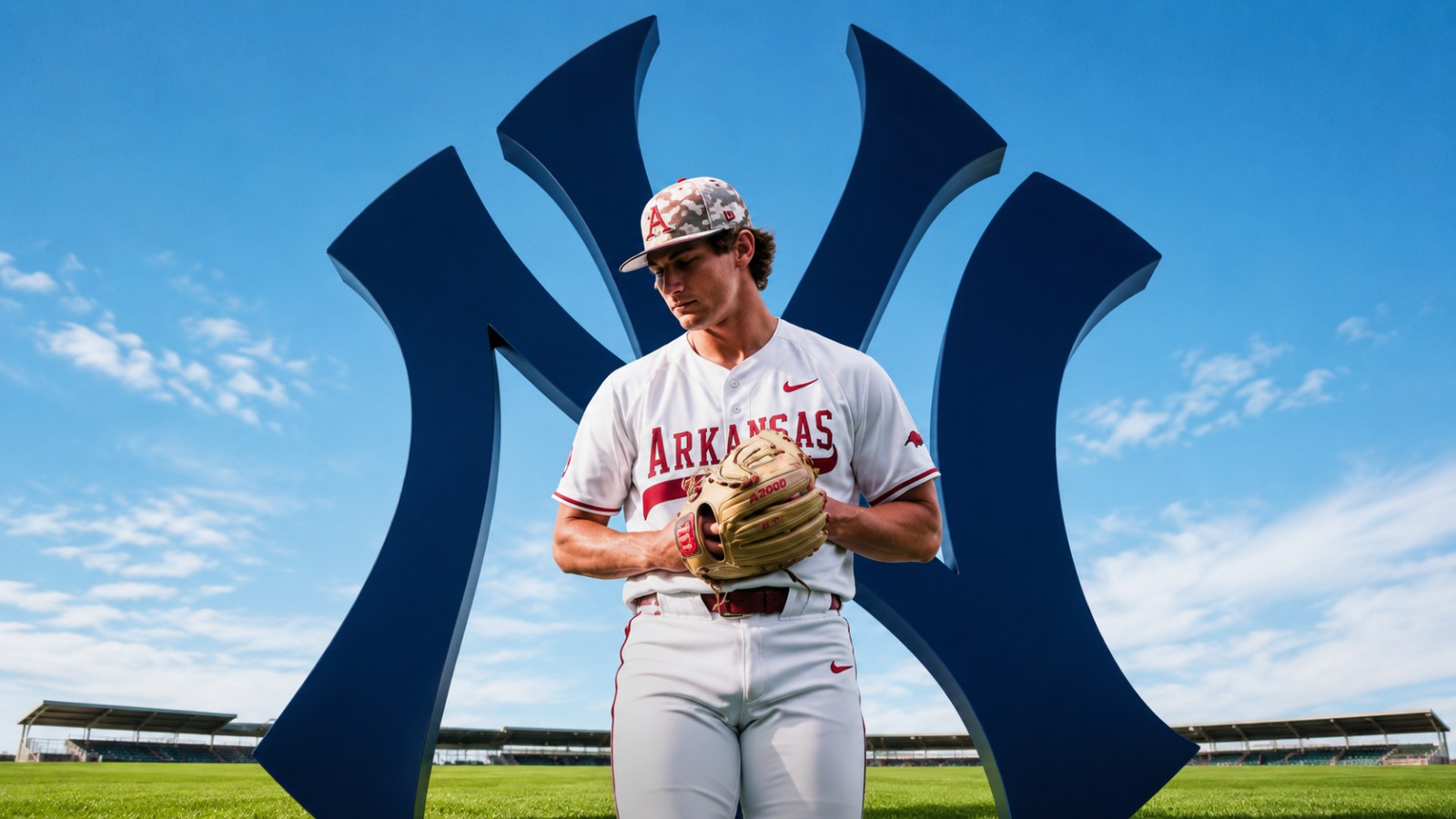
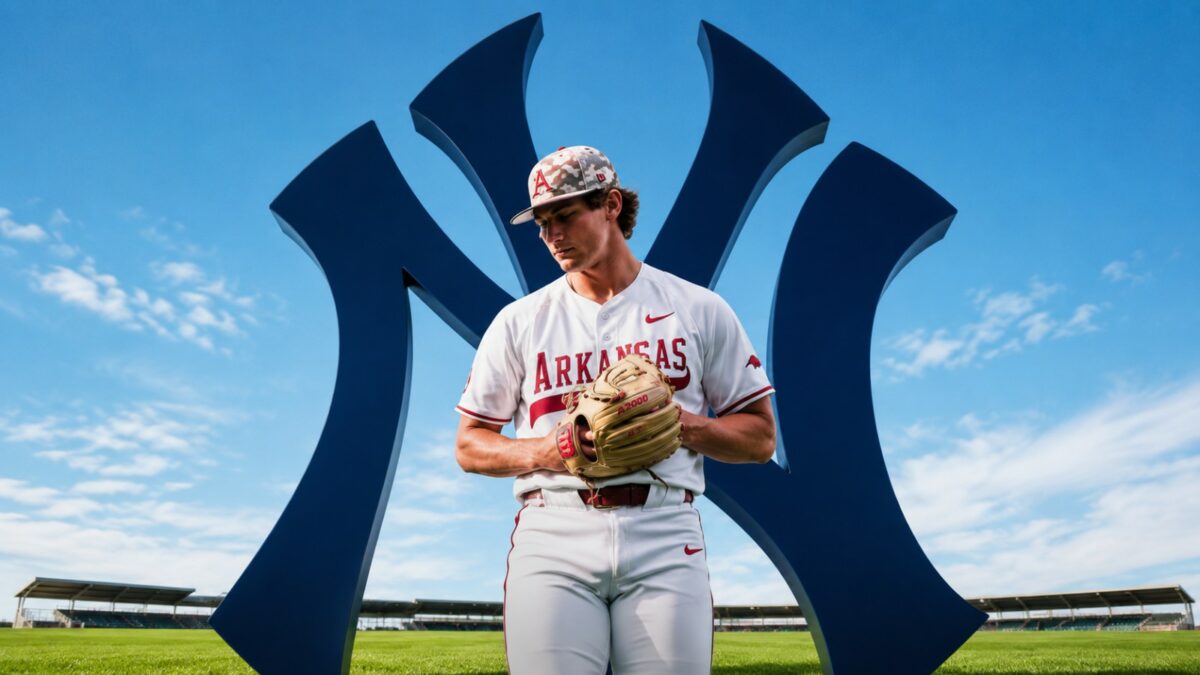
With the No. 35 selection, the Yankees drafted Hunter Dietz, the left-hander from the University of Arkansas. The choice surprised some who expected the club to chase a catcher, one of the thinnest spots in the system. Instead, the Yankees took the arm that had fallen to them.
The value was hard to miss. MLB Pipeline ranked Dietz as the No. 17 prospect in the class. Baseball America had him 34th. The Athletic placed him as high as 12th. The spread showed how differently teams read the same player, and how his health history split the room.
The talent was not in dispute. Dietz stands 6-foot-6 and throws a fastball that sits 94-96 mph and has touched 99. His slider and cutter both grade as plus pitches, and scouts across the industry listed him among the best college left-handers available, with several calling him the best.
His 2026 season backed the reports. Dietz posted a 3.57 ERA with 131 strikeouts over 85 2/3 innings for the Razorbacks, a 36.2 percent strikeout rate. He earned All-SEC First Team honors and closed the year with a 14-strikeout start in the NCAA Lawrence Regional against Kansas.
Why the Yankees felt comfortable
For a franchise that has turned pitching development into a strength, the profile fit. The Yankees have leaned on their pitching pipeline to produce big-league starters, and they saw Dietz as another candidate for that track. Damon Oppenheimer, the club’s vice president of domestic amateur scouting, framed the pick in plain terms.
“Hunter is right up our alley,” Oppenheimer said.
Oppenheimer explained what made the arm stand out from the rest of the board. He pointed to the two pitches that scouts had flagged.
“He has a big left-handed arm with a deluxe fastball and a breaking ball that can be a wipeout pitch,” Oppenheimer said.
The team’s history with SEC arms shaped its confidence. The Yankees have drawn comparisons between Dietz and Clarke Schmidt, another Southeastern Conference pitcher the club developed into a major-league starter. That track record gave the front office reason to look past the medical questions others could not.
Oppenheimer also spoke about the difficulty of drafting from a late first-round slot, where the best available talent thins out quickly. He credited the group with reading the board and pouncing when Dietz remained.
“We’re ecstatic that we were able to get this where we picked, and have this kind of top-end-of-the-rotation ceiling,” Oppenheimer said.
A quick deal and a slow-play plan
The Yankees did not wait long to lock him up. Within roughly 50 hours of the draft, the club agreed to terms with Dietz, one of the first of its picks to sign. The slot value for No. 35 was set at $2,826,700, with the exact bonus still to be finalized.
The Yankees reached the pick despite a handicap. The club forfeited draft position through a 10-pick penalty for exceeding the second luxury-tax threshold, which pushed their first selection down to No. 35 and squeezed their bonus pool. They entered the draft with one of the smaller pools in the league.
What happens next on the mound is undecided. Oppenheimer said Dietz will report to the player development complex in Tampa, Florida, and that the club has not settled whether he will pitch in games this year. The Yankees have slow-played recently drafted pitchers, and Dietz may follow that pattern.
“That’ll be something that the player development guys, pitching people, they’re going to decide where he’s at in terms of how much he’s thrown,” Oppenheimer said. “I don’t know if he’ll get innings or not. We’ve kind of slow-played the pitching from the Draft the last few years.”
The state of the signing
Dietz is one piece of a class the Yankees hope to sign in full before the July 27 deadline. His deal gives the farm system a high-ceiling left-hander who slid further than his talent suggested he should have.
The gap between how the Yankees valued Dietz and how the rest of the league did is the heart of the story. Other clubs saw an injury risk and passed. The Yankees saw a rotation arm and moved. Whether that judgment pays off will play out over the next several seasons in the minor-league system.
For now, the left-hander who scared off the top of the draft belongs to the team that bet on his upside. The next word will come from Tampa, where the Yankees decide how soon the world sees him pitch.
What do you think? Leave your comment below.