New York — The play took maybe four seconds, and almost nobody talked about it afterward.
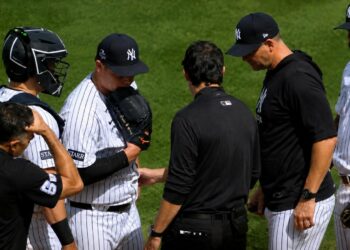
It was late in the New York Yankees’ series against the Washington Nationals. The Yankees were trailing by a run. CJ Abrams put a charge into a ball and sent it screaming toward the left side at 106.5 mph, the kind of one-hop rocket that turns infielders into spectators.
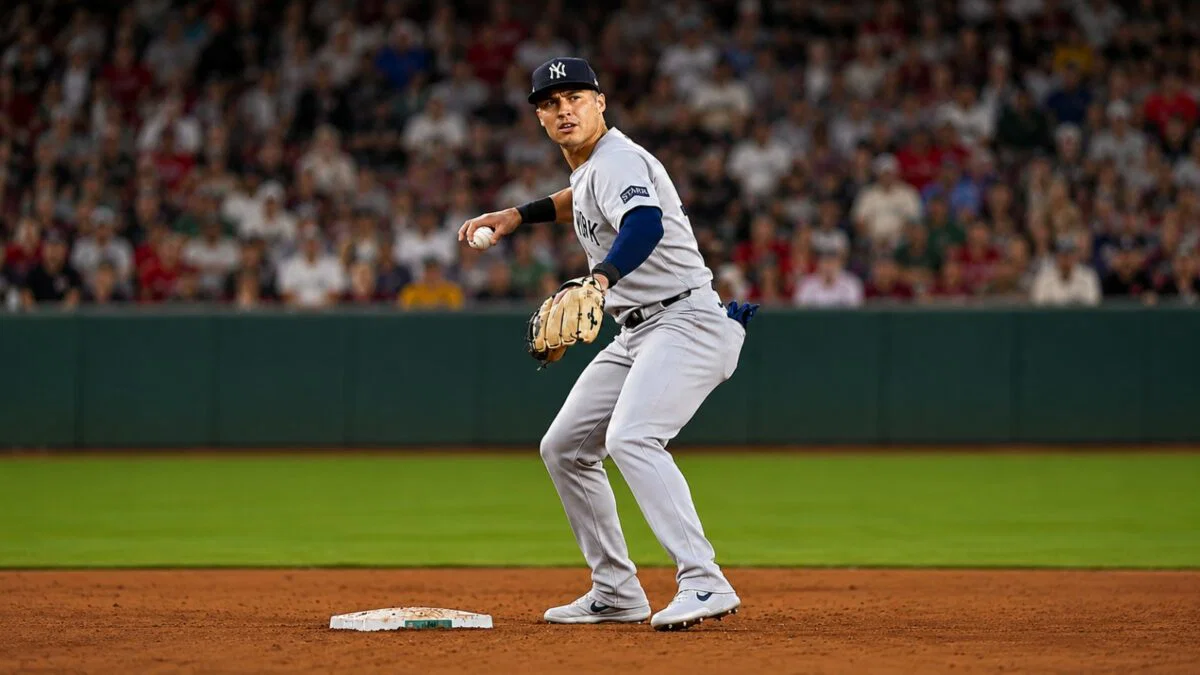
Anthony Volpe dropped to his knees and smothered it. He came up, made the routine throw to Paul Goldschmidt, and recorded the first out of the inning. David Bednar’s night got easier. The Yankees eventually walked out of the nation’s capital with a 5-3 win and a four-game winning streak heading into the All-Star break.
The play generated no highlight package. It should have. A year ago, that same baseball off that same bat was the kind of thing Yankees fans watched through their fingers.
That is the quiet story of the Yankees’ first half, and it has consequences the front office is about to have to reckon with.
The glove that came back from surgery
Volpe spent most of 2025 playing shortstop with a partially torn left labrum. He got through the year on cortisone shots and stubbornness. The results showed.
He posted minus-6 Outs Above Average last season and graded out in the eighth percentile defensively. For a player who won the American League Gold Glove at shortstop as a rookie in 2023, becoming the first Yankees rookie to win the award since its creation in 1957, the collapse was jarring. He was a finalist again in 2024. Then his shoulder gave out.
He had surgery last October. The version playing this season is a different fielder. Volpe now sits at plus-6 Outs Above Average and ranks in the 93rd percentile among big league defenders. That is a 12-run swing in the field from one season to the next.
The arm is still not a cannon. It never was, and it never will be. Any team acquiring him would have to accept that. What they would be getting instead is elite range and clean hands from a shortstop who is only 25 years old.
Why rival executives should be calling the Bronx
All of which sets up the uncomfortable question nobody around the Yankees wants to ask out loud before the Aug. 3 deadline.
Anthony Volpe might be the most valuable trade chip Brian Cashman has.
Consider what a rival contender would actually be buying. Volpe is signed for $3.48 million this season. He does not reach arbitration until 2027. He is not a free agent until 2029. That is three additional years of control over a shortstop in the 93rd percentile with the glove, at a fraction of what that profile costs on the open market.
The bat remains the problem, and there is no point pretending otherwise. Volpe hit .212 with a .663 OPS across 153 games last season. His contact quality this year has been ordinary, with an 87.8 mph average exit velocity and a .296 expected weighted on-base average. His playing time has tailed off recently, and he has been kept out of the lineup in three of four games during one stretch.
But a team trading for Volpe is not buying the bat. It is buying premium defense up the middle at a controlled price, with the theory that a 25-year-old two years removed from a Gold Glove might still figure out the rest.
The Lombard factor makes it possible
The reason the Yankees can even entertain this is George Lombard Jr. The organization has made no secret of how highly it regards its top prospect, and Lombard is widely viewed as the shortstop of the future in the Bronx. Moving Volpe would not leave a crater at the position. It would open a runway.
Jose Caballero has already been handling significant time at shortstop. The Yankees have shown, repeatedly, that they are comfortable building a lineup that does not run through Volpe. They kept him on the roster over Spencer Jones earlier this month, but the playing time tells a different story than the transaction wire does.
What the Yankees actually need in return
The Yankees do not need a bat back. They need arms.
The bullpen carried a major league-best 3.04 ERA into the break, which sounds like a strength until the underlying numbers are examined. New York relievers rank 16th in strikeout rate at 22.3 percent. Camilo Doval has been a liability. Jake Bird has been ordinary. The depth behind them thinned further this week.
Cashman met with reporters on July 10 to lay out the club’s health picture and its early deadline thinking. The bullpen is the obvious target, and high-leverage relief is the most expensive commodity on the July market.
Shortstop-needy clubs are not hard to find. Cleveland, Minnesota, Colorado, and Toronto have all carried questions up the middle. Any of them could look at a cost-controlled, glove-first 25-year-old and see a fit that a rebuilding team would happily pay for in relief pitching.
The window is open right now
Two months ago, the industry conversation around Volpe was about a struggling player the Yankees seemed content to leave in the minors. Selling then would have meant selling at the bottom.
That is no longer the situation. His glove is the best it has been since 2023. His health is not in question. His contract is an asset rather than a burden. His replacement is already in the system.
The Yankees open the second half Friday against the Los Angeles Dodgers with three weeks until the deadline. Volpe’s value will not stay frozen. If the bat keeps lagging, the market cools. If the glove regresses even slightly, the case evaporates.
For a front office that has spent three years defending this player, the hardest move might also be the smartest one, and the clock on it is already running.
What do you think? Leave your comment below.