NEW YORK — The Yankees entered the 2026 MLB Draft with a clear problem to solve and 20 picks to solve it. Years of trades had thinned the position-player ranks in the farm system. This class was built to answer that, without ignoring the arms.
The result was a Yankees haul that leaned on pitching at the top and swung for high-upside bats later. Two left-handers went first. A run of catchers, infielders and outfielders followed. Then came two undrafted signings to round out the group.
Damon Oppenheimer, the club’s vice president of domestic amateur scouting, called it a balanced class. The picks bear that out. The Yankees drafted eight pitchers and 12 position players across the 20 rounds.
Buried in the middle of that group was the name that drew the loudest reaction. It carried more history than any other selection, and it tied this draft to the Yankees‘ championship past. More on that shortly.
Two lefties set the tone on Day 1
The Yankees opened with Hunter Dietz, a left-hander from Arkansas, at No. 35 overall. Dietz works at 94-96 mph and has touched 98, throwing from a high arm slot that produces ground balls. Some evaluators viewed him as the best college lefty in the class.
Dietz has spoken about the lessons he took from a bumpy college career. He framed the setbacks as fuel rather than regret.
“I’ve learned every single thing I need to know about myself. I wouldn’t do it any different. I feel like the bumps have been really good for me,” Dietz told the Fort Smith Southwest Times Record in May.
The second-round pick was a bet on upside. The Yankees took Sean Duncan, a projectable 6-foot-3 left-hander from British Columbia, at No. 63. Duncan had Tommy John surgery in June and will rehab before he pitches, but the club sees a high ceiling.
Oppenheimer explained the pick by pointing to Duncan’s competitiveness and feel for pitching.
“We love Sean. We think he has a huge ceiling. He throws strikes and is ultracompetitive with a bit of a Cole Hamels feel to us,” the Yankees VP said.
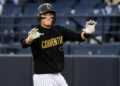
Day 1 closed with two college bats. Oklahoma catcher Brendan Brock went at No. 99, a fast, athletic backstop who also plays the outfield. Cal State Fullerton outfielder Paul Gutierrez-Contreras II followed at No. 127 after a .346/.441/.633 junior season.
The pick that carried a legend’s name
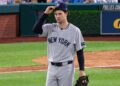
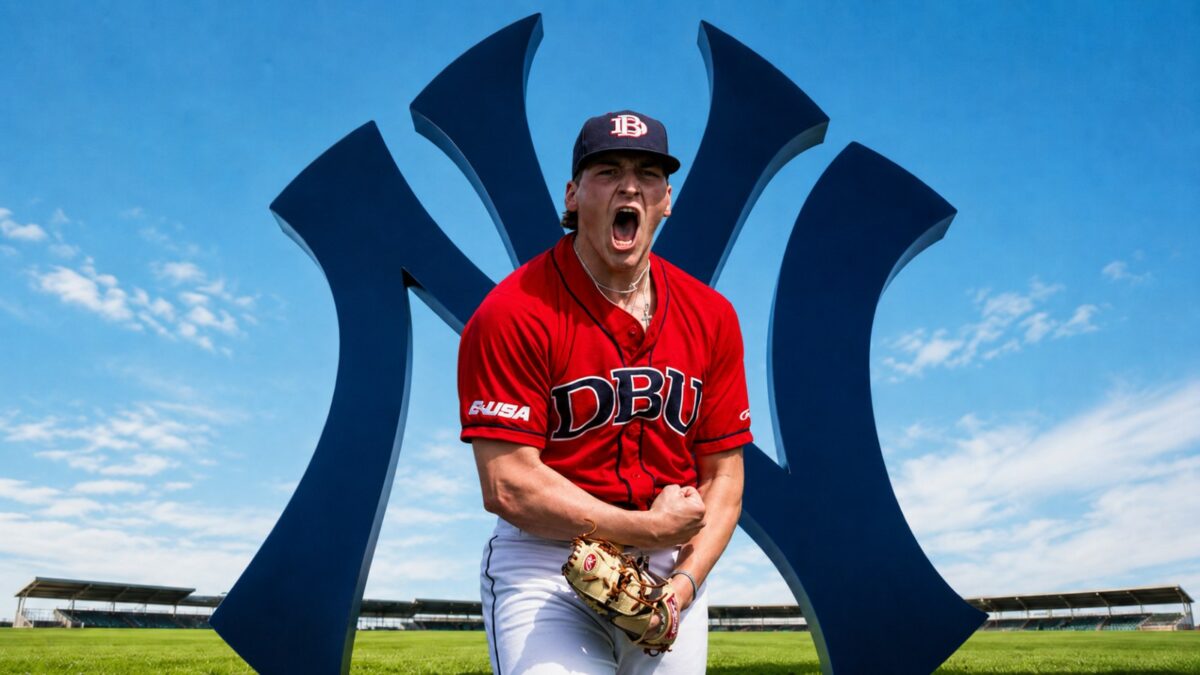
The eighth round is where this draft turned sentimental. With the 248th overall pick, the Yankees selected Luke Pettitte, a two-way player from Dallas Baptist and the son of five-time World Series champion Andy Pettitte.
Luke, 21, posted a 3.19 ERA over 48 innings in his first two college seasons before Tommy John surgery ended his junior year on the mound. He turned to hitting instead and slashed .337/.403/.693 with 16 home runs as a designated hitter. Scouts see his long-term future on the mound, where he throws a 90-93 mph fastball.
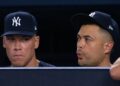
Yankees manager Aaron Boone learned of the pick from reporters after a win in Washington. His reaction made clear how personal the selection felt for a clubhouse that still leans on the elder Pettitte, now a special advisor.
“Heck yeah. Andy’s become a real good friend now, and obviously he’s a big part of our staff and our culture,” Yankees skipper said. “Getting to know Luke and his journey and his story, having Tommy John and going out raking in college this year. I’m looking forward to seeing his journey unfold. He’s a great kid. That’s great news.”
A shift toward bats after years of arms
For the first time in six years, the Yankees spent a top-10-round pick on a catcher. They used two, adding Texas A&M’s Bear Harrison at No. 160 to go with Brock. Harrison, the younger brother of a big-league pitcher, drew praise for his defense and a patient approach.
The middle rounds mixed prep gambles with college depth. The Yankees took third baseman Andrew Gonzalez out of a Texas high school in the sixth round and outfielder Lee Garris out of Virginia in the 13th. Both carry strong college commitments that could complicate signing.
The arms kept coming, too. Michael Harpster, David Leslie, Austin Berggren, Garrett Ahern and Jason Krieger gave the Yankees five more college pitchers to funnel into a development system that recently produced Cam Schlittler and Will Warren.
The late rounds featured power. Baylor first baseman Tyce Armstrong, drafted in the 19th round, broke his school’s single-season home run record with 24 and became the second player in NCAA history to hit three grand slams in one game.
Armstrong described the day of that three-slam game with a shrug, noting it came out of nowhere.
“Honestly, I didn’t feel great that day. My batting practice before it wasn’t anything special,” Armstrong said.
| Rd | Player | Pos | School | Calling card |
| 1 (35) | Hunter Dietz | LHP | Arkansas | Big velocity at 94-96 mph, touching 98, from an unusually high arm angle that induces ground balls. Some evaluators saw him as the best college left-hander in the draft. |
| 2 (63) | Sean Duncan | LHP | Terry Fox Secondary (BC) | Projectable 6-foot-3 lefty who had Tommy John surgery in June. Has a true three-pitch mix and shows a propensity for throwing strikes. |
| 3 (99) | Brendan Brock | C | Oklahoma | Uncommon speed and athleticism for a catcher, with raw power and a knack for crushing fastballs. Has also played all three outfield spots. |
| 4 (127) | Paul Gutierrez-Contreras II | OF | Cal State Fullerton | Big West Co-Player of the Year after a .346/.441/.633 line with 14 homers. A big, physical right-handed hitter who could get a look in center. |
| 5 (160) | Bear Harrison | C | Texas A&M | Defense-first backstop with solid pop times and framing, plus a patient approach and a career 15.6% walk rate. (MLB Pipeline / Baseball America) |
| 6 (189) | Andrew Gonzalez | 3B | Americas HS (Texas) | Prep bat with real power potential, though scouts question whether he sticks at third; first base or outfield are possible. (Jim Callis, MLB Network) |
| 7 (219) | Michael Harpster | RHP | East Tennessee State | Undersized righty sitting about 92 mph but with strong ride on the heater and a deep mix of cutter, sweeper and changeup. (MLB Pipeline) |
| 8 (248) | Luke Pettitte | TWP | Dallas Baptist | Son of Andy Pettitte. Raked as a DH (.337/.403/.693, 16 HR) after Tommy John; future likely on the mound with a 90-93 mph fastball. |
| 9 (278) | David Leslie | RHP | Pittsburgh | Projectable frame with a 92-94 mph fastball; posted a 2.05 ERA at D-III Grove City before transferring. (Baseball America) |
| 10 (308) | Bayram Hot | SS | Louisville | Queens native who hit .330/.448/.528 with nine homers and 17 steals; versatile infielder who may settle at third. (MLB Network) |
| 11 (338) | Anthony Potestio | SS | UC San Diego | Versatile utility player and line-drive hitter who grinds out at-bats; earned All-Big West honors at .298/.431/.436. |
| 12 (368) | Austin Berggren | RHP | Miami (Ohio) | College closer with 61 strikeouts in 44.1 innings; three-pitch mix of a low-mid 90s heater, a cutter and a mid-80s curveball. |
| 13 (398) | Lee Garris | OF | Maury HS (Virginia) | Left-handed prep bat and Virginia first-team all-state pick, ranked No. 235 on Kiley McDaniel’s top 250; committed to James Madison. |
| 14 (428) | Diego Castellanos | OF | Saint Mary’s | Elite bat-to-ball skills (88.2% contact) with gap power; set a program-record 39-game hitting streak and hit .382/.458/.554. |
| 15 (458) | William Cutshall | SS | Seneca HS (South Carolina) | Panama-born prep shortstop with a handsy swing and good bat-to-ball skills; Ole Miss commit who hit .577 as a junior. (Baseball America) |
| 16 (488) | Garrett Ahern | RHP | Grand Canyon | Lean 6-foot-5 right-hander who racked up strikeouts in college even as he struggled to keep runs off the board. |
| 17 (518) | Jason Krieger | RHP | Maine | Tall righty who bounced back from Tommy John with a strong close, including an eight-start, 2.52-ERA stretch and a dominant Cape Cod run. |
| 18 (548) | Blake Cyr | OF | Florida | The Yankees’ fourth outfielder of the draft, a 5-foot-11 bat out of the SEC. |
| 19 (578) | Tyce Armstrong | 1B | Baylor | Big-time power: broke Baylor’s single-season record with 24 homers and became the second player in NCAA history to hit three grand slams in a game. |
| 20 (608) | Dean Toigo | OF | Arizona State | The class’s fifth and final outfielder, a 6-foot-4 bat who took a winding college route through NAIA and UNLV before Arizona State. |
| UDFA | Josh Newell | RHP | Lindenwood | Program-record 297.1 innings; 2.65 ERA over a league-leading 102 innings in 2026. First Lindenwood player to sign an MLB deal since 2017. |
| UDFA | Zach Johnston | P | Wake Forest | Former Maine high school standout signed minutes after the draft ended; reported to the Yankees’ complex in Tampa. |
Two undrafted arms close out the class
After 20 rounds and the 608th pick, outfielder Dean Toigo of Arizona State, the Yankees added two pitchers who went unpicked. Both agreed to terms as undrafted free agents once the draft ended.
Right-hander Josh Newell came from Lindenwood, where he set a program record with 297 1/3 innings and posted a 2.65 ERA over a league-leading 102 innings in 2026. He becomes the first Lindenwood player to sign a major-league deal since 2017.
The second was Zach Johnston, a pitcher out of Wake Forest and a former high school standout in Maine. He got the call from the Yankees minutes after the draft ended and headed to the club’s complex in Tampa.
The full class now heads into the signing period, with the July 27 deadline ahead. Several prep picks will test the Yankees’ ability to buy players out of college commitments. The complete rundown of every pick and both undrafted signings appears below.
What do you think? Leave your comment below.