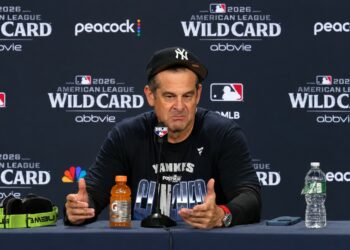
NEW YORK — Amed Rosario’s weekend against the Boston Red Sox produced the kind of swing that can change how a role player is viewed inside a pennant race. One afternoon put his mistakes under a microscope. By the end of the series, his bat had helped the Yankees turn the page.
In the opener of Saturday’s doubleheader at Yankee Stadium, Rosario became part of two damaging sequences in a 6-0 loss. In the fourth inning, Heliot Ramos drove a ball to center that Ceddanne Rafaela initially misjudged. Rosario, caught between tagging and advancing, tried for home and was thrown out on the relay. An inning later, his attempt to double off Adley Rutschman at first sailed away and allowed the runner to advance before Boston cashed him in.
Boston rookie Jake Bennett earned the win with six scoreless innings, while Carlos Rodon took the loss after allowing two runs in 4 2/3 innings. For the Yankees, the afternoon sharpened questions about execution at a time when every game against a direct wild-card rival carried extra weight.
Rosario responded quickly on the field. He went 2-for-2 with an RBI and a stolen base after entering the nightcap, a 9-2 Yankees win. He followed Sunday by going 2-for-4 with a walk and an RBI in New York’s 16-1 rout, which clinched a 7-6 season-series edge over Boston. Across those final two games, he went 4-for-6 with two RBIs.
The veteran’s larger season has remained uneven. FanGraphs lists Rosario at .234/.280/.421 with 10 home runs through Sunday. His value to the Yankees comes from right-handed contact and the ability to move around the infield, but Saturday’s mistakes briefly made him the focal point of a frustrating loss. Then the conversation moved away from baserunning and defense and into a separate issue surrounding his postgame interview.
Sheffield turns Rosario’s interview into a flashpoint
Rosario spoke with reporters after the loss through a Spanish-language interpreter. Gary Sheffield Jr., a baseball media personality and the son of former Yankees slugger Gary Sheffield, reacted on X by questioning why Rosario was still using one after a professional career that began in the Mets organization in 2012 and reached the majors in 2017.
Sheffield’s first post framed the interpreter as evidence that Rosario had failed to adapt after years in the United States.
“The fact that Rosario still needs a translator having been here 13 years is borderline impressive,” Sheffield Jr. wrote.
When another user compared Rosario’s situation with former Yankees catcher Gary Sánchez, Sheffield expanded the criticism beyond one player and described long-term reliance on an interpreter as disrespectful.
“It’s a sign of disrespect, no matter where you are in the world,” he wrote on X.
The posts spread widely across baseball social media and drew pushback from users who argued that conducting a media interview through an interpreter is not proof that a player cannot communicate in English. That distinction is central to how MLB itself treats interpreter access.
MLB’s own interpreter rules complicate the criticism
The current MLB-MLBPA Basic Agreement requires clubs to provide a qualified Spanish interpreter and makes that interpreter available for press conferences, media sessions, and scheduled pregame and postgame interviews. The provision does not impose a service-time cutoff after which a player loses access to that support.
The policy exists in part because media interviews demand precision. A player can understand or speak English in daily settings and still choose an interpreter when answering detailed questions about a mistake, injury, strategy, or other subject where wording matters.
There is also a direct Yankees connection to the system. MLB’s own history of the program credits Carlos Beltrán with pushing for formal Spanish-language interpreter support while he was with New York. Beltrán argued that Spanish-speaking players should receive the same type of communication assistance routinely available to players from Japan. MLB and the Players Association launched the full-time program in 2016.
That background does not prevent Sheffield from criticizing Rosario’s language choices. It does, however, make the act of using an interpreter a normal part of the league’s media structure rather than an exception tied only to newcomers.
Rosario’s answers stayed centered on the Yankees loss
Rosario’s postgame comments themselves dealt directly with the plays that hurt the Yankees. On the fourth-inning baserunning sequence, he acknowledged that his positioning left him with too little margin once Rafaela recovered the ball.
“Difficult read there, but at the end of the day, I just have to get myself in a better position, trying to give myself a chance there to score if you have an opportunity,” Rosario said through an interpreter. “I just put myself in a bad position to score.”
He also took responsibility for the fifth-inning throw. A cleaner play, Rosario said, could have erased Rutschman and ended the sequence before Boston added another run.
“I think a good throw gets us a double play there,” Rosario said of his defensive mistake.
Those answers made no attempt to deflect the baseball mistakes. The controversy came from the method Rosario used to deliver them, not from what he said about the loss.
Rosario’s rebound leaves the debate outside the lines
By Sunday night, the competitive picture had changed sharply. The official MLB standings had the Yankees at 78-59, four games ahead of the 74-63 Red Sox for the American League’s top wild-card position. New York had also secured the head-to-head tiebreaker with its 7-6 season-series victory.
Rosario contributed to that turnaround. His four hits over the final two games came immediately after the hitless opener and gave the Yankees needed production from a flexible right-handed bat while the roster continues to shift around injuries and matchups.
As of Aug. 31, neither Rosario nor the Yankees had issued a public response to Sheffield’s comments in the sources reviewed for this report. The league’s written policy remains clear that Spanish interpreters are part of standard clubhouse and media operations, while Rosario heads into the Yankees’ West Coast trip having answered his difficult Saturday with two productive games at the plate.
What do you think? Leave your comment below.