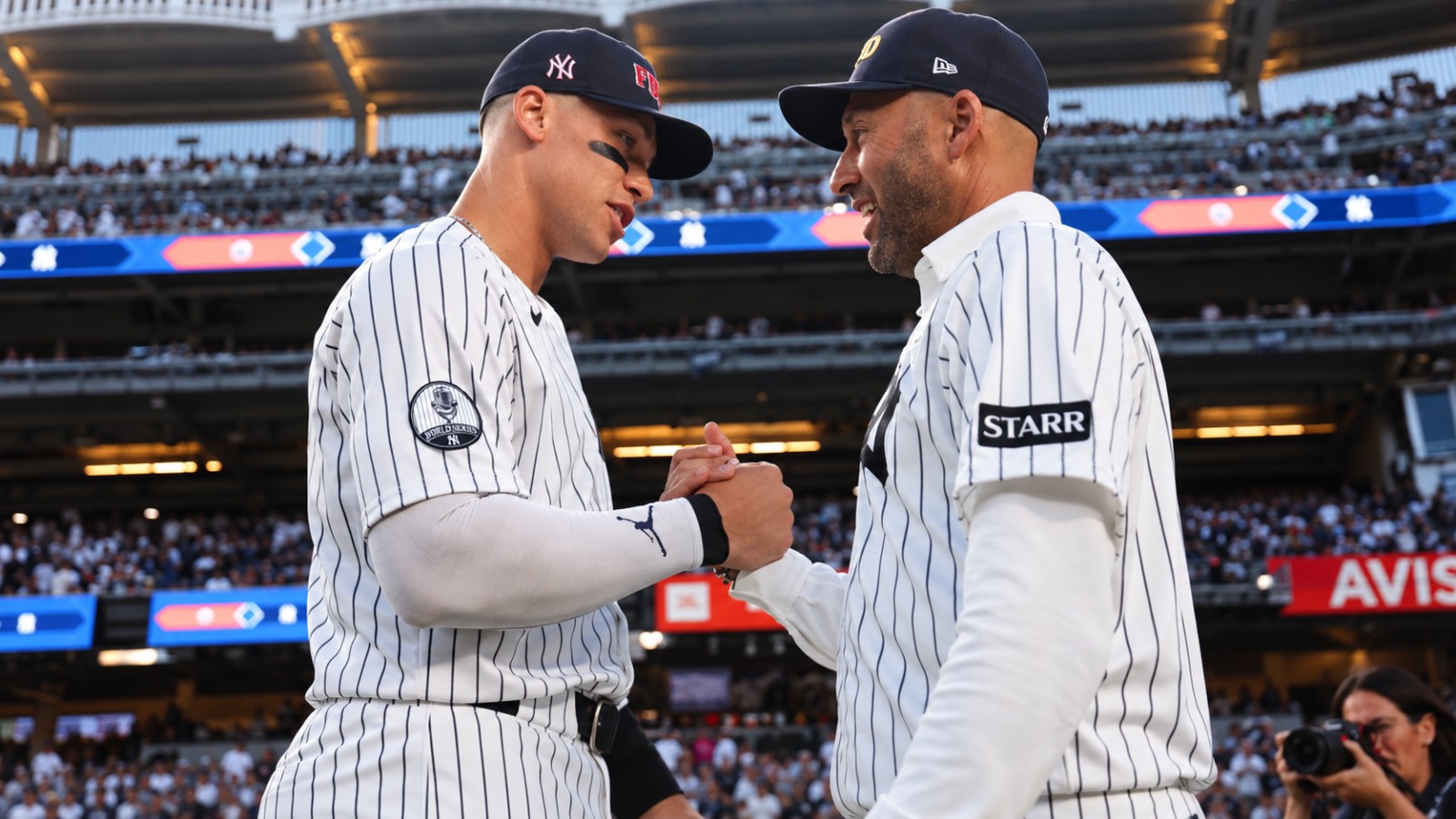
NEW YORK — The first pitch traveled a short distance and carried 25 years with it. Brielle Saracini stood on the mound at Yankee Stadium on Friday night, wound up, and threw to Cody Bellinger. The crowd knew the date. Few knew the full weight of the moment.
The Yankees had gathered their past for the 25th anniversary of the Sept. 11 attacks. Derek Jeter was there. So were Mariano Rivera, Joe Torre and other members of the 2001 team that helped a grieving city find its footing. The ceremony honored first responders, and both clubs wore caps to mark the day.
For most of the sellout crowd, the reunion was a familiar kind of tribute, the sort that surfaces every September. Legends return, a moment of silence falls, and the game goes on. It is a ritual the franchise has honored for a quarter-century.
Saracini’s presence turned the ritual into something more intimate. Her father, Victor Saracini, was the captain of United Airlines Flight 175, the plane flown into the South Tower. She was 10 years old when he died. What brought her back to the Bronx was not just remembrance but a relationship, one that started with a child’s letter and never ended.
The Yankees have leaned on that history for 25 years. The 2001 team, the last to reach a World Series before the franchise’s next era, became woven into the city’s recovery. Its players visited Ground Zero, met victims’ families and gave a shaken city something to rally around. Friday’s gathering was meant to honor all of it.
Yet within that broad tribute sat a single story that reframed the evening. It belonged to Saracini and to the Yankees captain who answered her when she was a grieving child, and it had continued in ways the public never saw.
A bond that outlasted the cameras
The part almost no one knew emerged only as Saracini reunited with Jeter on Friday. Their connection had outlasted the cameras, the photographs and the single emotional day that first brought them together. It had followed her into the hardest chapter of her adult life.
When Saracini later faced cancer, Jeter sent her a personal voicemail. It was not a public gesture or a staged appearance. It was a private message urging her to stay positive, left for a woman he had first met as a grieving girl.
She kept it close. Saracini said she listened to the voicemail again and again while she was hospitalized, drawing strength from the knowledge that a player she had admired since childhood was still in her corner. The message became a small anchor during treatment.
Describing the connection that has stretched across a quarter-century, Saracini summed up what has set it apart.
“The kindness does not stop,” Saracini said.
A letter three days after unimaginable loss
The relationship began in the rawest days after the attacks. Three days after her father died, Saracini wrote Jeter a letter. She explained her family’s loss and told him her father would have wanted her to fulfill her dream of meeting the Yankees shortstop.
Jeter wrote back. He invited Saracini and her family to Yankee Stadium, where the Yankees welcomed them during batting practice. What could have been a one-time kindness became something lasting. She has said the visit let her feel, however briefly, like a child again.
The connection deepened across the years that followed. Saracini said Jeter continued to check in, a quiet thread of contact that most Yankees fans never saw. That steady presence is what gave the voicemail its meaning when illness arrived.
Her life carried other echoes of that day. Saracini’s husband, Sean McGuire, also lost his father on Sept. 11. Patrick McGuire was working on the 84th floor of the South Tower. Brielle and Sean, both 10 at the time, met two years later at Camp Better Days, a program for children who lost parents in the attacks. They married in September 2017.
Jeter’s answer to a question he once could not answer
For Jeter, the families he met reshaped how he understood his job. In the days after the attacks, with games postponed and the city in mourning, the sport felt trivial. He has spoken about wrestling with its purpose.
Recalling that uncertainty, Jeter described the doubt that ran through the clubhouse as New York grieved.
“What does baseball mean?” Jeter remembered wondering.
Meeting families such as the Saracinis gave him an answer. Baseball could not undo what had happened, but the Yankees could offer a few hours of escape and something familiar to hold onto. The 2001 Yankees carried that role into an emotional World Series run, visiting Ground Zero and forging bonds with victims’ families and first responders.
Those relationships remain part of the Yankees’ identity 25 years later. In the surrounding weeks, the Yankees visited firehouses, hosted service events and recognized organizations tied to the attacks. Friday’s ceremony was the public face of a connection the team has never let lapse.
Twenty-five years after a 10-year-old fan mailed a letter to her favorite player, she stood on his old field beside him again, carrying a private message that had helped her through a hospital stay. For Jeter and the Yankees, the anniversary connected the team of 2001 to the one still chasing October, and showed the bond was never about a single day.
What do you think? Leave your comment below.