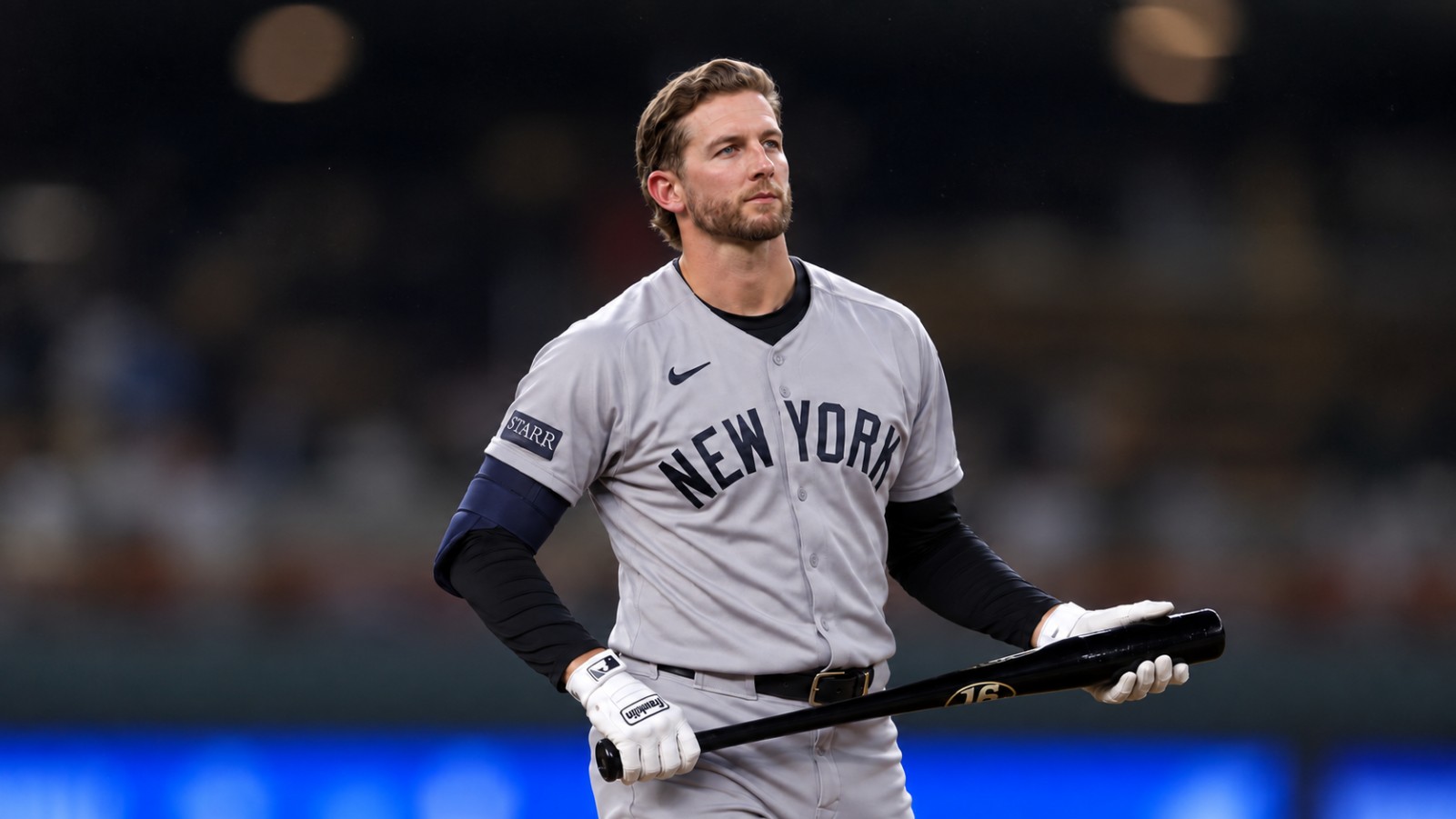
PHOENIX — The Yankees have spent September trying to turn a postseason berth into a cleaner October roster. One of their most uncomfortable evaluations now sits at third base.
Ryan McMahon arrived as a defense-first stabilizer, but the bat has become increasingly difficult to hide. His latest low point came Wednesday at Target Field, where he went 0-for-6 with four strikeouts in a 5-4, 13-inning loss to the Minnesota Twins.
The Yankees repeatedly fought back. Anthony Volpe tied it with a ninth-inning double. Ali Sanchez put New York ahead in the 10th, and Jose Caballero added a sacrifice fly in the 11th. Minnesota answered each time before Victor Caratini ended it with a walk-off single in the 13th. Tommy Nance earned the win, John Schreiber took the loss, and there was no save.
McMahon, batting seventh, finished the night at .210/.275/.346 with 10 home runs and 34 RBIs in 118 games. He has struck out 101 times, a 29.2% rate, while producing a .621 OPS. The current advanced-stat figure supplied with the criticism puts him at a 77 wRC+ and 0.5 fWAR.
The timing makes every empty at-bat more visible. The Yankees entered Friday 88-64, five games behind Tampa Bay in the AL East, with a postseason berth secured. Jazz Chisholm Jr. remains on the 10-day injured list with a right thumb sprain, while Volpe has returned from Triple-A and has been used at second base.
Volpe’s minor league work widened the Yankees’ options. During his Triple-A stint, he made starts at shortstop, second base and third base. That does not make him the answer at third, but it gives Aaron Boone another alignment to consider when Chisholm returns.
McMahon also carries a guaranteed $16 million salary for 2027. The Yankees must decide whether his glove and contract still justify an everyday role when the offensive gap has become this large.
McMahon enters the LeMahieu danger zone
That combination has pushed a growing chorus around the Yankees toward a harsher question: whether McMahon should lose his regular job, be squeezed off the postseason roster or eventually be designated for assignment.
The comparison gaining traction is DJ LeMahieu, whom the Yankees released in July 2025 with roughly $22 million still owed. FanGraphs lists LeMahieu’s final Yankees season at a 94 wRC+, .338 on-base percentage and 24.6% strikeout rate.
McMahon is below each of those offensive markers. His .275 on-base percentage and 29.2% strikeout rate leave the Yankees getting less offense than they received from LeMahieu before deciding he no longer fit their roster.
The situations are not identical. LeMahieu was 36, his role had narrowed, and New York wanted Chisholm at second base. McMahon is younger and still brings third-base value. But the LeMahieu decision established that guaranteed money does not always protect a veteran’s roster spot.
Boone keeps the focus on the group
The Yankees have not publicly framed McMahon as a roster casualty. After clinching, Boone spoke about how the clubhouse handled a difficult season rather than signaling any decision on one veteran.
“But credit to them for coming together. Through all the ups and downs, they’ve been a together group,” Boone said.
That comment does not resolve McMahon’s place in October. It underscores the distinction between external calls for an ouster and a decision the Yankees have actually made.
Defense is no longer a complete answer
McMahon’s strongest argument remains his glove. The supplied snapshot lists minus-1 DRS and plus-1 Fielding Run Value, while Statcast’s live page shows slightly positive overall fielding value. The precise number varies by metric and update timing, but the defensive edge is not masking a .621 OPS.
A third baseman with a .621 OPS can remain playable when his defense is elite and the rest of the lineup is healthy. The Yankees have less margin while Chisholm is out, and October makes every lineup spot more consequential.
Volpe is not a proven major league third baseman, and the Yankees have not indicated they plan to hand him the position. Still, his recent Triple-A work there gives Boone a real alternative. His shortstop experience makes the arm-strength objection less simple, but it does not prove he would defend third well in October.
The Okamoto comparison needs context
Another comparison circulating among Yankees fans puts McMahon next to Toronto third baseman Kazuma Okamoto. MLB lists Okamoto at .235 with 33 home runs, 88 RBIs and a .774 OPS. His four-year, $60 million contract carries a $15 million average annual value.
McMahon is making $16 million and has 10 homers with a .621 OPS. On the surface, the contrast is stark.
It is not a clean one-for-one front-office choice. McMahon was already under contract after the Yankees acquired him in 2025, while Okamoto reached MLB on a separate free-agent timeline. Still, the salary comparison helps explain why criticism has intensified and why some of it has widened to general manager Brian Cashman.
October forces the Yankees to choose a role
There is no verified indication that the Yankees have decided to designate McMahon for assignment or remove him from the postseason roster. He remains active, and Chisholm’s uncertain return date keeps the infield picture fluid.
But the question is no longer whether McMahon is slumping. It is how much playing time the Yankees can afford to give a 77 wRC+ bat when October begins.
New York opens a three-game series Friday at Chase Field against Arizona. McMahon has time to change the conversation, but the Yankees now have a shorter runway and more infield alternatives than they did a month ago.
What do you think? Leave your comment below.