


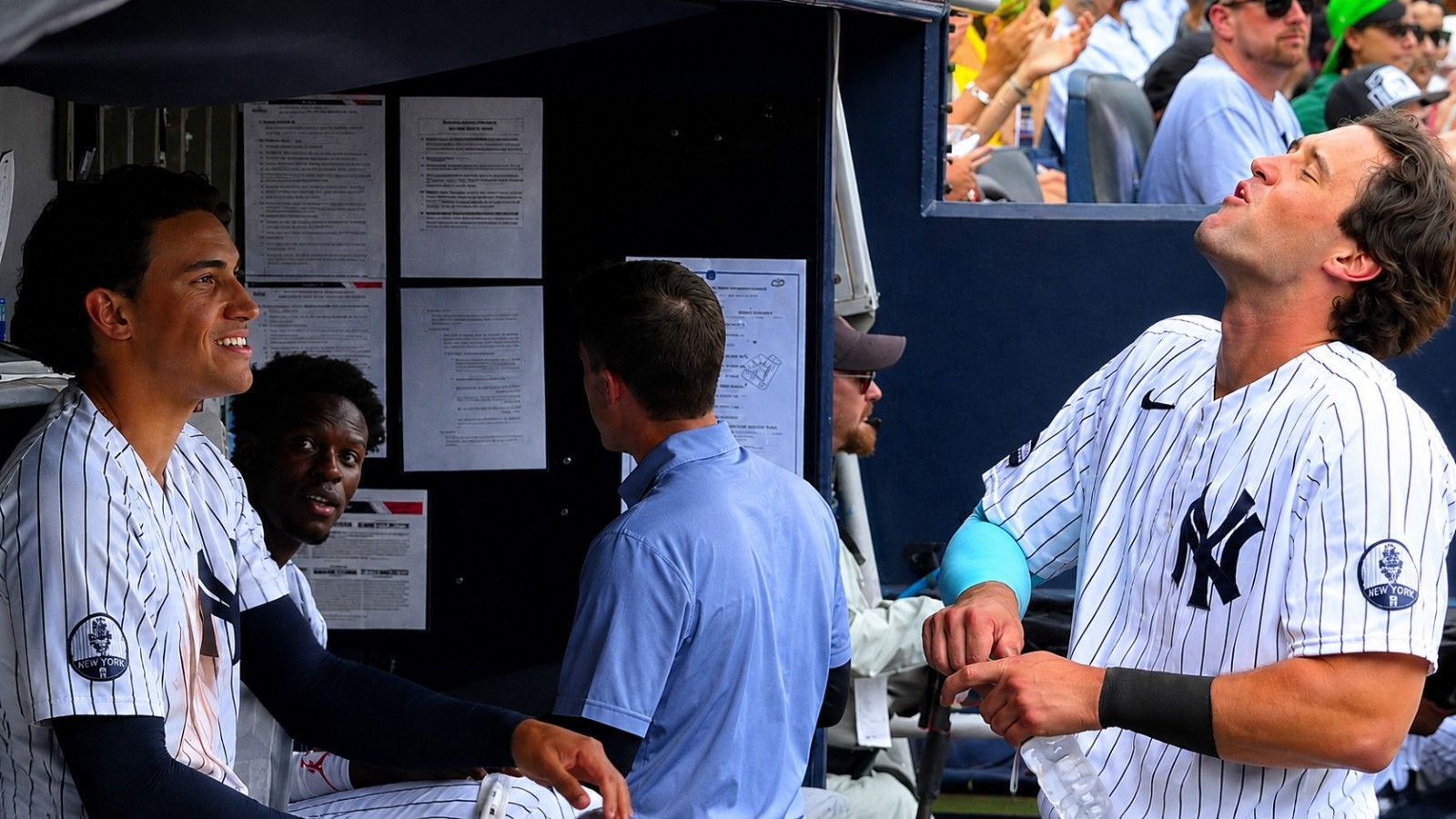
NEW YORK — For years, the knock on Spencer Jones was never about the raw tools. It was about the swing that too often caught air.
The 25-year-old outfielder carried elite power and premium athleticism up the Yankees system, along with a strikeout rate that scouts warned could cap his ceiling. Evaluators graded his power near the top of the scale and his ability to make contact well below it. Whiffs, not talent, were the reason the Yankees held their breath every time he stepped in.
That fear followed him to the majors. Even in his first big-league looks this season, the swing-and-miss lingered, and the question hung over his roster spot as the Yankees got healthier around him.
Then came the roster squeeze that was supposed to send him back to the minors, and the quiet stretch of at-bats that has flipped the story entirely.
Jones did not homer in the Yankees’ 8-3 win over the Toronto Blue Jays on Sunday at Yankee Stadium. He did something that mattered more to his long-term case. He controlled the strike zone, drove in a run, ran the bases and saved one in the field.
A stat line that answers the doubts
Jones reached base three times against the Blue Jays, going 2-for-3 with a walk, an RBI double and two runs scored. He opened the scoring in the second inning, lacing a double into the right-center gap that brought home George Lombard. In the sixth, his single helped fuel the three-run rally that broke a 2-2 tie and put the game away.
The bat was only half of it. Jones also made a sliding catch in the outfield, the kind of two-way contribution that changes how the Yankees value a young player. He has now hit safely in seven of his past 10 games.
That production has come without the towering home runs that made his name. This was gap power, patience and defense, a more complete profile than the one the Yankees drafted 25th overall in 2022.
The contact number nobody expected from Jones
The most telling figure does not appear in the box score. Since Jones was recalled on July 26, his rate of contact on pitches inside the strike zone has climbed to roughly 79 percent. For a hitter whose in-zone contact was long viewed as a potential dealbreaker, that mark lands in the neighborhood of the game’s elite bats.
The rest of the profile has followed. Over his past 15 games, Jones is slashing .275/.362/.510, and his season adjusted offensive production has climbed to a wRC+ of about 108, meaning he has been a better-than-average major league hitter across the full season. Since the All-Star break, he ranks among the league leaders in the rate at which he barrels the ball.
The swing-and-miss that defined his scouting reports has not vanished. It has simply stopped defining him. That is the shift the Yankees have waited on, and it arrived at the moment they needed lineup help most.
Teammates, manager notice the adjustments
Manager Aaron Boone has watched Jones tighten his approach against big-league pitching. Asked about the young outfielder’s progress, Boone framed it as steady growth rather than a sudden leap.
“He’s made good adjustments to the league and I feel like he has a good understanding of his strengths and weaknesses,” Boone said. “It’s been a good year on balance for him as far as his development.”
Cody Bellinger, back in the lineup Sunday after a month out, was asked about Jones and pointed to the quality of the at-bats rather than the exit velocities.
“I feel like he’s controlling his at-bats really well,” Bellinger said. “Obviously the power is there, but he really does work a lot of good at-bats. He understands what he wants to do with his plan and with his mechanics. He’s a freak athlete, a great defender, and I think he’s doing really well right now.”
Jones credited veteran outfielder Trent Grisham for a piece of spring-training advice that has helped his defense in the corners.
“In center field, you’re able to sync yourself up with your pitcher, because you’re able to see everything from out there, but he gave me some advice in the spring in the corners, to focus more on the batter and his rhythm and sync up with that,” Jones said. “That’s something I’ve been holding onto this year, and I think it’s helping play the corners a lot better.”
A roster squeeze that never came
Days earlier, Bellinger’s return had put Jones’ spot in jeopardy. The math suggested one of the Yankees’ left-handed outfielders would be the odd man out. Instead, an injured-list move elsewhere on the roster spared him, and Jones answered by making himself difficult to remove.
He now profiles as a platoon option in right field alongside the right-handed-hitting Heliot Ramos, an arrangement the Yankees expect to lean on until Aaron Judge is comfortable returning to the position. With Judge and Giancarlo Stanton both sidelined, a lineup starved for production has found a reliable piece in a player it nearly sent down.
On the season, Jones is slashing .233/.315/.428 with a .743 OPS, seven home runs and 22 RBIs across 57 games. The recent surge has pulled those numbers up and reframed the conversation around his role.
The decision the Yankees now have to make
The better Jones plays, the harder the Yankees’ eventual choice becomes. Judge will return at some point. Bellinger is already back. Grisham is entrenched. Playing time in the outfield will tighten, and Jones is forcing his way into that equation rather than out of it.
The Yankees, 74-56, sit three games behind the first-place Tampa Bay Rays in the American League East and hold a strong position in the wild-card race. They take Monday off before opening a three-game series against the Houston Astros on Tuesday night in the Bronx.
For Jones, the timing could not be sharper. The one flaw that shadowed his rise is fading, and the Yankees are watching a prospect turn into a player who demands a role.
What do you think? Leave your comment below.















All he needed was the chance to get comfortable. He should play a lot more than Ramos his production will continue to climb.