NEW YORK — For nearly two months, Luis Garcia Jr. occupied an unusual place on the Yankees roster. He was too productive to dismiss, too talented to view as depth and, at first, not an obvious positional answer.
New York acquired him during an injury crisis even though Ben Rice and Paul Goldschmidt already covered first base and Giancarlo Stanton was expected to reclaim designated hitter at-bats.
The trade brought a breakout hitter to the Bronx, but it also created skepticism about how the pieces would fit once the Yankees got healthier. Garcia had hit .283 with 23 homers and an .873 OPS in 104 games for Washington. His final regular-season work with the Yankees was quieter: .264/.302/.434 with seven homers and 16 RBIs in 43 games, according to StatMuse.
There was another surprise. Scouting concerns followed Garcia’s defense after poor marks, but Yankees first base became a workable answer. By mid-September, he had plus-3 Defensive Runs Saved for the Yankees, and evaluators on YES noted that his hands, arm and instincts looked better at first than the earlier reports suggested.
September then sharpened the offensive question. Garcia entered the final stretch fighting his timing. A Sept. 26 report had him at .224 with a .579 OPS through his first 18 games of the month. A later 15-game snapshot posted by SleeperYankees had him at .250 with two homers and a .393 slugging percentage.
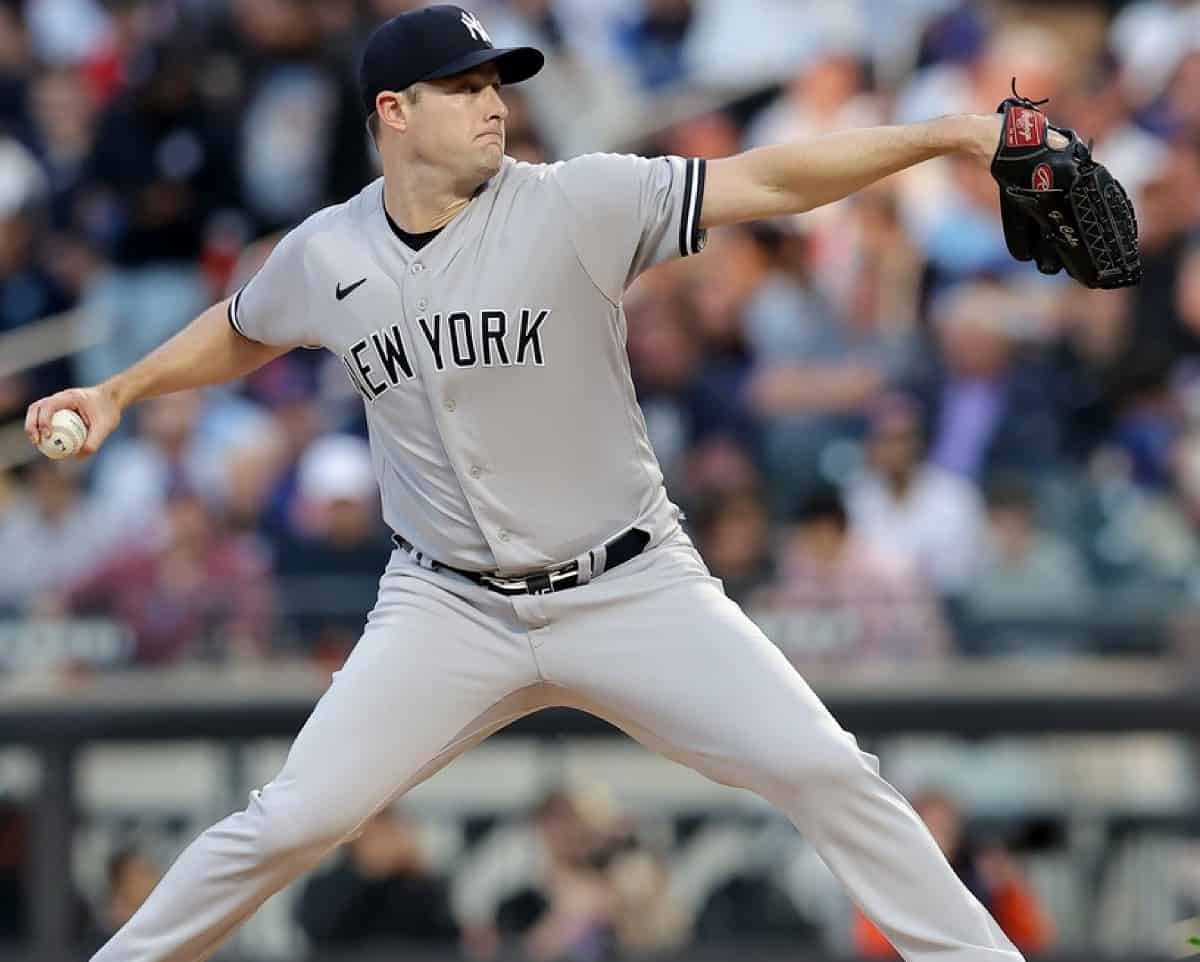
Aaron Boone’s first Wild Card decision reflected that uncertainty. Garcia did not start Game 1 against Boston left-hander Payton Tolle, and his first postseason plate appearance ended in a double play. A night later, with right-hander Sonny Gray starting, Boone hit Garcia third. Max Fried and Gray carried a scoreless duel into the fourth inning at Yankee Stadium before the Yankees pulled away for a 9-2 series-clinching win.
The awkward deadline fit becomes a postseason answer
That is where Garcia changed the story. Leading off the fourth, he drove Gray’s 1-2 sweeper 387 feet into the right-center seats. The ball left his bat at 107 mph and gave the Yankees a 1-0 lead in his first career postseason start.
Garcia then singled in the fifth and sixth, including a hit against left-hander Erik Miller. He finished 3-for-5 as every Yankees starter recorded a hit in a 14-hit attack.
Fried earned the win with six innings of one-run ball and six strikeouts. Gray took the loss after allowing two runs in 4 2/3 innings. There was no save.
Garcia gets the pitch he was waiting for
Garcia’s home run rewarded a specific plan against Gray. He did not abandon his normal strike-zone target because the stakes had changed.
“Usually when I face [Gray] in the past, I try to find a good pitch to hit, especially middle-up in the zone,” Garcia said through translator Marlon Abreu. “I tried to do that tonight. There was a breaking pitch that stayed in the zone a little higher, and I was able to connect there.”
The contact quality backed up the result. Garcia had lined out at 108.5 mph in the first inning. His homer registered 107 mph, and MLB reported that his sixth-inning single was his third ball in play of the night at 106 mph or harder.
The Yankees bought that impact on Aug. 2, sending right-handers Jake Bird, Yovanny Cruz, Jack Cebert and Ben Grable to Washington. At the time, the roster fit looked crowded. By October, Garcia’s bat had forced its way into the middle of the lineup against right-handed pitching.
Yankee Stadium is changing the math
MLB reported that Garcia hit .316/.369/.558 at home after the trade, with six homers and five doubles at Yankee Stadium. All seven of his regular-season homers for New York came against right-handed pitching.
MLB’s home split and Wednesday’s box score shows that seven of Garcia’s eight home runs in a Yankees uniform, including the postseason, have come at Yankee Stadium. That is 87.5% of his New York home run total.
The park is not creating soft contact. Garcia’s playoff homer traveled 387 feet at 107 mph. His pull-oriented swing simply gives that damage an especially useful destination in the Bronx.
“The angle from a right-handed pitcher, I think, favors me in a way,” Garcia said. “And hitting here at Yankee Stadium, I’ve always been a pull hitter, so I don’t change anything about that. I keep trying to win every pitch, and then let the course happen.”
Boone now has a different lineup problem
Garcia’s final 2026 regular-season line stands at .277 with 30 homers, 92 RBIs and an .830 OPS. After two playoff games, he is 3-for-6 with a homer and a 1.500 OPS.
Those numbers do not erase the uneven finish or the original first-base and DH questions for the Yankees. They do change Boone’s immediate postseason calculation. Against a right-handed starter, Garcia just supplied three hits from the No. 3 spot and broke open a scoreless elimination game.
The Yankees now move into an AL Division Series against the AL East champion Tampa Bay Rays beginning Saturday. Garcia reaches that series as more than a deadline fit waiting for definition. His first postseason start produced New York’s first run, three hits and the clearest October answer yet about where his bat belongs.
What do you think? Leave your comment below.