NEW YORK — The Yankees spent two roster-building windows believing their October bullpen could be strengthened without paying the full price for a proven late-inning reliever.
The winter brought back Paul Blackburn and Ryan Yarbrough, and New York acquired Angel Chivilli. But the Yankees did not land an established impact reliever from outside the organization. At the trade deadline, they again passed on adding bullpen help even as relief pitching remained an identified need.
The larger plan was built around conversion. New York expected its rotation surplus and rehabbing starters to spill into the bullpen by October. Will Warren, Ryan Weathers and Clarke Schmidt all fit that possibility, while Carlos Rodon also loomed as a potential short-series relief weapon depending on the postseason rotation.
That approach preserved prospect capital. It also left the Yankees dependent on pitchers getting healthy on schedule. Days before the Wild Card Series, that margin has largely disappeared.
Schmidt injury wipes out one part of Yankees’ October plan
The Yankees placed Schmidt on the 15-day injured list Thursday with right biceps neuritis, retroactive to Sept. 21. His earliest activation date is Oct. 6, ruling him out of the Wild Card Series and at least the opening portion of the AL Division Series if the Yankees advance.
Schmidt had returned from Tommy John surgery only eight days earlier. He struck out two and allowed two bloop singles over two-thirds of an inning against Minnesota on Sept. 16, his only major league appearance of 2026.
New York hoped that outing would begin a rapid bullpen ramp-up. Instead, Schmidt developed biceps discomfort while warming in Arizona and could not progress quickly enough.
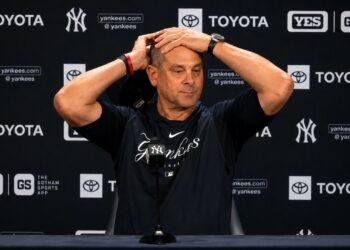
Aaron Boone had made clear that the Yankees were running out of time. Before the IL move, Boone said the club would have “to go a different way” if Schmidt could not throw as hoped.
That is now exactly what the Yankees must do.
The deadline need was known, but pitching went unchecked
The Yankees were not surprised by the need for relief help. MLB’s own deadline coverage identified bullpen reinforcement as one of New York’s priorities in July. When the Aug. 3 deadline passed, the Yankees had added Luis Garcia Jr. and Heliot Ramos for the lineup but no reliever. Pitching and catching were left unchecked.
Cashman later turned to the margins. Michael Fulmer signed in late August after Cruz suffered his elbow injury. John Schreiber arrived on waivers from Kansas City on Aug. 31, just in time to retain postseason eligibility. Those moves gave Boone usable pieces, but neither was the impact deadline reliever the Yankees had spent July seeking.
Schmidt was part of the internal reinforcement plan. So were other injured or transitioning arms. That approach saved prospect capital at the deadline, but it also made New York dependent on recoveries that had little room for setbacks.
The cost of that gamble is clearer now because one former Yankee has become exactly the kind of bullpen stabilizer New York could use.
Starter-to-reliever gamble is running out of healthy starters
Schmidt’s setback matters because it hits the exact area the Yankees chose to address internally.
New York’s apparent postseason blueprint was to use Gerrit Cole, Max Fried, Cam Schlittler and Rodón in the rotation, then shift surplus starters such as Warren and Weathers into relief. Schmidt was also being prepared for bullpen work because there was not enough time to rebuild him as a starter.
That plan required the Yankees to reach October with those pitchers available.
Ryan Weathers has been out since Aug. 23 with a left forearm flexor strain and was considered unlikely to appear again during the regular season. The Yankees still hoped to build him into a postseason relief option, but he entered the final weekend without a major league appearance in more than a month.
Fernando Cruz is another uncertainty. He has not pitched since Aug. 25 because of a partially torn right UCL. Cruz resumed throwing in September and is attempting to return without surgery, but his availability cannot be treated as guaranteed entering a best-of-three Wild Card Series.
That long-shot comeback path ended Friday. The Yankees transferred Cruz to the 60-day injured list while promoting Alexander Cornielle from Triple-A Scranton/Wilkes-Barre before the second game of their doubleheader against Baltimore. Cruz had only recently resumed throwing while trying to avoid surgery for the partial UCL tear. The move takes him out of the Wild Card Series and AL Division Series picture and makes a 2026 return highly unlikely.
Cruz had been one of the few proven swing-and-miss options Boone could still hope to add back. He posted a 3.13 ERA with 67 strikeouts and 32 walks in 54 2/3 innings across 61 appearances before the elbow injury. Losing even the possibility of that arm further narrows a bullpen that was already being asked to absorb Schmidt’s setback.
Fernando Cruz move puts even more weight on Ryan Weathers
With Schmidt and Cruz unavailable for the Wild Card round, Ryan Weathers has become the most important unresolved bullpen piece. Boone said Friday that the left-hander looked healthy in a one-inning simulated game and reached 96 mph. Boone still stopped short of saying Weathers would be available for the best-of-three Wild Card Series.
If New York carries 11 pitchers in the Wild Card round, a plausible construction starts with five pitchers who spent the season as starters, followed by David Bednar, Brent Headrick and Paul Blackburn. Without Weathers, that would leave three spots to sort among John Schreiber, Tim Hill, Ryan Yarbrough and Michael Fulmer. A healthy Weathers would give Boone a power left-hander with starter length and would push one of those fringe options off the roster.
That distinction matters because the choices thin quickly behind the top group. Hill entered the final weekend with a 4.60 ERA and negative WAR value in 2026. Weathers, meanwhile, worked 137 1/3 innings with a 3.60 ERA, 3.61 FIP and 3.24 xFIP while striking out 25.2% of hitters and walking 6.7%.
The more encouraging split came after Weathers changed his pitch usage in July, leaning less heavily on the fastball and more on his secondary arsenal after home runs had inflated his early-season results. In eight starts beginning July 10, he logged 45 innings with a 2.20 ERA, 2.74 FIP and 3.00 xFIP. The supplied split data also shows a 60.9% ground-ball rate with a 21.4% strikeout rate and 6.0% walk rate over that stretch.
That profile gives Weathers value beyond simply being another available arm. Bednar and Headrick are the clearest late-inning options, while Blackburn offers length and flexibility. Weathers could give the Yankees a harder left-handed look and multiple innings without forcing Boone to lean as heavily on Hill or piece together middle innings from the back end of the bullpen.
From a roster-construction standpoint, that combination of velocity, handedness and starter-built length gives Weathers a stronger October case than the current bullpen options behind Bednar and Headrick.
The risk is now obvious. New York did not acquire a reliever at the deadline, and several pitchers expected to create October bullpen depth are hurt or uncertain.
First window: Loaisiga decision looks different now
That is where a forgotten November decision becomes relevant again.
The Yankees declined Jonathan Loaisiga’s $5 million club option for 2026 after he posted a 4.25 ERA and 1.48 WHIP across 29 2/3 innings in 2025. Back trouble and a flexor strain ended his season, and he had appeared in only 50 major league games over the previous three years.
The decision was understandable on health alone.
Arizona signed Loaisiga, and the right-hander has responded with a 2.42 ERA and 1.03 WHIP across 67 innings and 67 appearances this season. He has 48 strikeouts against 12 walks and again offers the velocity, ground-ball profile and multi-inning flexibility that once made him one of Boone’s most valuable relief weapons.
Loaisiga also delivered two scoreless innings against the Yankees on Sept. 20.
His rebound does not prove New York should have exercised the option. The Yankees had legitimate durability concerns.
But the context around that decision has changed.
Cashman’s other two-window bet reaches its October test
The Yankees entered the winter needing to reshape a bullpen that lost Devin Williams and Luke Weaver to free agency. They retained familiar pieces and added depth, but they did not secure a proven outside late-inning arm.
Then they reached the deadline with bullpen reinforcement still a need and again did not acquire a reliever. New York instead continued betting that injured pitchers and surplus starters would eventually cover the innings.
Now Schmidt is on the IL. Weathers is still trying to return. Cruz is attempting to pitch through a significant elbow injury. The Yankees are sorting through Blackburn, Brent Headrick, Tim Hill, John Schreiber, Michael Fulmer and other combinations behind closer David Bednar.
By Friday night, Cruz had been removed from that equation by the 60-day IL transfer. That leaves Weathers as the one injured arm from the internal conversion plan with a realistic chance to materially change the Wild Card bullpen, and Boone had not yet committed to him for the opening round.
Loaisiga, meanwhile, has become the kind of dependable power reliever the Yankees could use in October.
That does not make one declined option the sole reason for New York’s bullpen uncertainty. It does make the broader strategy harder to separate from the current problem.
The Yankees chose internal conversion over a major bullpen addition twice. Their postseason now begins with several pitchers central to that plan unavailable or uncertain.
What do you think? Leave your comment below.