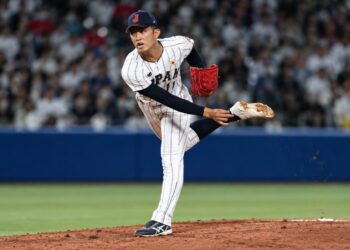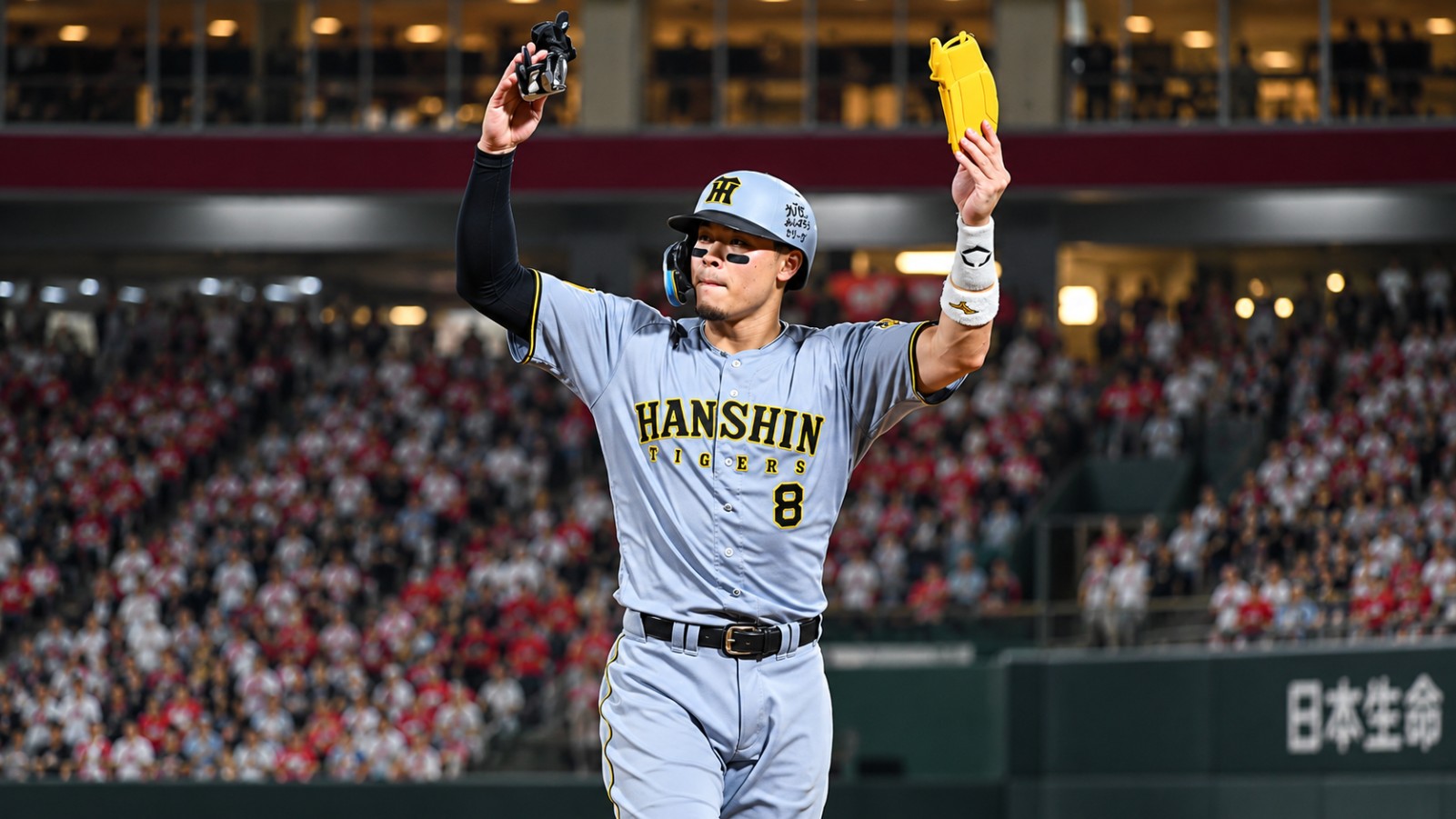
NEW YORK — A rare opportunity to add a 39-home run hitter has arrived at a vulnerable point for the Yankees. The front office has an opening at third base, an offense seeking another dangerous bat and a free-agent market offering few hitters with Teruaki Sato’s upside.
The 27-year-old Hanshin Tigers slugger won Japan’s Central League Triple Crown this season. He hit .306 with 39 homers and 106 RBIs, following a 40-home run season in 2025. His ability to produce power in a difficult hitting environment has made him an attractive candidate for a move to the majors.
New York has reason to investigate. Ryan McMahon remains under contract for 2027 after hitting .213 with 11 home runs in 124 games during 2026. The Yankees also enter the winter after another Division Series elimination, with questions about offensive depth and infield stability.
Yet the appeal of Sato’s left-handed power has collided with a familiar roster-building dilemma. A player who adds offense does not necessarily solve the position where the Yankees most need help. His availability also creates a financial decision that goes well beyond the value of a single season.
The Yankees are weighing two significant issues as Sato enters the posting market: concerns about his third-base defense and a projected contract worth at least $25 million per year. Those questions have produced differing expectations about whether New York will pursue him aggressively.
Defensive questions complicate Yankees’ third-base search
On YES Network’s Yankees Hot Stove, Jack Curry described third base as an “area of need,” even with McMahon signed for another season. Curry indicated that he does not see Sato as a likely Yankees target because of concerns about his glove.
That concern has a statistical basis. Sato won a Golden Glove at third base in Japan in 2025 but made 18 errors there in 2026, finishing with a .937 fielding percentage. Fielding percentage alone cannot measure defensive range, but it underscores why evaluators are studying whether he can remain at the position.
The alternative positions are not straightforward for New York. Sato has played the outfield, while Ben Rice occupies first base and Aaron Judge is a fixture in right field. Moving Sato off third would require another lineup adjustment rather than cleanly filling the Yankees’ infield opening.
Ken Rosenthal offered a different assessment of the club’s likely involvement while discussing Sato’s market Monday.
“I expect the Yankees to be involved in the Sato market,” Rosenthal said.
The distinction matters. Curry’s comments concern positional fit, while Rosenthal’s assessment concerns whether New York will enter negotiations. Both can be true even if the Yankees eventually decide another team is better positioned to sign Sato.
A $25 million annual price changes calculation
The second hurdle is cost. Sato is projected to seek a deal lasting at least four or five years with an average annual value of $25 million or more. That implies a guarantee of at least $100 million over four years or $125 million over five, before the posting fee paid to Hanshin.
Under the MLB-NPB posting formula, a four-year, $100 million contract would produce a $16.875 million release fee for Hanshin, putting the combined contract-and-posting commitment at about $116.9 million. A five-year, $125 million guarantee would generate a $20.625 million fee, bringing that combined figure to about $145.6 million.
Those figures are illustrations based on the reported salary projection, not an announced offer. The Yankees must consider whether a long-term contract makes sense for a hitter who might ultimately play outside the position the team needs to strengthen.
Steamer suggests promise, but also major-league adjustment risk
The Steamer projections supplied for Sato’s 2027 major league debut place his offensive outlook near two Japanese hitters who arrived a year earlier. Sato projects for a 112 wRC+ and .782 OPS, compared with pre-2026 projections of 118 and .789 for Munetaka Murakami and 111 and .765 for Kazuma Okamoto.
| Projection | Sato (2027) | Murakami (2026) | Okamoto (2026) |
| wRC+ | 112 | 118 | 111 |
| OPS | .782 | .789 | .765 |
| SLG | .468 | .457 | .444 |
| K% | 27.7% | 29.0% | 17.0% |
Sato’s projected .468 slugging percentage exceeds both comparison figures, but his projected 27.7% strikeout rate is much closer to Murakami’s 29% than Okamoto’s 17%. Sato struck out frequently in NPB and posted a 26.7% rate in 2026, making his swing-and-miss profile another factor in assessing the size of a potential contract.
The Yankees would be paying for a substantial offensive ceiling, rather than certainty that his Triple Crown numbers will translate directly to MLB.
Fan frustration follows mixed signals
Curry’s assessment drew criticism from some Yankees fans who questioned the club’s willingness to tolerate defensive mistakes by existing infielders while expressing concern about Sato.
One fan’s reaction focused directly on the perceived inconsistency.
“Worried about his glove but kept playing Volpe and Jazz when they continuously made errors lmfao. Unserious franchise,” the fan wrote.
Another reaction was shorter.
“I hate this front office,” a fan wrote.
Sato was posted Nov. 1 and clubs were permitted to begin talks Nov. 2. His market includes potential competition from other big-market teams. For the Yankees, the decision is whether his offensive upside outweighs the defensive uncertainty and financial cost attached to a multiyear investment.
What do you think? Leave your comment below.