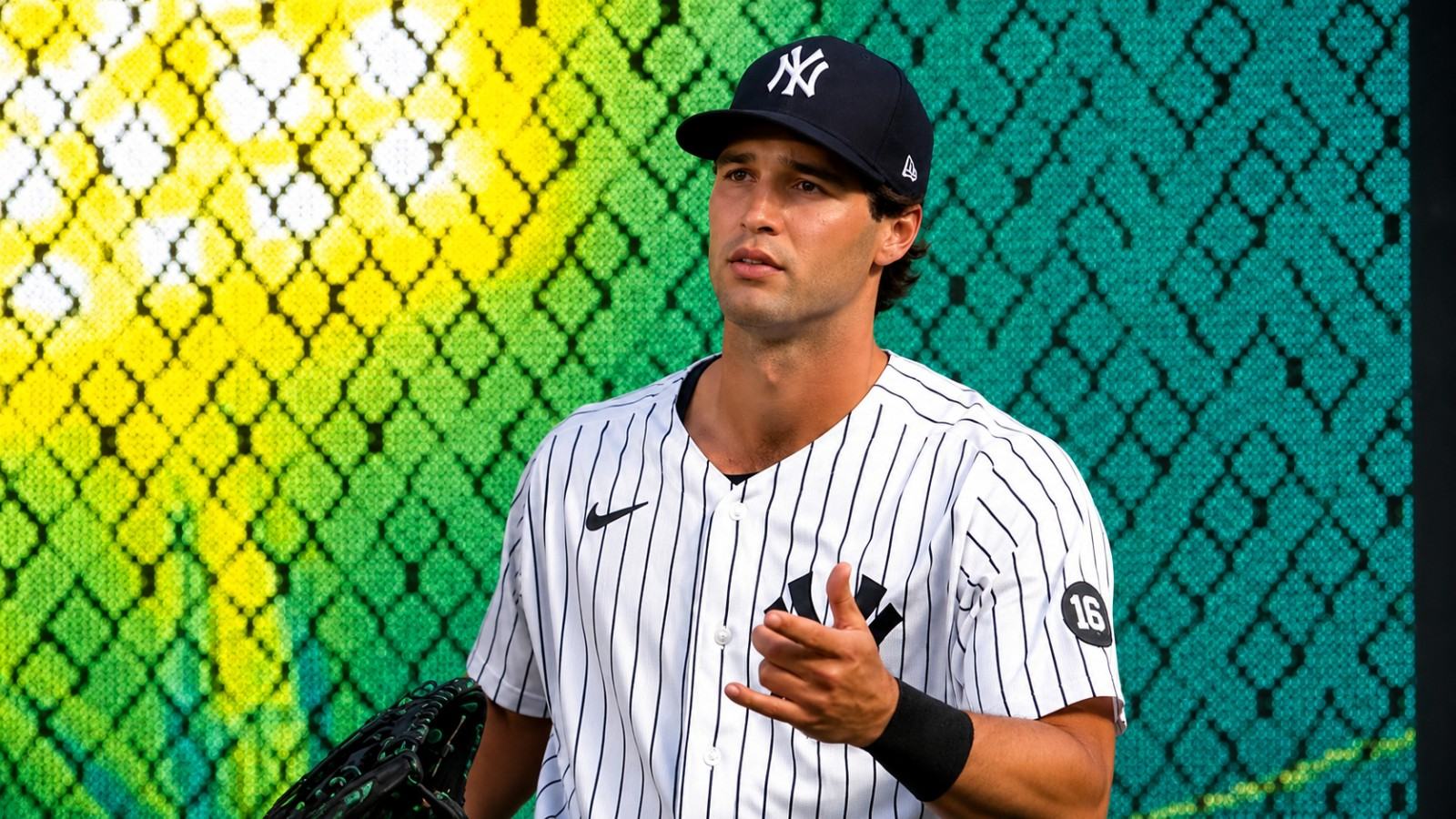
NEW YORK — The Yankees spent most of September trying to get healthy enough to make their postseason roster choices easier. Instead, the final hours before the Wild Card Series made their outfield puzzle more complicated.
Aaron Judge pushed to return from a right calf strain. Trent Grisham progressed from a hamstring injury. Giancarlo Stanton worked his way back into the roster conversation. Heliot Ramos remained part of the right-field mix, while Cody Bellinger was the one obvious fixture in left.
That left Aaron Boone and the Yankees weighing more than health. They also had to decide how much defense they were willing to trade for offense, how much experience mattered in a three-game series and whether a September surge should override a full season of evidence.
Boston sharpened that calculus by handing Game 1 to left-hander Payton Tolle. The Red Sox rookie held the Yankees to one earned run across 13 innings in two regular-season starts and struck out 18. The matchup immediately raised the value of every right-handed option, but it also forced New York to examine which left-handed bats had actually handled same-side pitching.
There is little room for a developmental choice in a best-of-three series. A manager can lose an October game because a center fielder takes the wrong route, because a bench bat is unavailable in the seventh inning or because a lineup designed around reputation ignores the player producing the better matchup.
The Yankees also have to build for more than the first pitch Tuesday night. Judge’s mobility could change how much right field he can handle. Grisham’s hamstring could affect whether he can start, enter late for defense or merely provide depth. Any decision at one outfield position creates another decision somewhere else.
That left one player, once viewed as a future piece rather than an immediate October centerpiece, at the center of the Yankees’ toughest Wild Card choice.
Jones forces his way into the decision
That player is Spencer Jones.
The 25-year-old rookie played himself into an argument to start in center field and hit in the middle of the lineup, even against Tolle.
Jones finished at .245/.313/.429 with 11 home runs, 40 RBIs and 10 stolen bases in 86 games. His 105 strikeouts in 289 plate appearances still reflected his longstanding swing-and-miss issue.
But his platoon split changed the equation. Jones hit .389 with a .441 on-base percentage and .667 slugging percentage in 59 plate appearances against left-handed pitching. Against right-handers, his OPS was .646.
Boone said Monday that the Yankees were not dismissing the left-on-left production because of the sample size.
“I think we get a lot of times caught up in a smaller sample, but from my watching him, I feel like he’s been really impressive against left-handed [pitching],” Boone said.
The manager said the quality of the at-bats mattered.
“It’s not just, ‘Yeah, he’s gotten hits,’ but he’s faced a lot of tough lefties and not only held his own but kind of thrived,” Boone said.
A short series changes Jones’ value
Statcast data shows why the choice is more complicated.
Jones produced a 94.1 mph average exit velocity and a 15.9 percent barrel rate. Statcast also graded him at minus-2 Outs Above Average overall, including minus-2 in center field.
Grisham finished at .211/.308/.395 with 18 homers and a .703 OPS. He brings years of center-field experience and steadier routes.
That creates the tradeoff. Jones offers the more dangerous bat against the left-handed pitching Boston plans to feature. Grisham offers the more established defensive option at a premium position.
Jones said his success against left-handers has come from simplifying his plan.
“It’s just about I think making tight turns,” Jones said, “and being ready and preparing yourself for left-handed arms. Kind of just having an idea, visualizing, what you want to do and where you want to hit the ball. It’s a combination of a lot of things.”
Grisham’s return could squeeze the rookie
Grisham is the variable that can change Jones’ role fastest.
The veteran has been out since Sept. 4 with a right hamstring strain. He took live at-bats and participated in outfield work during Monday’s Yankee Stadium workout.
Boone said Trent Grisham was “very much in play” for the Wild Card roster.
If Grisham is carried, the Yankees can return him to center and use Jones in right, off the bench or in matchup-based starts. If Judge is active but limited defensively, the alignment shifts again.
The Yankees could also start Jones and use Grisham as a late defensive replacement.
Jones goes from spectator to postseason decision
A year ago, Jones was not part of the Yankees’ postseason roster. He watched Cam Schlittler’s Wild Card Game 3 performance against Boston on an iPad while driving home from Triple-A with his girlfriend, including a stop at Chipotle.
Now the Yankees are deciding how much of the same stage to give him.
Jones said that was exactly the opportunity he imagined.
“What I was thinking about was: being on the team, being in that lineup and being able to play in these games,” Jones said. “Now we get to come in here this week, and I’m excited about it.”
The Yankees no longer have to decide whether Jones belongs in the Wild Card conversation.
They have to decide whether his bat is valuable enough to outweigh the defensive certainty Grisham can still provide.
What do you think? Leave your comment below.