


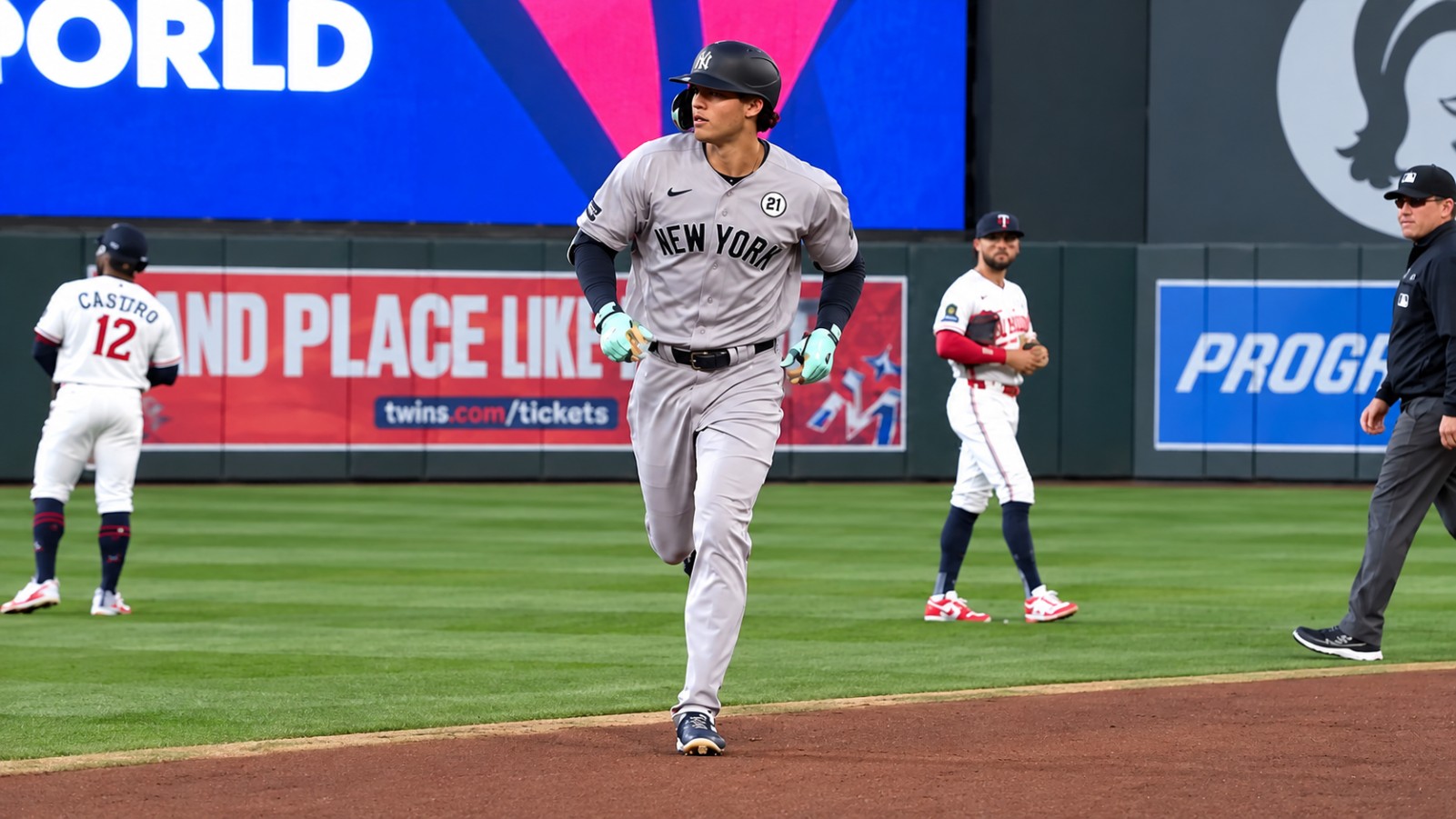
MINNEAPOLIS — For two straight nights, the Yankees reached seven runs with the same swing. Aaron Judge supplied the three-run blast Monday. Twenty-four hours later, Spencer Jones did it against a matchup New York once tried to shield him from.
Jones turned on a 2-2 sweeper from Twins left-hander Taylor Rogers in the sixth inning Tuesday and drove it 423 feet to straightaway center. The three-run homer gave the Yankees a 7-1 lead in an eventual 8-1 win at Target Field.
The matchup made the swing more revealing than the distance. Rogers had faced 133 left-handed batters this season without allowing a home run before the Yankees rookie broke that streak. Jones had fouled off a series of sweepers before getting another one over the middle and sending it out at 108 mph.
Cody Bellinger had already given the Yankees a 2-0 first-inning lead with his 16th homer, while Max Fried worked seven innings of one-run ball. The Yankees finished with 14 hits, every starter had at least one, improved to 88-63, and won for the seventh time in eight games.
Jones’ homer was his 10th, making him the 11th Yankee to reach double figures this season, the club’s most since 2019.
The power had gone quiet for nearly two weeks, but the bat had not. Jones hit .333 during the 11-game homerless stretch. Over his last 25 games, he is 28-for-81, a .346 average, with 10 extra-base hits, five homers, 19 RBIs, 17 runs, and a .993 OPS.
The development curve is becoming hard to ignore
Jones’ season line, .259/.331/.452, hides how much his Yankees profile has changed. He opened May at .167/.259/.167 in 10 games, moved to .255/.340/.468 in June, and slugged .611 in eight July games. August brought a .239/.290/.446 line, but September has produced a .340/.415/.532 slash through 13 games.
The broader second-half trend is similar. The Yankees rookie has hit .271/.337/.490 since the All-Star break after posting .233/.317/.370 before it. He has done it while handling center field regularly and continuing to work through the strikeout issues that followed him through the minors.
Former Yankees manager Joe Girardi highlighted the breadth of that improvement before Monday’s game. Girardi pointed to Jones’ adjustments with runners in scoring position, his ability to catch premium velocity, his defense, running, and arm strength.
“He can do everything,” Girardi said.
Bellinger, who shares the Yankees outfield with Jones, said the change goes beyond results. He pointed to how settled the rookie looks regardless of which arm is on the mound.
“It’s been amazing. I mean, his swing is, it’s a really good swing, and mentally, he understands what he wants to do against [left-handers] and he understands what he needs to do against them,” Bellinger said. “Righty or lefty on the mound he doesn’t seem phased. He has a good approach.”
Jones has turned platoon question upside down
The numbers explain why the Yankees’ original approach no longer fits. Jones has 51 plate appearances against left-handed pitching and is batting .435 with a .490 on-base percentage and .761 slugging percentage, good for a 1.251 OPS. He has 20 hits in 46 at-bats, including three homers and 12 RBIs.
Among MLB hitters with at least 50 plate appearances against lefties, both his batting average and OPS rank first. That is an unusual development for a Yankees rookie who entered the majors with swing-and-miss questions and initially was handled carefully in same-side matchups.
The split is also carrying an outsized share of his production. Jones has 59 hits, 10 homers, and 37 RBIs in 78 games overall. A PinstripesNation calculation shows that only about 20% of his at-bats have come against lefties, yet those matchups account for roughly 34% of his hits, 30% of his homers, and 32% of his RBIs.
Over his last 32, the Yankees outfielder is hitting .317 with a .900 OPS, a .532 slugging percentage, and five homers. The Yankees were also watching whether the quality of his at-bats held even when the home-run swing temporarily disappeared.
Those numbers have changed the way Yankees manager Aaron Boone handles him. Earlier in the season, Boone tried to ease the left-handed-hitting rookie into major-league life by limiting some of his exposure to southpaws. More than four months later, that protection has essentially disappeared.
“I was easing him in. And he’s kind of kicked that door in,” Boone said with a chuckle. “He’s faced a lot of tough lefties, too, and really, I feel like he’s been in control of the at-bats, which is pretty good to see.”
October lineup question may already be answering itself
The Yankees once had a straightforward reason to protect Jones from lefties. They no longer do. His production against southpaws has become one of his strongest traits, removing a matchup-based reason to sit him when October bullpens begin cycling through specialists.
That matters because center field has changed quickly. Trent Grisham has hit .211/.308/.395 in 121 games, while Jones has moved from an irregular Yankees role into regular work as the postseason race tightens. His ability to stay in the lineup against either hand gives Boone more freedom with Bellinger, Heliot Ramos, and the rest of the roster.
The Yankees still have to decide how every piece fits when the roster is whole. Jones has made one part of that discussion much simpler. A weakness Boone tried to manage in May now looks like a matchup opponents may have to plan around in October.
What do you think? Leave your comment below.













Happy for him. Getting the opportunity and kicking the door in