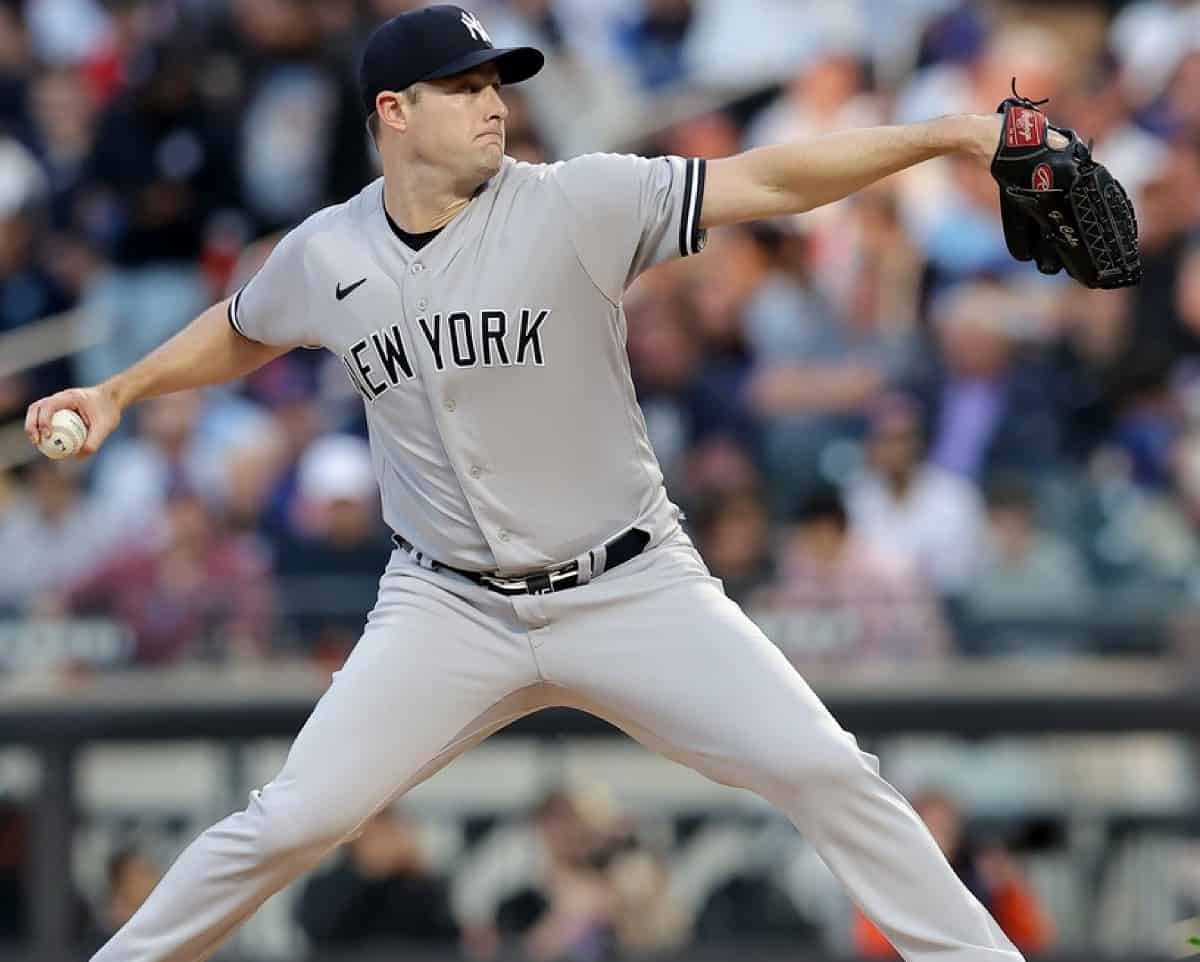
NEW YORK — For most of the past decade, Gerrit Cole automatically got the Yankees’ biggest games.
That certainty is gone.
With October less than two weeks away, the pitcher who defined the staff has become its most uncomfortable question. The velocity still flashes, but the results have deteriorated at the worst time. Aaron Boone has tried to downplay the concern. The evidence keeps making that harder.
Cole, the Yankees’ 2023 Cy Young Award winner, has allowed seven home runs over his last two starts, the most in any two-start span of his career, according to MLB.com. A former Game 1 lock has slipped down the October pecking order and created a real debate over whether he should start a win-or-go-home game.
For a Yankees team with baseball’s best ERA, this is the crack in the foundation. New York clinched a playoff berth Monday and sits at 88-63. Pitching is why the club believes it can make a deep run. Cole was supposed to headline that strength, not become its biggest uncertainty.
A mental issue that Yankees dread
On Sept. 6, Cole allowed home runs to the first three Padres hitters he faced. Fernando Tatis Jr., Jake Cronenworth and Manny Machado went back-to-back-to-back.
Six days later, the Mets hit the Yankees ace harder in a 12-2 rout. Francisco Lindor homered on Cole’s third pitch. Rookie Carson Benge later took him deep on a slider. Cole lasted 4 1/3 innings, allowed five runs and three homers, and heard boos as he left.
After the game, his explanation made the Yankees loss looked worse.
Cole has a 6.08 ERA over his last four starts, with 17 strikeouts in 22 2/3 innings, and has allowed at least three earned runs in four straight outings.
For the season, he is 8-9 with a 3.67 ERA and 20 homers allowed in 115 1/3 innings. The Yankees have averaged only 3.67 runs in his starts, turning games that once felt automatic into coin flips.
What the Yankees are actually worried about
The concern is not that Cole suddenly lacks major-league stuff. It is why hitters look so comfortable against it.
YES Network analysts David Cone and Paul O’Neill both raised the possibility that Cole is tipping pitches, which could explain why hitters have handled a fastball that still reaches 98 mph.
Pitching coach Matt Blake did not dismiss it.
“It’s possible,” Blake said, adding that “that’s one of the things we’re going to look at.”
Blake also pointed to a simpler issue. Cole is throwing strikes at a career-best rate, but too many are catching the middle.
“We’ve got to get the ball out of the big part of the plate,” Blake said. “Also, maybe better two-strike execution to get to better areas.”
Cole has acknowledged the problem without pretending to have solved it.
“You have to start making adjustments,” Cole said.
He also pushed back on the tipping theory, saying his stuff should still provide margin even if hitters anticipate it.
“Even if they know (what’s coming), it’s still hard to hit,” Cole said. “The stuff should be giving us more margin for error.”
How the rotation math is shifting
Cole’s slump has scrambled the rotation hierarchy.
Cam Schlittler, in a breakout second season, has emerged as the staff’s best arm and a likely American League Cy Young contender. He profiles as the Game 1 starter. Max Fried, back from an elbow injury, and Carlos Rodon both carry sub-3.00 ERAs and look like cleaner early-series choices.
The matchup makes it worse. The Yankees are likely headed for a best-of-three Wild Card Series against Boston. Cole owns a career 5.30 ERA against the Red Sox, and only the Mets have hit him harder.
Veteran columnist Joel Sherman framed the October question around one word: leash. His scenario had Cole starting a middle game with far less room for error.
“I think Schlittler, Fried and Cole are going to start the games,” Sherman said. “The difference will be a very, very short leash for Cole, which historically he wouldn’t have.”
Sherman also tied the Yankees’ postseason ceiling directly to Cole and Aaron Judge getting back to form.
“The Yankees could be out of the playoffs in under 48 hours or they could win the World Series,” Sherman said. “Both are in play and the upside of it gets a lot more possible if Cole and Judge get their act together in the next two weeks because they’re Gerrit Cole and Aaron Judge and they’re great players when they’re right.”
The breaking-ball data explains the collapse
Cole has held left-handed hitters to a .683 OPS. Right-handed hitters are the problem, slugging .448 against him, the highest mark by righties in any season of his career.
The Yankees ace’s breaking balls are driving the damage. Right-handed hitters are slugging .652 against his curveball, by far the worst figure of his career. They are slugging .463 against his slider, also a career high and his worst mark as a Yankee by a comfortable margin.
Those pitches are also missing fewer bats. His curveball has produced only a 17% whiff rate against righties, while his slider sits at 25%. He is also throwing the slider in the heart of the zone against right-handers at the highest rate of his career, explaining both the reduced swing-and-miss and harder contact.
Pitch-quality models show the same erosion. Cole’s slider has fallen from a 125 Stuff+ grade in 2020 to 106 this season. The Yankees star’s curveball has dropped from 120 to 104. Both remain above average, but the margin that once made him overpowering has narrowed.
Cole turned 36 on Sept. 8 and is in his first season back from Tommy John surgery, a year sports medicine suggests is often less sharp than the second. Whether the issue is mechanical, pitch tipping or simple fatigue, New York has less than two weeks to find the answer.
For now, the ace who once owned the biggest assignments is auditioning for an October role he used to command.
What do you think? Leave your comment below.