NEW YORK — Yankees’ best contract value of 2026 wasn’t Aaron Judge or Max Fried or Cody Bellinger – and it wasn’t particularly close.
Final Pinstripes Value Score rankings show how cheap, high-end production helped New York offset some of the largest contracts on its payroll.
The Yankees spent heavily to build their 2026 roster, but some of their most valuable production came from players making a fraction of what the club paid its established stars.
That is the clearest takeaway from the final 2026 Pinstripes Value Score, a metric designed to measure how much on-field production the Yankees received relative to each player’s payroll cost.
And by that measure, nobody delivered more bang for the Yankees’ buck than Cam Schlittler.
Schlittler finished the regular season with a 99.0 PVS, narrowly edging Ben Rice at 98.5 for the best contract-efficiency score on the roster. Brent Headrick, Will Warren and Ryan Weathers rounded out a top five dominated by inexpensive pitchers.
The results help explain how a team carrying several enormous contracts was still able to generate significant surplus value across the roster.
Final 2026 Yankees qualified PVS
| Rank | Player | Role | fWAR | Payroll input | PVS | Surplus value |
| 1 | Cam Schlittler | SP | 6.2 | $0.82M | 99.0 | +$79.6M |
| 2 | Ben Rice | H | 4.2 | $0.82M | 98.5 | +$53.9M |
| 3 | Brent Headrick | RP | 2.1 | $0.82M | 97.5 | +$31.5M |
| 4 | Will Warren | SP | 2.2 | $0.82M | 97.3 | +$28.2M |
| 5 | Ryan Weathers | SP | 2.5 | $1.35M | 96.1 | +$31.5M |
| 6 | Austin Wells | H | 1.7 | $0.90M | 94.5 | +$14.3M |
| 7 | Spencer Jones | H | 0.7 | $0.82M | 87.1 | +$4.7M |
| 8 | Jose Caballero | H | 1.3 | $2.00M | 85.6 | +$9.9M |
| 9 | Paul Blackburn | RP | 0.7 | $2.00M | 85.0 | +$9.3M |
| 10 | Fernando Cruz | RP | 0.4 | $1.45M | 82.5 | +$5.3M |
| 11 | Ryan Yarbrough | RP | 0.7 | $2.50M | 81.9 | +$8.8M |
| 12 | Jazz Chisholm Jr. | H | 3.5 | $10.20M | 81.9 | +$35.6M |
| 13 | George Lombard Jr. | H | 0.4 | $0.82M | 81.0 | +$2.7M |
| 14 | Anthony Volpe | H | 1.4 | $3.50M | 78.5 | +$9.2M |
| 15 | Paul Goldschmidt | H | 1.6 | $4.00M | 78.4 | +$10.4M |
| 16 | David Bednar | RP | 1.9 | $9.00M | 76.6 | +$20.3M |
| 17 | Jake Bird | RP | 0.1 | $0.98M | 70.0 | +$1.3M |
| 18 | Luis Garcia Jr. | H | 0.5 | $2.00M | 67.6 | +$2.2M |
| 19 | Max Fried | SP | 3.5 | $27.25M | 62.8 | +$18.6M |
| 20 | Cody Bellinger | H | 3.5 | $32.50M | 58.6 | +$13.4M |
| 21 | Gerrit Cole | SP | 2.1 | $36.00M | 43.7 | -$8.0M |
| 22 | Aaron Judge | H | 2.0 | $40.00M | 40.0 | -$13.3M |
| 23 | Carlos Rodon | SP | 1.8 | $27.00M | 37.5 | -$10.7M |
| 24 | Ryan McMahon | H | 0.5 | $11.70M | 26.3 | -$7.5M |
| 25 | Trent Grisham | H | 0.7 | $22.00M | 20.1 | -$16.4M |
| T-26 | Yerry De Los Santos | RP | -0.1 | $0.82M | 0.0 | -$0.8M |
| T-26 | Jasson Dominguez | H | -0.2 | $0.82M | 0.0 | -$0.8M |
| T-26 | Amed Rosario | H | -0.2 | $2.50M | 0.0 | -$2.5M |
| T-26 | Tim Hill | RP | -1.1 | $3.00M | 0.0 | -$3.0M |
| T-26 | Camilo Doval | RP | -0.1 | $6.10M | 0.0 | -$6.1M |
Source: FanGraphs final 2026 Yankees WAR leaderboard, updated Sept. 28, 2026. PVS uses the previously established payroll and market-WAR methodology. Players tied at 0.0 are shown as tied.
Schlittler delivered enormous surplus value
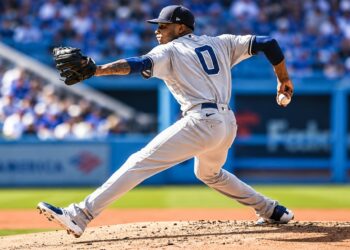
Schlittler’s rise to the top of the leaderboard was driven by the combination every front office covets: high-end production at a minimal payroll cost.
The right-hander finished the regular season with a 1.95 ERA across 193 2/3 innings while carrying a payroll input of roughly $820,000. FanGraphs credited him with 6.2 WAR.
Under the PVS model, that production was worth approximately $80.4 million on the open market. After accounting for his payroll cost, Schlittler generated about $79.6 million in estimated surplus value and a 99.0 PVS.
The reason is straightforward. New York paid close to the league minimum and received something approaching ace-level production. That kind of return creates enormous roster flexibility because the Yankees did not need to spend $25 million or $30 million to get top-of-the-rotation results.
Ben Rice was barely behind
Rice made the race close.
The first baseman played 154 games, hit 41 home runs and finished with 4.2 FanGraphs WAR while carrying essentially the same minimum-level payroll cost as Schlittler.
That combination gave Rice a 98.5 PVS and approximately $53.9 million in estimated surplus value.
Rice’s season illustrates why young stars are so valuable from a roster-construction standpoint. A veteran producing at the same level might require an eight-figure annual salary. The Yankees received that production for less than $1 million.
Yankees pitching delivered huge value
Schlittler was hardly the Yankees’ only inexpensive pitcher to outperform his salary.
Brent Headrick finished third with a 97.5 PVS, followed by Will Warren at 97.3 and Ryan Weathers at 96.1. Headrick produced 2.1 WAR, Warren 2.2 and Weathers 2.5 while each carried a modest payroll cost.
Those performances created an important counterbalance to the Yankees’ expensive veteran rotation contracts.
Max Fried, for example, still finished comfortably above the market-value line despite a $27.25 million payroll figure. His 3.5 WAR produced a 62.8 PVS and approximately $18.6 million in surplus value.
That is a different type of contract success. Fried was not inexpensive. He simply produced enough to justify – and exceed – the significant investment the Yankees made in him.
Chisholm Jr. was one of Yankees biggest bargains
Among the Yankees’ established position players, Jazz Chisholm Jr. stood out.
Chisholm produced 3.5 FanGraphs WAR while carrying a $10.2 million payroll figure, resulting in an 81.9 PVS.
More importantly, his estimated surplus value reached approximately $35.6 million. The model values his production at about $45.7 million, leaving a substantial gap between what the Yankees paid and what they received.
That surplus figure is especially notable. PVS measures efficiency, while surplus value measures the estimated dollar difference between production and payroll cost. Chisholm excelled in both categories.
Paul Goldschmidt also delivered strong value, finishing with a 78.4 PVS against a $4 million payroll input. Anthony Volpe and Jose Caballero also finished comfortably above the 50-point market-value line.
Bellinger and Fried justified expensive deals
High salaries do not automatically produce poor PVS scores.
Cody Bellinger demonstrated that. Despite carrying a $32.5 million payroll input, Bellinger produced 3.5 WAR and finished with a 58.6 PVS and approximately $13.4 million in surplus value.
Fried similarly remained above the benchmark. Those were not bargain-bin contracts. They were expensive contracts that still produced more than the Yankees paid for under the model.
That is one of the benefits of PVS as a contract metric: it does not simply reward inexpensive players. A highly paid player can still score well if his production exceeds what the Yankees paid to acquire it.
Judge’s low ranking requires context
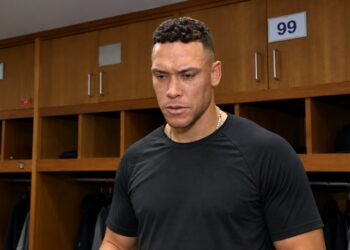
Aaron Judge finished much lower than fans might expect from the face of the franchise.
His final PVS came in at 40.0, below the 50-point fair-market benchmark. FanGraphs credited Judge with 2.0 WAR in 285 plate appearances.
That does not mean Judge was the Yankees’ 22nd-best player. It means the Yankees committed approximately $40 million in payroll to him, creating a dramatically higher production threshold than the one facing Ben Rice, Schlittler or Warren.
Missed time also mattered. PVS measures realized production. It does not project what a player might have produced over 162 games or remove the financial impact of injuries. If a player misses time, the Yankees are still carrying the contract.
Gerrit Cole faced a similar issue. Cole accumulated enough innings to qualify and produced 2.1 WAR, but his $36 million payroll commitment pushed his PVS to 43.7. Carlos Rodon also finished below 50 at 37.5.
The Yankees’ roster construction lesson
The most revealing part of the final rankings is not where Judge, Cole or Bellinger finished. It is how much value the Yankees extracted from inexpensive players.
Schlittler. Rice. Headrick. Warren. Weathers. Austin Wells.
Those players gave New York significant production without consuming significant payroll space. Six Yankees finished above 94 on the PVS scale, and all six carried relatively modest payroll figures.
That allowed the Yankees to carry several massive contracts without needing every expensive veteran to outperform his salary.
And that may be the clearest roster-building lesson from the 2026 season. The Yankees did not maximize value because every major contract worked perfectly. They did it because some of their cheapest players performed like stars.
No player embodied that better than Schlittler. The Yankees paid him like a pre-arbitration pitcher. They received ace-level production. And by the end of 2026, that made him the best contract value on the roster.
What do you think? Leave your comment below.
| The Pinstripes Value Score (PVS) is not designed to identify the Yankees’ best player. It is designed to answer a different question: How much production did the Yankees receive compared with what that production cost them? PVS uses FanGraphs WAR to estimate the market value of a player’s production and compares it with the Yankees’ payroll commitment to that player. A score of 50 represents approximately fair market value. A score above 50 indicates the Yankees received more production than their payroll investment would ordinarily purchase. A score below 50 means the player produced less value than the club’s financial commitment. To prevent small samples from skewing the rankings, only players with at least 150 plate appearances, 50 innings as a starter or 20 innings as a reliever qualified. That distinction matters. The rankings measure contract efficiency, not raw talent, star power or overall importance to the franchise. Methodology note: Qualified PVS uses FanGraphs WAR, a 150, PA minimum for hitters, 50 inning minimum for starting pitchers and 20 inning minimum for relievers. A PVS of 50 represents approximately fair market value. |