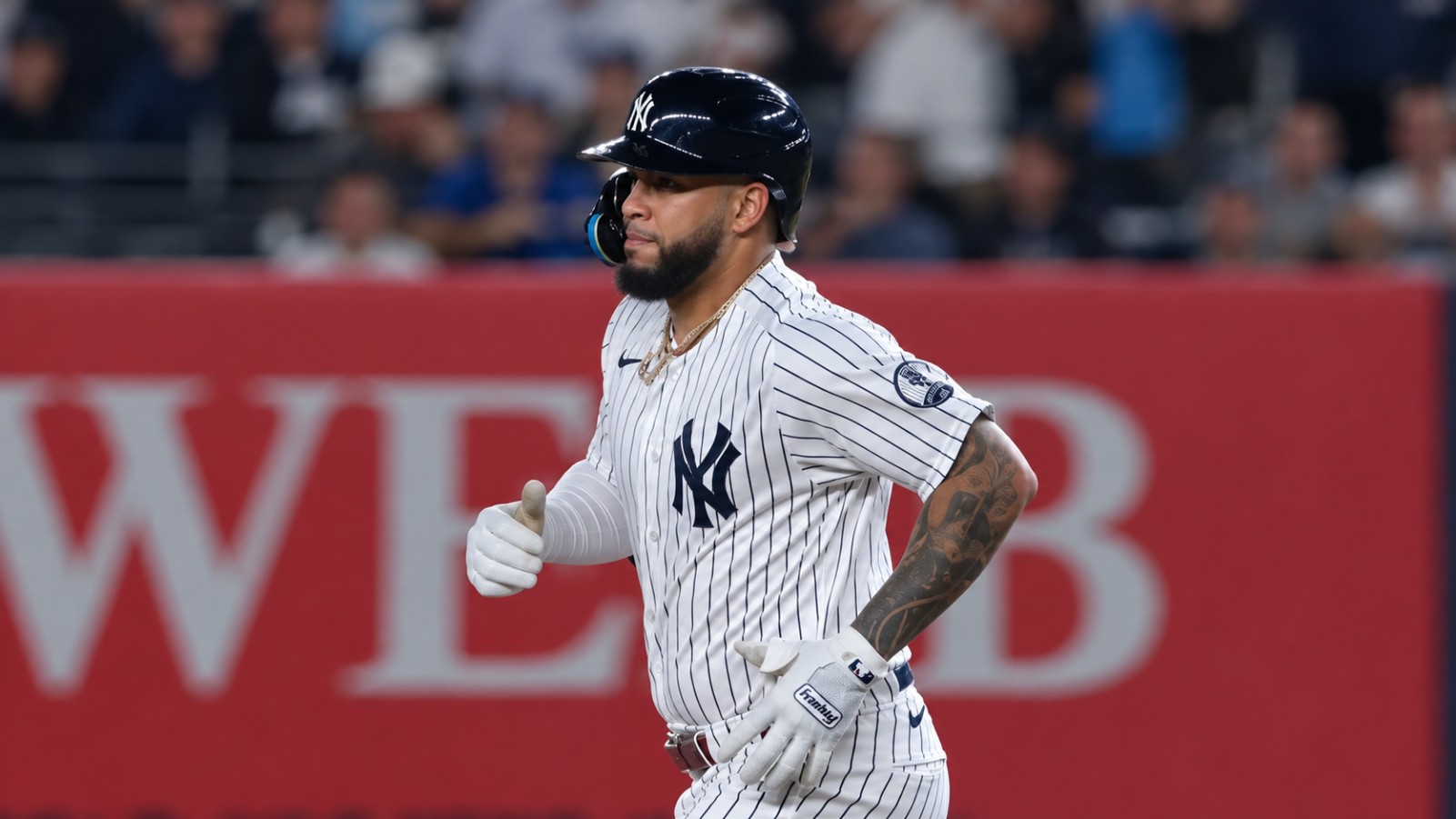
BRONX, N.Y. — George Lombard Jr. supplied the loudest swing Wednesday, but another left-handed bat opened the scoring and kept building a much quieter September case.
Luis García Jr. turned on a 94.9 mph sinker from Tomoyuki Sugano in the second inning and drove it 412 feet to right-center. The homer left his bat at 105.6 mph and gave the Yankees an early lead in a 6-1 win over the Colorado Rockies at Yankee Stadium.
García later doubled ahead of Lombard’s grand slam and finished 2-for-4 with two runs. Will Warren earned the win with six innings of one-run ball. Sugano took the loss, and no save was needed.
His 29th career homer performance pushed García’s Yankees line to .304/.342/.518 through 31 games. He has 34 hits, six home runs, 13 RBIs and 16 runs in 112 at-bats since New York acquired him from Washington on Aug. 2.
Update: Luis Garcia Jr. hit his career home run no. 30 in the Yankees’ 10-3 win over the Rockies. His career line in the pinstripes now stands. García’s Yankees line now stands at .299/.336/.530 through 32 games. He has 35 hits, seven home runs, 15 RBIs and 17 runs in 117 at-bats since joining New York.
Those numbers carry more weight now. The Yankees are 83-62, four games behind the 87-58 Tampa Bay Rays in the AL East and 10 games clear of the wild-card cutoff entering Thursday. Aaron Judge is back, and the October lineup is beginning to take shape.
That leaves a different question around Luis García Jr. The Yankees spent two seasons trying to rebuild the left-handed damage they lost when Juan Soto left after 2024. García is not a one-for-one replacement. He may, however, have become an unexpected part of the answer, and his contract clock gives New York reason to think beyond this postseason.
A different answer to the Soto problem
Juan Soto hit .288/.419/.569 with 41 home runs, 109 RBIs and 129 walks for the 2024 Yankees before signing a 15-year, $765 million deal with the Mets. García does not bring that kind of on-base dominance.
What he does bring is left-handed contact with legitimate pull-side power. That was exactly what the Yankees needed when they traded four pitchers, including prospects Jack Cebert and Ben Grable, to Washington.
García already had 23 homers and a .560 slugging percentage in 104 games for the Nationals. Aaron Boone immediately viewed him as more than depth.
Boone was addressing an offense that had been short on healthy middle-order threats when he described García after the trade.
“He’s been a wrecking ball in the National League this year,” Boone said. “He becomes an instant presence in our lineup. We’ve had our struggles offensively for a good stretch now, and we think he helps that a lot.”
That assessment has held. García’s batting average and on-base percentage have both improved since he became a Yankee.
A 112-at-bat split changes the contract question
García has 34 hits in 112 Yankees at-bats. Twelve have gone for extra bases, six doubles and six homers, for 58 total bases.
His .304 average is 21 points higher than the .283 mark he posted for Washington. His .342 on-base percentage is 29 points higher. His slugging percentage has dropped from .560 to .518, but his Yankees OPS still sits at .860.
The full-season breakout is larger. García is hitting .288/.320/.550 with 29 home runs and 89 RBIs across 135 games. His previous career high was 18 homers in 2024.
The Stadium fit was visible before the deal. García had raised his pulled-air-ball rate to a career-high 18.5% and entered the deadline period with a career-best 12.4% barrel rate.
García explained after arriving that he had intentionally worked to lift and pull more pitches with authority.
“It’s one of the adjustments that I made this year, to get the ball in the air more frequently to be able to pull it with more authority, especially on certain pitches in the zone,” García said. “So it’s no secret, playing here at Yankee Stadium, it’s exciting to be part of that. We’ll see what happens there.”
Wednesday’s homer traveled well beyond the short porch, but the swing path remains a natural match for the ballpark.
First base adds to Garcia’s long-term value
García’s position also matters. He came up as a middle infielder, but MLB lists him with 119 games at first base this season.
The Yankees initially saw him as a first-base and designated-hitter option against right-handed pitching. Boone indicated this week that García is likely to remain at first even with Anthony Volpe returning to the infield mix.
There is still a platoon concern. García owns a .652 OPS against left-handed pitching this season compared with .914 against right-handers. That split will matter in October and in any long-term projection.
But he is only 26 and is squarely in his physical prime. Garcia is making $6.875 million this season, is arbitration-eligible again in 2027 and can reach free agency after that season.
The Yankees can simply keep him for one more year. They can also decide that his 2026 changes are real enough to buy out that final arbitration year and some free-agent seasons before the cost climbs.
Yankees now have an offseason clock
The timing is unusual. MLB’s current collective bargaining agreement expires at 11:59 p.m. ET on Dec. 1, and the league and players already are negotiating a new deal. A lockout remains possible if there is no agreement.
That does not force New York to negotiate during the season. It does make the period between the postseason and the CBA expiration more significant than in a normal winter.
For now, García remains a postseason piece. The Yankees need his left-handed bat against right-handed pitching, and Judge’s return means García no longer has to help carry an injury-thinned lineup.
The larger question will still be there after October. García was acquired to help the Yankees through 2027. His first 31 games in pinstripes have supplied a reason to consider a longer timeline.
New York will never recreate everything Soto provided with one player. García does not need to do that. If this version of his swing holds, he may have replaced enough of the missing left-handed threat to turn his next contract into a real Yankees priority.
What do you think? Leave your comment below.