NEW YORK — Every star the Yankees have chased this month has come with a crowd attached. Catchers with five suitors. Relievers who would trigger bidding wars. Prices set by teams that know somebody else is calling.
One name on their list does not work that way.
The player is a former World Series MVP, signed through next season, and his club has every reason to sell. What he does not have is competition for his services.
That absence is worth more to the Yankees than any scouting report.
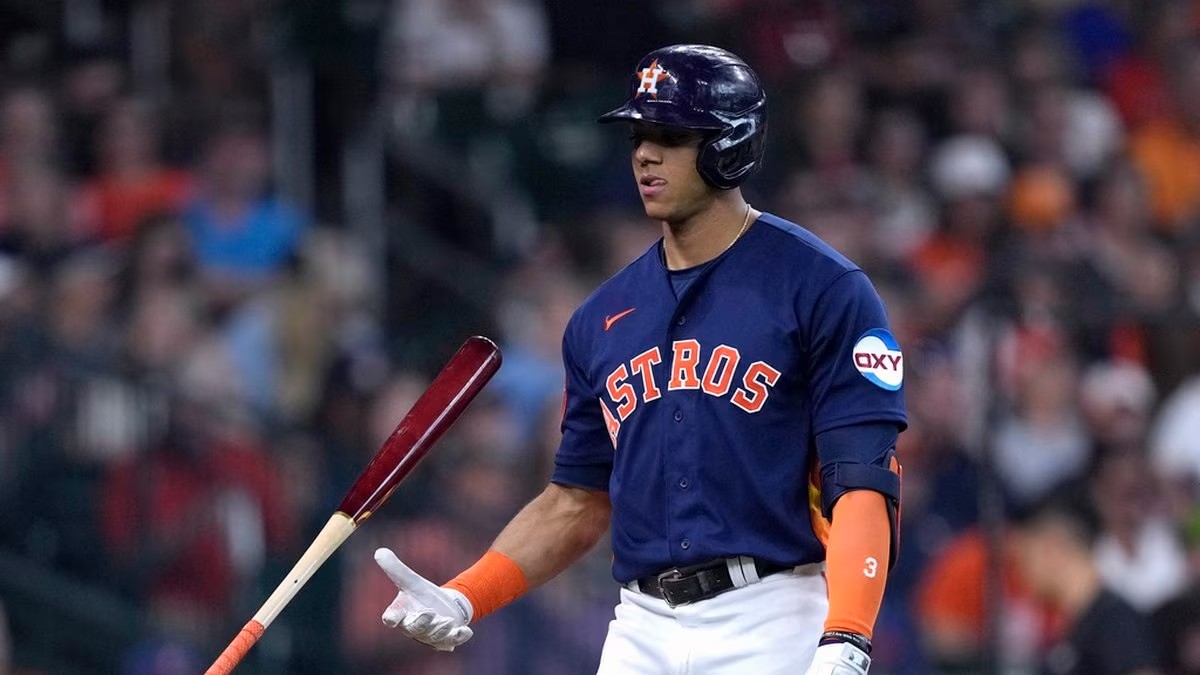
Astros shortstop Jeremy Pena sits in an unusually thin market, with national evaluators noting that few contenders need a shortstop, and that scarcity of rival bidders gives the Yankees a rare opening if Houston makes him available before the Aug. 3 deadline.
A market with almost no buyers
ESPN’s Jeff Passan and Kiley McDaniel placed the odds of a Pena trade at 35 percent in their deadline rankings, and the reason they gave for the hesitation is the same thing that would help New York.
They framed the shortstop market as the complication rather than Pena’s price, noting that Houston may simply have nowhere good to sell.
“The one potential drawback from Houston’s perspective: There aren’t a whole lot of contenders in the market for a shortstop, and it might make more sense to wait until the winter,” Passan and McDaniel wrote.
For most clubs that line is a reason to look elsewhere. For the Yankees, who have gotten almost nothing from the position, it means any conversation with Houston would not turn into an auction.
Passan has named the Yankees a potential fit for Pena, and Buster Olney has listed the Rays, Braves, Blue Jays and Red Sox as other possible destinations. None of those clubs carries the same urgency at shortstop that New York does.
Deadline prices are set by competition rather than by talent alone. A star with six suitors costs a farm system; the same player with one serious bidder costs considerably less, and that arithmetic is what makes this situation different from every other name on the Yankees list.
Why Houston has to decide something
The Astros are 47-54 and carry a farm system ranked among the worst in the sport. Passan framed the choice facing them in blunt terms.
“Replenishing a bad farm system with few players close to the big leagues takes a move like trading Pena, and the only question at this point is whether it will be before (the) Aug. 3 (trade deadline) or before the Dec. 1 lockout,” Passan wrote.
The contract situation adds pressure. Pena hired Scott Boras last year, which effectively ended extension talks, and Boras clients rarely sign early. He reaches free agency after the 2027 season.
Houston has watched this pattern before with George Springer and Alex Bregman, both of whom left. General manager Dana Brown and manager Joe Espada are also in the final years of their contracts, which cuts the other way and argues for keeping a player who makes the team better now.
What the Yankees would be buying
Pena, 28, has been productive when available. He is hitting .295 with six home runs, 22 RBIs and eight stolen bases, though injuries have held him to 53 games.
The list is long. He missed 32 games in April and May with a hamstring problem, played through a broken ring finger sustained in spring training, and returned in late June from a left calf strain. He sat one game this week with a hamstring cramp before returning to the lineup.
The healthy version is an All-Star, and the kind of bat the Yankees have lacked at the position. Pena hit .304 with 17 home runs, 62 RBIs, 20 stolen bases and a career-high .840 OPS in 2025, his first All-Star season.
October is the part that would resonate in the Bronx. Pena was named MVP of both the AL Championship Series and the World Series during Houston’s 2022 title run, hitting .345 with four home runs across 13 postseason games.
His defensive metrics have wobbled. Both Defensive Runs Saved and Fielding Run Value grade him below average in 2026 after rating him well in 2025, though shortstop defensive models are volatile and he is coming off injury.
Evaluators disagree sharply on what that adds up to. Some see a five-win player, others closer to three, and where a club lands on that question would determine what the Yankees or anyone else would be willing to surrender.
A position the Yankees cannot ignore
The need is not theoretical. Anthony Volpe has one home run and a .663 OPS in 47 games after missing April following offseason shoulder surgery.
Jose Caballero has contributed 10 home runs and 23 stolen bases, but he hit .210 with a .658 OPS across 24 games in June, and neither player has secured the job.
Commentary around the Yankees has increasingly pointed the same direction. Joel Sherman has suggested the club would think seriously about Pena if Houston made him available, a view Alex Rodriguez has echoed recently.
The counterweight sits in Scranton. Top prospect George Lombard Jr. is close to a major league debut, and acquiring a shortstop signed through 2027 would complicate that timeline rather than simplify it.
That tension is real for a Yankees front office weighing October against next spring. Pena would raise the floor immediately, while Lombard represents the cheaper answer the organization has spent three years developing.
Houston has not signaled that Pena is available. What has changed is the shape of the market around him, and the Yankees are among the few teams positioned to use it.
What do you think? Leave your comment below.