NEW YORK — Every conversation the Yankees have had about a deadline blockbuster runs into the same wall. Rival clubs ask for George Lombard Jr. The Yankees say no. The talks stall there.
Scouts surveying the farm system have been blunt about the consequence. Without their top prospect in a package, the Yankees do not have another name that moves a negotiation.
That reading may be incomplete.
There is a second shortstop in the organization who cracked baseball’s top 100 this winter, and almost nobody outside the front office is talking about him.
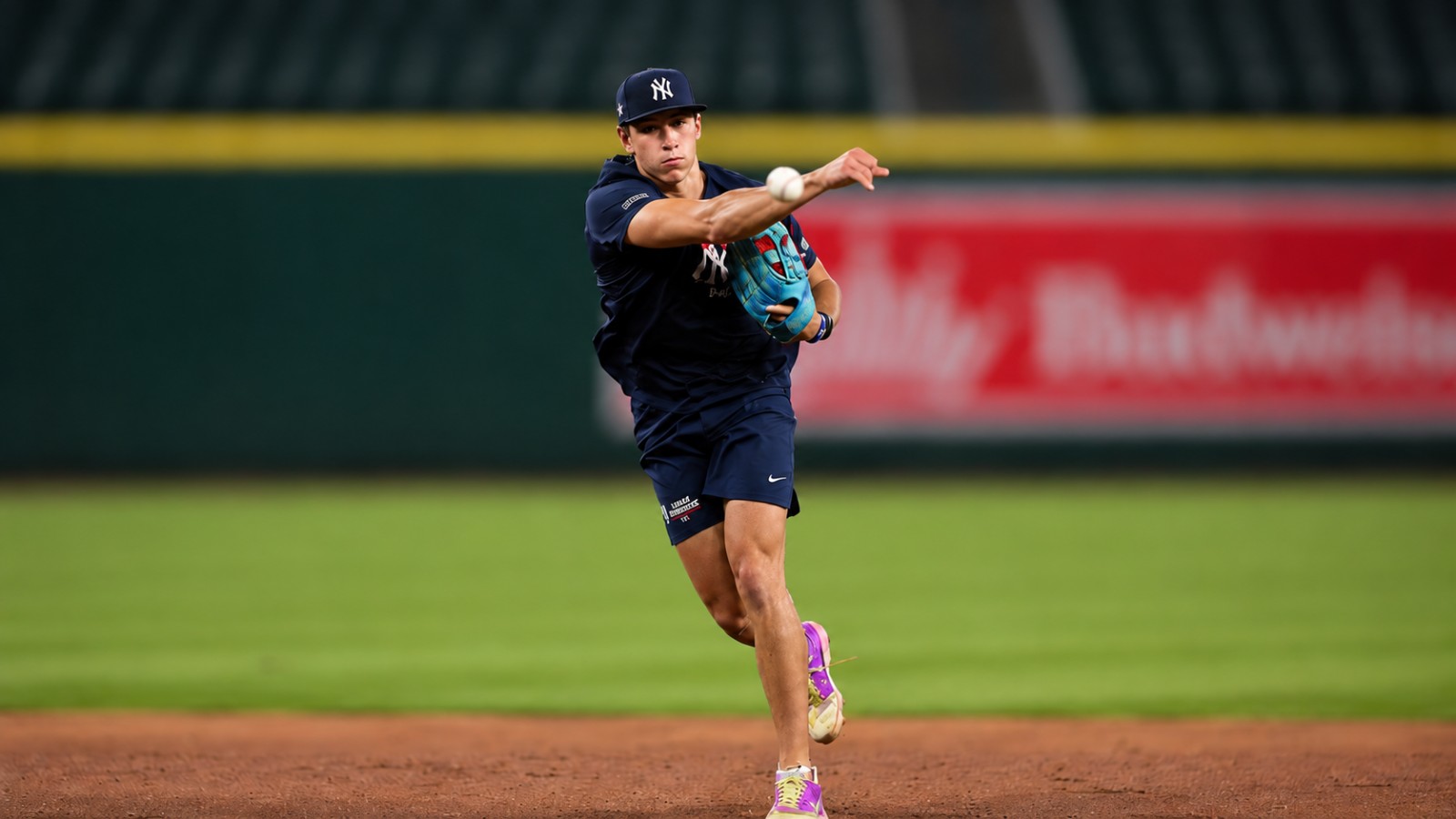
Dax Kilby, the Yankees’ first-round pick in the 2025 draft, ranks 61st among all prospects according to Baseball America, 15 spots behind Lombard, giving the club a potential centerpiece that would let it chase a star before the Aug. 3 deadline without surrendering the infielder it considers untouchable.
What the Yankees have in Kilby
Kilby went in the first round out of Newnan High School in Georgia, and he did not need long to justify the pick. In 18 games at the Single-A level after signing, he hit .353 with a .457 on-base percentage and a .441 slugging percentage.
The underlying data suggested the line was real rather than a small-sample mirage. Kilby posted a 91.9 mph average exit velocity and a 45.6 percent hard-hit rate, numbers that hold up against players several years older.
His plate discipline stood out further. He walked in 16 percent of his trips and struck out in 13.6 percent, drawing more free passes than whiffs months removed from high school.
That combination is what scouts weigh most heavily in teenage hitters. Power tends to arrive later as a player fills out, but the ability to control the strike zone against professional pitching is harder to teach and travels better through the minors.
Independent evaluators noticed. Analyst Thomas Nestico, who tracks batted-ball data, placed Kilby among the best offensive prospects in his class in a February assessment.
“Dax Kilby (NYY) flashed above-average raw power, posting a 108.9 MPH Max EV and a 49.1 HardHit% post-draft. His combination of contact ability and damage potential gives him one of the highest offensive ceilings in his class,” Nestico wrote, ranking him the No. 74 prospect in baseball.
The injury that muddied his season
The complication is that Kilby has barely played in 2026. A hamstring injury cost him the chance to build on his debut, leaving rival evaluators with the same 18-game sample the Yankees have.
That cuts both ways in a negotiation. A healthy Kilby with a full season of production would carry a higher price tag, and the Yankees would be less willing to move him. An injured one is easier to trade and easier for another club to discount.
The injury does not appear to be the kind that alters a player’s long-term outlook, which is what makes the timing awkward for the Yankees. They would be selling a top-100 talent at a moment when his value is depressed by circumstance rather than performance.
Front offices price prospects on projection rather than recent production, so a hamstring problem rarely moves an evaluation far on its own. The larger question for any club considering Kilby is how much weight to put on 18 games, however impressive those games were.

Why Lombard is not available
Lombard sits 46th on the same Baseball America list and has spent the season at Triple-A Scranton/Wilkes-Barre, where a promotion has started to look imminent. Joel Sherman reported the Yankees could call him up at some point this summer.
That plan explains the resistance. Scouts consulted about the Yankees roster this month described Lombard as the closest thing the organization has to an elite trade chip, and also as the player it is least willing to move.
The bind is straightforward. San Diego surrendered Leo De Vries, then the second-ranked prospect in the sport, to acquire Mason Miller a year ago. Any club selling a comparable arm now will start negotiations at that tier.
Kilby will not match Lombard’s name recognition. What he offers is a top-100 ranking, a shortstop profile with speed and power, and an age that gives an acquiring team years of control before he reaches arbitration.
The 15-spot gap between the two on the prospect list is also narrower than the gap in public perception. Lombard has spent three seasons climbing through the Yankees system and is knocking on the door of the majors. Kilby has been a professional for barely a year.
A fit that points toward San Diego
The Padres make sense as a landing spot for reasons beyond Miller. Their top shortstop prospect, 19-year-old Jorge Quintana, has not reached the Baseball America top 100 that Kilby occupies.
Their major league situation is unsettled as well. Xander Bogaerts has not delivered what San Diego expected when it signed him, and the club moved Fernando Tatis Jr. off the position long ago.
A package built around Kilby would need company. Names such as Elmer Rodriguez, Ben Hess and Carlos Lagrange sit among the Yankees’ other top prospects, and a deal of that size would likely require a big league arm, with Will Warren or a Ryan Weathers return among the possibilities.
Miller is not the only target that math applies to. The Yankees have also been linked to catchers Shea Langeliers and Hunter Goodman, each of whom would command a substantial return.
Nothing has been reported as an offer. What has changed is the assumption that the Yankees must choose between keeping Lombard and making a significant addition, and Kilby is the reason that choice may be a false one.
What do you think? Leave your comment below.