PHOENIX — The Yankees left Chase Field with the kind of loss that can make one pitch feel bigger than an entire weekend.
A 4-1 lead disappeared in the fifth inning Sunday. The blames was put on Brent Headrick, the Yankees workhorse and spotless arm so far.
Nolan Arenado supplied the swing that finished the reversal. His grand slam sent Arizona in front and helped hand New York an 8-4 loss in its final road game of the regular season.
The inning began with Will Warren still protecting a three-run advantage. Arizona loaded the bases with one out before Aaron Boone went to the bullpen. The Yankees had already received third-inning home runs from Heliot Ramos, George Lombard Jr. and Spencer Jones, a burst that chased Corbin Burnes and briefly put the game in New York’s control.
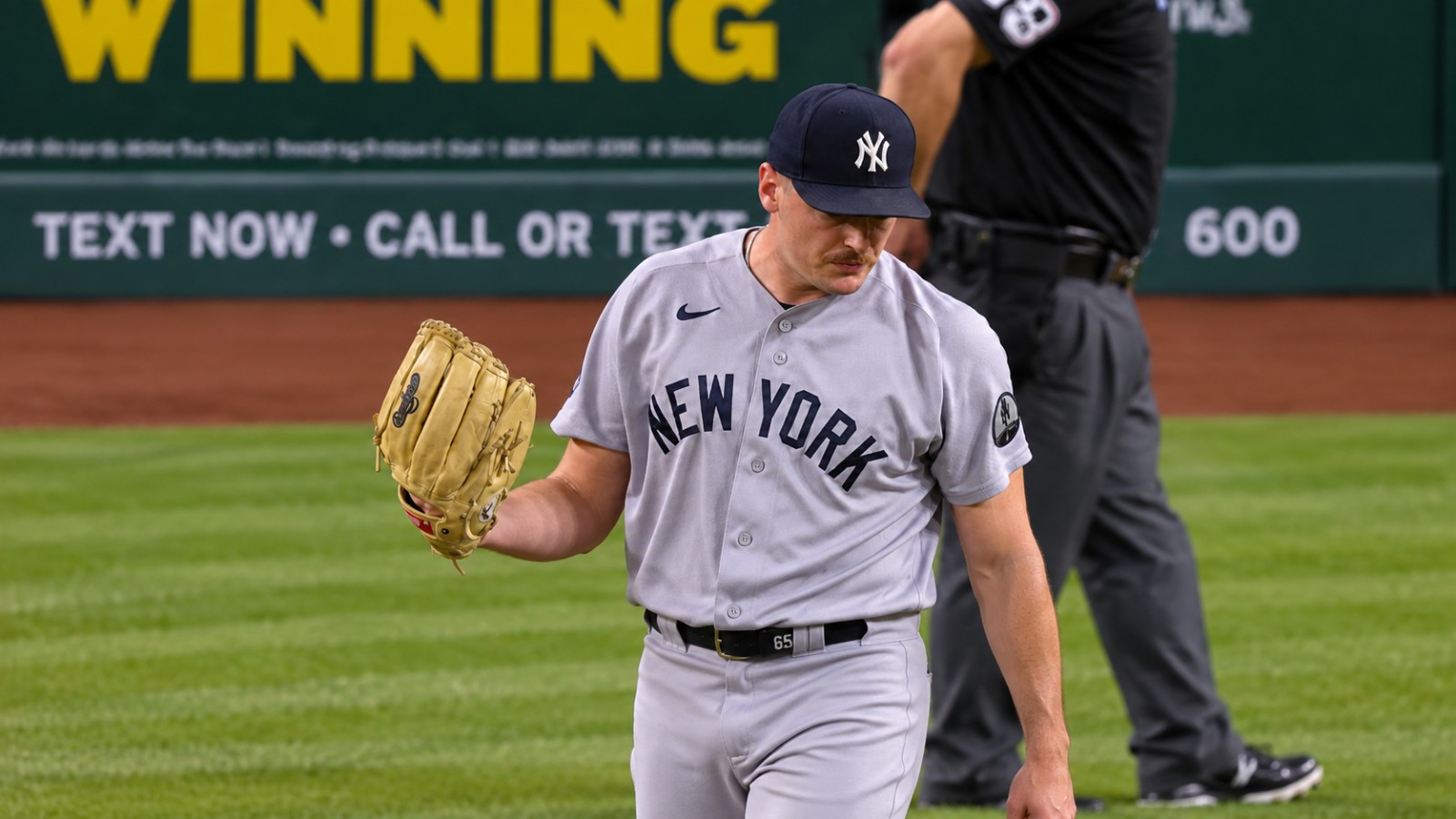
Headrick entered with the bases full. He struck out Geraldo Perdomo for the second out, then walked Corbin Carroll to force home a run. Arenado pulled the next pitch foul down the left-field line. One pitch later, he stayed fair.
The four-run shot turned a 4-2 game into a 6-4 Arizona lead. Headrick took the loss, and no save was credited.
Number behind grand slam creates major Yankees concern
The larger issue surfaced after the game. Headrick’s fastball was noticeably lighter than it has been for most of his breakout season. The left-hander averaged 92.9 mph with the pitch Sunday, according to a post by Yankees beat writer Brendan Kuty. Baseball Savant lists Headrick’s 2026 four-seam average at 94.2 mph.
That 1.3 mph gap does not establish an injury, and Headrick has not been reported as hurt. But it arrives at the end of a workload unlike anything he has handled as a major league reliever. Headrick has appeared in 79 games and thrown 77 innings. MLB lists him at 7-4 with a 2.10 ERA, 96 strikeouts, 25 walks and a 1.18 WHIP.
Kuty’s post put the velocity change into a simple frame after Headrick’s most damaging outing of the season.
“Headrick’s average fastball velocity tonight in Arizona against the Diamondbacks was 92.9 mph,” Kuty wrote.
Headrick worked on consecutive days in Arizona, throwing two-thirds of an inning Saturday and again Sunday. He has struck out 10 over 8 1/3 innings in September through Sunday.
Headrick approaching territory few Yankees have reached
The frequency is what separates this season from a normal relief workload. Headrick has pitched in 79 of the Yankees’ 155 games, just over half of the schedule. MLB reported Sunday that only one major league pitcher has appeared more often this season.
The team history gives that number more weight. Paul Quantrill set the Yankees franchise record with 86 appearances in 2004. Scott Proctor worked 83 games in 2006. Headrick’s 79 already match Mike Stanton’s 2002 total and Tom Gordon’s 2005 total. With seven games left, he is already in one of the heaviest bullpen seasons the franchise has seen.
The change from 2025 is substantial. MLB records show Headrick threw 23 innings for the Yankees and 24 at Triple-A last season. His 77 major league innings this year already exceed that combined total by 30 innings.
A late-season dip matters as Yankees need best October version
Headrick’s full-season numbers still make him one of the strongest pieces in the Yankees bullpen. He has allowed only five home runs to 318 batters faced. He has held right-handed hitters to a .205 average, according to current MLB split data, helping him avoid a matchup-only role.
The recent line is less dominant. Over his last seven appearances, Headrick has a 4.76 ERA in 5 2/3 innings. That is a small sample, but the timing matters because Boone will need reliable bullpen options behind the postseason rotation.
The Yankees built Headrick for heavier use over the winter. Pitching coach Matt Blake had identified recovery as the main challenge months ago, when Headrick was already among MLB’s most-used relievers. The current question is whether the Yankees can reduce his exposure during the final week without losing the sharpness that made him indispensable.
Yankees now have rest decision hidden inside AL East race
For the Yankees, the defeat pushed the AL East math close to its limit. New York is 89-66 and six games behind Tampa Bay with seven games remaining. The Yankees have already clinched a postseason berth, but they now open a four-game home series against the Rays with little margin left in the division race.
Sunday also closed a 47-34 road schedule, one of the strongest away records in baseball.
New York finishes with three games against Baltimore after Tampa Bay. With no more travel after Arizona and October already secured, the final week doubles as a chance to decide which arms are ready for the postseason. That makes the condition of the pitching staff nearly as important as the standings themselves.
The Rays series complicates that choice. As long as the division remains mathematically open, the Yankees have reason to use their best available relievers in close games. If Tampa Bay clinches, the calculation changes quickly. Protecting Headrick’s arm and restoring his normal fastball could become more valuable than another high-leverage inning in the standings.
Sunday’s grand slam will remain the visible mistake because it decided the game. The quieter development is the one the Yankees have to monitor now. Headrick has carried a major share of the bullpen for six months, and his fastball arrived in Arizona at its weakest point when October is almost here.
What do you think? Leave your comment below.