NEW YORK — The Yankees reached October with one of baseball’s most effective bullpens. They still enter another winter facing a difficult question: how much of that success can they realistically bring back?
The pitching staff helped New York survive a season that repeatedly tested its depth. Late-inning arms shouldered heavy workloads, and the club depended on steady relief work even as injuries and offensive inconsistency shaped its schedule. The Yankees nevertheless exited against Tampa Bay in the American League Division Series, leaving another championship pursuit unfinished.
The numbers suggest the answer is not to tear apart the relief corps. The Yankees finished the regular season with a 3.13 bullpen ERA, the second-best mark in the majors, according to the New York Post. Their relievers also recorded a 0.57 postseason ERA. Yet the free-agent calendar and an unusually demanding workload mean New York cannot simply assume the same group will be available or equally effective in 2027.
Closer David Bednar is approaching free agency after converting 35 of 39 save opportunities in 2026. He logged a career-high 69 1/3 innings with a 2.47 ERA, and his return is not guaranteed. Left-hander Brent Headrick appeared in 81 games, the most in MLB, according to an October assessment published by Yankees On SI. Those figures establish two separate needs: retain reliable ninth-inning production and find ways to distribute innings before the final three outs.
A two-time champion enters Yankees bullpen conversation
One possible addition is Alex Vesia, the Los Angeles Dodgers left-hander and two-time World Series champion who is eligible for free agency after the season. Recent assessments have identified him as a potential fit for the Yankees. There is no verified report of negotiations, an offer or a formal pursuit by New York.
Vesia, 30, won championships with the Dodgers in 2024 and 2025. He appeared in 72 regular-season games this year and finished 3-1 with a 2.64 ERA, 74 strikeouts and a 1.07 WHIP in 58 innings, according to MLB statistics. Those 74 strikeouts work out to 11.48 per nine innings, a useful indicator of how often he can finish plate appearances without requiring a ball in play.
The Yankees would not be shopping only for a familiar name with championship credentials. They would be examining a reliever who has maintained a high strikeout rate while working frequently and carrying assignments into October. Those traits could matter as manager Aaron Boone weighs matchups and rest days across a full season.
Postseason record strengthens Vesia’s case
Vesia’s latest postseason offers another piece of evidence. MLB’s player records through Oct. 16 show five appearances, 3 1/3 scoreless innings, four strikeouts and a 0.90 WHIP. Across 31 career postseason games, he owns a 1.59 ERA with 27 strikeouts in 22 2/3 innings.
Those totals translate to 10.72 strikeouts per nine postseason innings. Taken together with his regular-season results, they provide a more meaningful picture than the two championship rings alone. They also show how a left-handed option could contribute without serving as a full-time closer.
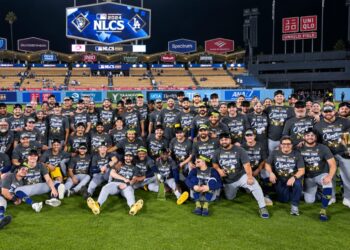
His final October work with Los Angeles matters because the Dodgers were eliminated by Milwaukee in the National League Championship Series on Oct. 15. Vesia can therefore be evaluated on a completed 2026 season rather than on an unfinished postseason run.
Hidden workload question behind a possible signing
The Yankees’ closer debate may command the largest headlines, but the relief workload offers a less obvious way to measure any addition. Vesia made 72 appearances in 58 innings, an average of 0.81 innings per appearance. Brent Headrick’s 81 outings illustrate the frequency with which New York asked its existing group to respond.
That comparison does not establish Vesia as an automatic replacement for any current Yankee. It points instead to a complementary role. Adding a second experienced left-hander could give Boone another choice against difficult stretches of a lineup while reducing the pressure to use the same arm in successive high-leverage situations.
The Yankees would still need to assess Vesia’s walks, platoon performance and ability to handle inherited runners. His 2.64 ERA and postseason resume are substantial credentials, not a guarantee that every matchup in the AL East would suit him.
Bednar decision leaves Yankees with two separate priorities
Bednar’s market remains the larger unresolved bullpen issue. Re-signing him could protect the ninth inning, while adding a pitcher such as Vesia would strengthen the bridge to it. Signing a setup option without settling the closer role would leave the most important late-inning assignment undecided.
There is also no confirmed contract projection establishing Vesia as a bargain. He reaches the open market after another strong season, and the Yankees must balance relief spending with other roster needs.
For now, Vesia is a credible free-agent possibility, not an announced Yankees target. His performance and championship experience make the fit worth examining, but New York has not publicly signaled that it will pursue him.
What do you think? Leave your comment below.