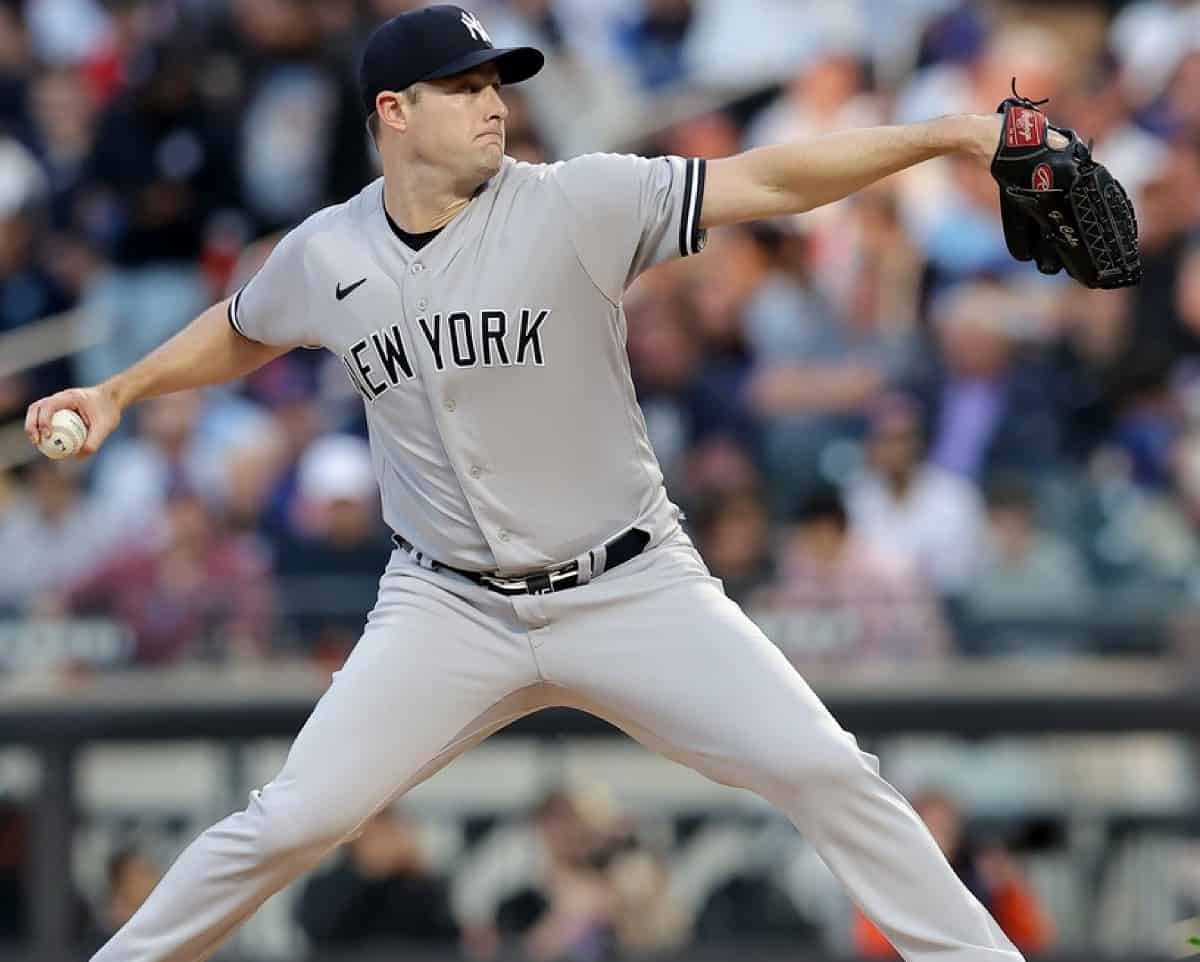
NEW YORK — Domingo German’s Yankees career has long been defined by extremes. He reached a place only three other Yankees pitchers had reached when he threw a perfect game in Oakland in June 2023. Yet his seven-season major league run also included repeated interruptions, an abrupt end to his final Yankees season and a short stay with the Pittsburgh Pirates in 2024. The baseball record is familiar to New York fans. A separate financial trail tied directly to his Yankees compensation is far less visible.
The right-hander earned his way from a fringe roster arm into a regular part of the Yankees pitching staff. MLB records credit him with 119 career appearances, 91 starts, a 31-29 record, a 4.54 ERA and 561 strikeouts over 543 innings. His last major league work came with Pittsburgh in 2024, when he posted a 7.84 ERA across seven appearances. None of those numbers explains why his Yankees paychecks later became important in a Bronx courtroom.
The issue reaches back to a type of financing built around future professional sports income. Unlike a conventional loan, the arrangement described in court papers was designed around a player’s projected earnings and team pay schedule. Payments were supposed to move through a controlled account. If the player earned less than expected while remaining compliant with the agreement, the lender’s recourse was limited to professional sports compensation.
That structure makes the timeline more important than a single headline number. German was still building his Yankees career when the first money changed hands. He later became a rotation regular, served a lengthy suspension, returned to New York, threw a perfect game and eventually left the Yankees. Court records reviewed by PinstripesNation show that the lender says the payment mechanism broke down before that final Yankees season, creating a dispute that eventually moved into New York Supreme Court in the Bronx.
Court records put Yankees earnings at center of dispute
Rockfence Baseball LLC sued German in Bronx Supreme Court, alleging breach of a loan agreement and seeking to collect a claimed $6,088,974.12. The figure is an allegation by the plaintiff. It is not a judgment against German, and the court has not ruled that he owes that amount.
According to the March 14, 2025, decision, RockFence Capital Markets LLC loaned German $2.25 million on July 13, 2018. An amended agreement on Aug. 2, 2019, added another $1.045 million, bringing the advances described by the court to $3.295 million.
The filing says German repaid $964,181.46 from July 2018 through Oct. 14, 2022, while he played for the Yankees. Rockfence alleged that he defaulted on Oct. 14, 2022, by failing to have his compensation deposited into the required blocked account. The plaintiff said it accelerated the loan on Sept. 22, 2023, and later claimed the $6.09 million balance.
Judge stopped Rockfence’s fast-track bid
Rockfence tried to obtain summary judgment in lieu of a complaint, a procedure that can permit a money claim based on an qualifying instrument to move quickly. The company also sought permission to serve German by email and mail after telling the court that he had gone to the Dominican Republic.
Justice Fidel E. Gomez rejected the request for alternate service on March 5, 2025. The judge said the plaintiff had not shown that ordinary service methods were impracticable, noting that the record did not establish attempts to serve German at a Florida address identified in the papers.
The court summarized the problem in a direct sentence that undercut the plaintiff’s request for special service.
“Plaintiff has not demonstrated that the statutory methods for service of process have proven ineffective.”
Nine days later, Gomez also denied Rockfence’s unopposed summary-judgment motion because proper service had not been established. The decision said the court therefore lacked personal jurisdiction over German for that application. It also noted that the court could not dismiss the action on its own on that basis, leaving the case in a non-final posture in the published ruling.
The numbers show how sharply the claim grew
The court figures create a notable Yankees-specific comparison. The two advances total $3.295 million. The $964,181.46 in repayments described in the decision equal about 29.3% of that original principal. Rockfence’s claimed $6.09 million balance is about $2.79 million more than the combined advances and roughly 1.85 times the amount originally loaned.
Those calculations do not establish what German legally owes. The underlying loan agreement, repayment schedule and per diem interest table were among documents the court addressed in sealing proceedings, and the published decision does not provide a final merits ruling on the debt calculation. The gap therefore should not be treated as a simple interest computation.
For Yankees fans, the unusual connection is that the contract was built around the same compensation German was earning while pitching in New York. The March 5 decision even noted, for purposes of that motion, that the agreement involved in part his employment by the Yankees when discussing a possible New York jurisdictional basis.
German’s Yankees tenure ended after the 2023 season. MLB transaction records show Pittsburgh designated him for assignment on Sept. 5, 2024, after his final major league appearance one day earlier. The published Bronx rulings do not show Rockfence winning a money judgment. What they do show is a multimillion-dollar claim, a failed attempt at alternate service and a financial dispute whose paper trail runs directly through German’s Yankees earnings.
What do you think? Leave your comment below.