NEW YORK — The Yankees recalled Bradley Hanner from Triple-A Scranton/Wilkes-Barre on Tuesday, giving the 27-year-old his first major league opportunity. He replaced Kervin Castro, who went on the 15-day injured list with right elbow neuritis in a move retroactive to Aug. 10.
The right-hander did not arrive with a top-prospect label, a first-round pedigree or a fastball built for radar-gun headlines. His Yankees path has included three organizations, minor league free agency and imperfect control. Yet hitters have continued to swing through his pitches often enough for the strikeouts to pile up.
The profile stands out at a time when clubs routinely stock bullpens with velocity first and ask questions later. New York instead has a pitcher whose results have been driven by shape, movement and a breaking ball that misses bats.
Hanner’s strikeout rate comes without premium velocity
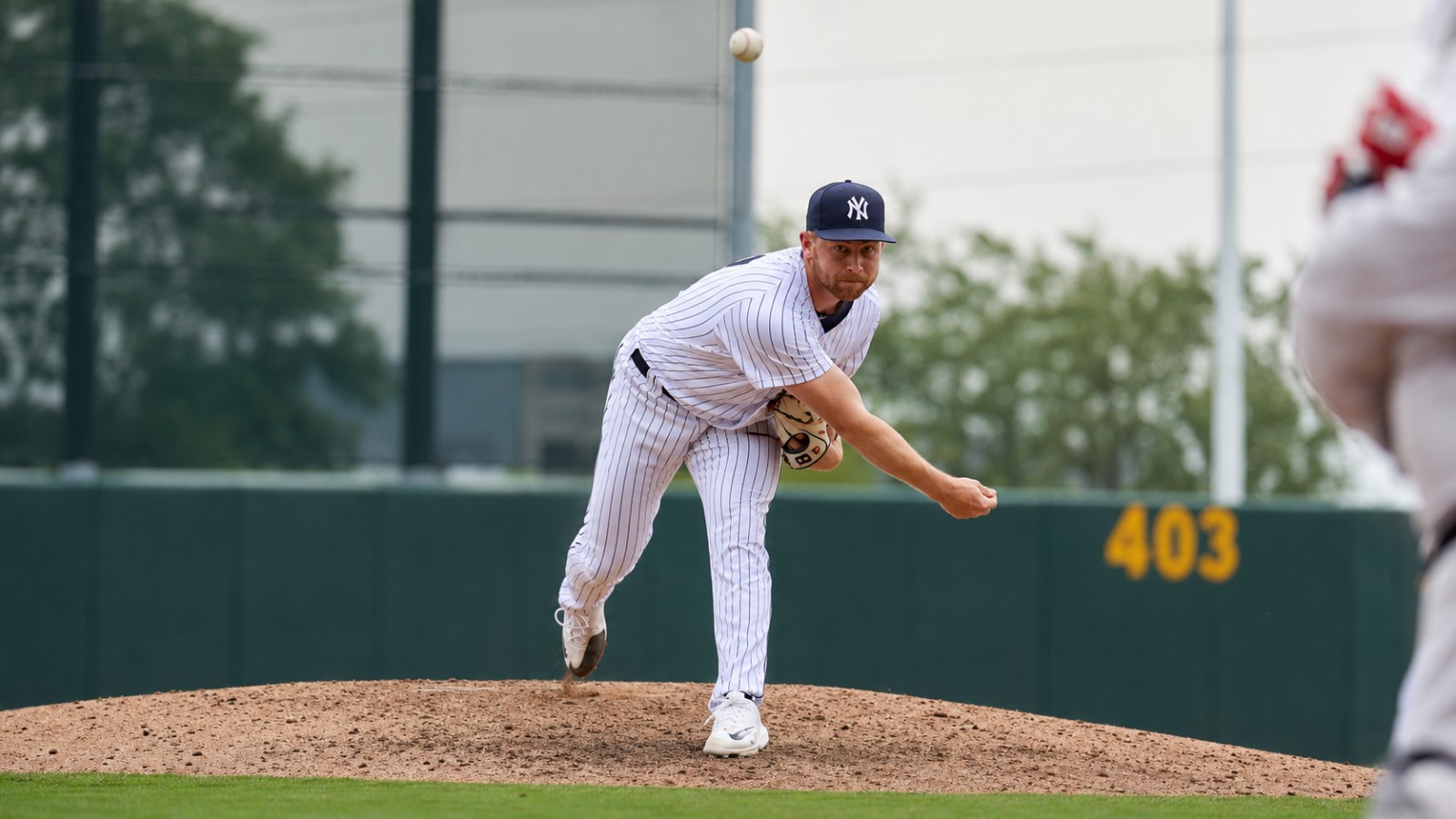
Bradley Hanner reached the Yankees after posting a 2.10 ERA across 51 1/3 innings in 40 Triple-A relief appearances. He went 6-2 with four saves, 61 strikeouts and 24 walks. His strikeout rate sat at roughly 29%, notable for a pitcher whose four-seam fastball averages about 93.4 mph rather than the upper-90s velocity common among power relievers.
Hanner does not depend on one pitch or one speed band. His mix includes a four-seam fastball, sinker, cutter and sweeper. The sweeper has generated significant swing-and-miss and gives the Yankees a breaking-ball weapon that can help the rest of the arsenal play above its raw velocity.
The control is the obvious pressure point. Hanner walked 11.4% of the Triple-A hitters he faced, consistent with a history of below-average command. Against MLB lineups, the Yankees will learn quickly whether his movement can keep producing chase against more selective hitters.
A roster decision in July set up the call
The promotion was not the Yankees’ first major roster decision involving Hanner. He triggered an opt-out in his minor league contract in July, forcing New York to add him to the 40-man roster or allow him to pursue another opportunity. The Yankees selected his contract July 18 and immediately optioned him back to Scranton/Wilkes-Barre.
The Yankees’ official transaction record lists that July 18 selection and option, followed by Tuesday’s recall. The club signed Hanner to a minor league deal in December after he became a free agent from Cleveland’s organization.
ESPN’s Jeff Passan reported the promotion before the Yankees announced it. His report underscored how far Hanner had traveled from late-round pick to a potential major league debut.
“The New York Yankees are calling up right-handed reliever Bradley Hanner, sources tell ESPN,” Passan reported Tuesday. “Hanner, 27, has a 2.10 ERA with 61 strikeouts in 51.1 innings at Triple-A. A 21st-round pick in 2019, Hanner will make his major league debut when Aaron Boone calls his number.”
A long route from the 21st round to the Yankees
Minnesota selected Hanner in the 21st round of the 2019 draft. He never advanced beyond High-A in the Twins system before Cleveland took him in the minor league phase of the 2022 Rule 5 draft. He later posted a 4.74 ERA at Triple-A in 2025 before reaching minor league free agency.
The Yankees saw enough to bet on a rebound. By July 18, Hanner had a 1.99 ERA with 50 strikeouts in 40 2/3 innings. He had also worked in multi-inning bursts, giving New York another potential source of length rather than a one-batter matchup specialist.
Hanner carried a 1.156 WHIP when the Yankees protected him in July. His performance held after the roster move, and he pushed his strikeout total to 61 before the Yankees called him to the majors.
Why Hanner is different from the usual bullpen lottery ticket
For the Yankees, Hanner’s appeal is tied to how different the package looks. Hanner has produced Triple-A strikeouts through movement, pitch shapes and sequencing rather than relying on 99 mph.
That does not guarantee the formula will survive against major league hitters. It gives Boone another profile to test. Hanner is in his first minor league option year, so the Yankees can send him back to Scranton/Wilkes-Barre without exposing him to waivers.
Castro had a 1.42 ERA and eight strikeouts over 6 1/3 innings in five appearances for the Yankees before the elbow issue interrupted his run. Hanner now occupies that bullpen spot while Castro recovers, making the call-up a practical response to an injury as well as a reward for Hanner’s Triple-A season.
Hanner has already forced his way onto the 40-man roster and then the active roster. The remaining test is the one minor league numbers cannot answer: whether a 93.4 mph fastball, a swing-and-miss sweeper and an unconventional path can keep missing bats in the majors when Boone finally calls No. 93.
What do you think? Leave your comment below.