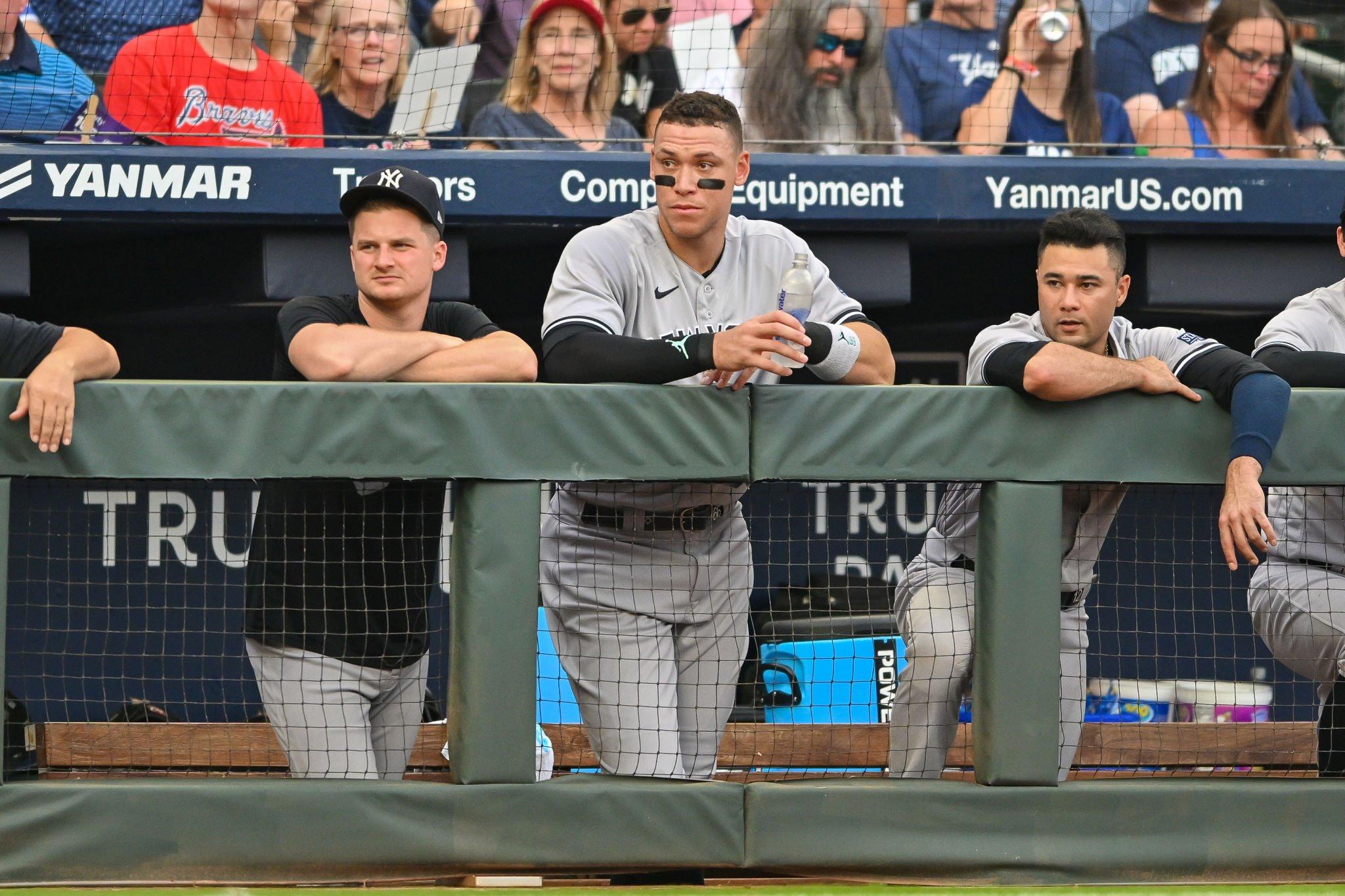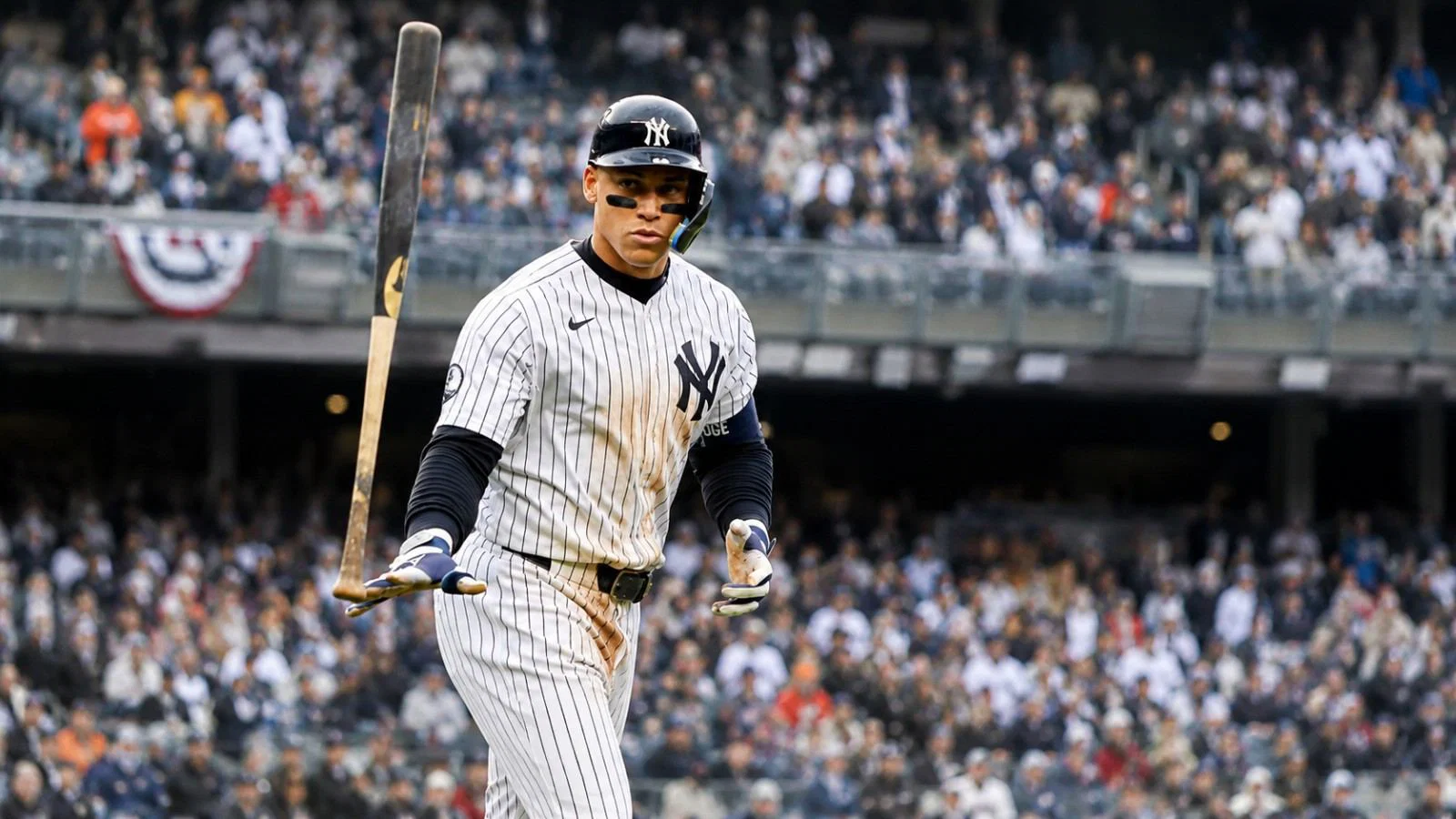
NEW YORK — Aaron Judge is preparing for his first major league at-bats in more than three months with a place among Yankees history’s most imposing sluggers already secure. The question now is whether his return can help New York finish a difficult summer with the offense it needs for October.
The Yankees captain has 385 career home runs, including 17 this season. He remains behind Babe Ruth, Mickey Mantle and Lou Gehrig on the franchise’s career home-run leaderboard, but his production has arrived at a frequency few hitters in baseball history have matched.
That distinction matters when comparing players from different eras. Career totals reward longevity. A power-hitting evaluation can also consider how often a player homers, the heights of his best seasons and how dramatically he stood out against his contemporaries. Those measurements do not necessarily produce the same order as an all-around greatness list.
The contrast is particularly relevant for Judge, whose career includes four seasons of at least 50 home runs but no World Series championship. His latest recognition arrives as the Yankees welcome their most important bat back into a postseason race that has tightened during his absence.
Judge places behind only Ruth
Bleacher Report writer Joel Reuter ranked Judge second among the 10 greatest power hitters in Yankees history in a list published Sept. 2. Ruth took the top spot, followed by Judge, Mickey Mantle and Gehrig. Alex Rodriguez completed the top five.
The ranking is a writer’s assessment, not an official Yankees award or a vote conducted by the organization. It places Judge ahead of several franchise legends specifically for power production, rather than declaring him a greater overall player.
Reuter considered home-run totals, at-bats per homer, the number of 30- and 40-homer seasons and a hitter’s standing within his era. His list also includes Joe DiMaggio, Jason Giambi, Roger Maris, Reggie Jackson and Giancarlo Stanton.
The complete Yankees top 10
Joel Reuter’s Sept. 2 ranking, with the original Yankees-only statistics.
| Rank | Hitter | NYY HR | AB/HR | HR high | 30+ | 40+ | 50+ |
| 1 | Babe Ruth | 659 | 11.0 | 60 | 13 | 11 | 4 |
| 2 | Aaron Judge | 385 | 11.2 | 62 | 6 | 4 | 4 |
| 3 | Mickey Mantle | 536 | 15.1 | 54 | 9 | 4 | 2 |
| 4 | Lou Gehrig | 493 | 16.2 | 49 | 10 | 5 | 0 |
| 5 | Alex Rodriguez | 351 | 15.9 | 54 | 8 | 2 | 1 |
| 6 | Joe DiMaggio | 361 | 18.9 | 46 | 7 | 1 | 0 |
| 7 | Jason Giambi | 209 | 14.0 | 41 | 5 | 2 | 0 |
| 8 | Roger Maris | 203 | 14.8 | 61 | 3 | 1 | 1 |
| 9 | Reggie Jackson | 144 | 16.3 | 41 | 2 | 1 | 0 |
| 10 | Giancarlo Stanton | 189 | 14.7 | 38 | 3 | 0 | 0 |
HR high: most home runs in one Yankees season. AB/HR: at-bats per home run. 30+, 40+ and 50+: seasons reaching each threshold. Source: Bleacher Report
The table preserves the figures in the published ranking. They are Yankees-only regular-season totals, with the active players’ figures reflecting the article’s September snapshot. The season-count columns show how many times each hitter reached the stated threshold.
Why Judge moves ahead of Mantle and Gehrig
The clearest separation is home-run frequency. Judge’s 11.2 at-bats per homer is almost identical to Ruth’s 11.0. Mantle needed 15.1 at-bats per homer, while Gehrig averaged 16.2. Judge has also produced the highest single-season total of the group, hitting 62 in 2022.
Reuter acknowledged that the comparison is narrower than an overall career ranking. His explanation centered on the difference between complete careers and pure power production.
“Mickey Mantle, Lou Gehrig and several other players behind him on this list have had more complete careers than Aaron Judge,” Reuter wrote.
Mantle hit 536 home runs, won three AL MVP awards and captured the 1956 Triple Crown. Gehrig hit 493 homers and averaged 39 per season from 1927 through 1937. Those achievements provide a strong argument for their greater career standing, even if Judge’s rate and peak power support his placement here.
Judge also matched Ruth’s four 50-homer seasons in 2025. His four such years are 2017, 2022, 2024 and 2025, with totals of 52, 62, 58 and 53. Ruth reached 50 in 1920, 1921, 1927 and 1928.
The historical ranking meets an immediate Yankees need
The recognition comes at a consequential moment. The Yankees reinstated Judge from the 60-day injured list Monday night after a right rib stress fracture kept him out of 84 games. He is expected to return Tuesday against the Colorado Rockies at Yankee Stadium without a minor league rehab assignment.
New York enters the game 81-62, four games behind Tampa Bay in the AL East and two games ahead of Boston for the top American League wild-card spot. The Yankees went 45-39 without Judge, leaning heavily on their pitching staff while the lineup struggled to maintain consistent production.
Judge was batting .248 with a .375 on-base percentage, a .533 slugging percentage, 17 homers and 38 RBIs when he went on the injured list. His return gives Aaron Boone a right-handed middle-of-the-order hitter capable of changing opposing pitchers’ approach to the rest of the lineup.
The Yankees may initially limit Judge’s workload as he rebuilds game stamina. He faced live pitching Monday, but the organization must balance the immediate need for offense against the importance of having him healthy for the postseason.
The next milestone is 400 career home runs, which Judge would reach with 15 more. For now, the Yankees have a more immediate test: how quickly their captain can translate his historically productive power into runs during the final 19 games of the regular season.
What do you think? Leave your comment below.