NEW YORK — Look at Trent Grisham’s batting average and the instinct is to worry. Look at everything else and the picture changes completely.
The Yankees outfielder is hitting .178 through the first six weeks of the 2026 season. That number jumps off the page. It is the kind of average that gets a player benched, optioned or quietly shopped around. Yankees fans have noticed. Some have already written him off.
The metrics disagree. Sharply.
Dig one layer deeper and Grisham does not look like a struggling Yankees hitter at all. He looks like a very good hitter who has been running into walls. The baseball has simply not been falling for him. The gap between what he is producing and what he should be producing by now is among the largest in the sport.
Surface numbers that do not tell the full story
Through his first 121 at-bats of the 2026 season, Grisham is slashing .178/.308/.372 per ESPN. He has six home runs and 26 RBIs for the Yankees. The batting average is alarming. The power and the walk rate are not.
Grisham accepted the Yankees qualifying offer after a career year in 2025. That season he smashed 34 home runs, drove in runs at a career-best clip and posted 3.4 Baseball Reference WAR. The nickname The Big Sleep, earned for his calm demeanor and habit of delivering in big moments, felt fully earned by the end of that year.
The 2026 Yankees version looks like a different player on the surface. It is not. The tools are the same. The contact quality is the same. The results have just refused to cooperate.
What Baseball Savant actually says about Grisham
The advanced metrics paint a picture that looks nothing like the Yankees box score. Baseball Savant has Grisham with a .346 expected weighted on-base average against a .297 actual wOBA. That 49-point gap between expected and actual production is not a rounding error. It is the fingerprint of an unlucky hitter.
His hard-hit rate sits at 50.9 percent. His barrel rate is 14.2 percent. Both numbers rank among the better marks in the league. His squared-up percentage sits at the 100th percentile. He is making elite contact at an elite rate and coming away empty far more often than the math says he should.
The number that tells the real story is his batting average on balls in play. His BABIP sits at .181. The MLB average hovers around .300. That 119-point shortfall means the Yankees outfielder is getting out on balls that most hitters turn into hits. The balls are leaving his bat hard. They are finding gloves.
He also carries a career-high walk rate and a career-low strikeout rate in 2026. He is making more contact, drawing more walks and swinging at fewer bad pitches than at any point in his Yankees career. The plate discipline metrics are trending in exactly the right direction. The batting average is not moving with them.
Twenty-two outs on balls over 100 mph
Here is the number that stands out most. Grisham has 22 outs on batted balls exceeding 100 miles per hour in 2026. That total leads all of MLB by a significant margin.
To put that in context: a ball hit at 100 mph or harder typically converts to a hit at a high rate across the sport. Grisham is finding the exception to that rule on a near-daily basis. Catches at the warning track. Hard-hit balls directly at fielders. Line drives into shifts. The distribution of his batted ball outcomes has been brutal and statistically unlikely.
His xOPS sits at .821. His actual OPS is .680. That gap does not reflect poor hitting. It reflects poor fortune. The Yankees know the difference. The Yankees front office and coaching staff have not lost confidence in the 29-year-old, and his projected numbers provide the clearest reason why.
Based on his current contact quality and expected production, Grisham is on pace for 23 home runs and 98 RBIs by the end of the season. Those are productive numbers for any Yankees outfielder in baseball.
Grisham thrives when the game is on the line
Strip away the overall average and look at where Grisham has actually done his damage for the Yankees in 2026. The split numbers in high-leverage situations tell the story the regular stat line has been hiding.
In 30 plate appearances with runners in scoring position this season, Grisham is slashing .280/.333/.760 with an OPS of 1.098 for the Yankees. He has four home runs and 23 RBIs in those situations.
In 12 high-leverage plate appearances, his numbers jump further. He is hitting .364/.417/1.000 with two home runs and 10 RBIs. Those are numbers that belong to a cleanup hitter at peak production, not a player being questioned for his place in the lineup.
The nickname fits the Yankees outfielder perfectly. The Big Sleep goes quiet when it does not matter. When it does matter, he wakes up.
Camden Yards home run makes the case in real time
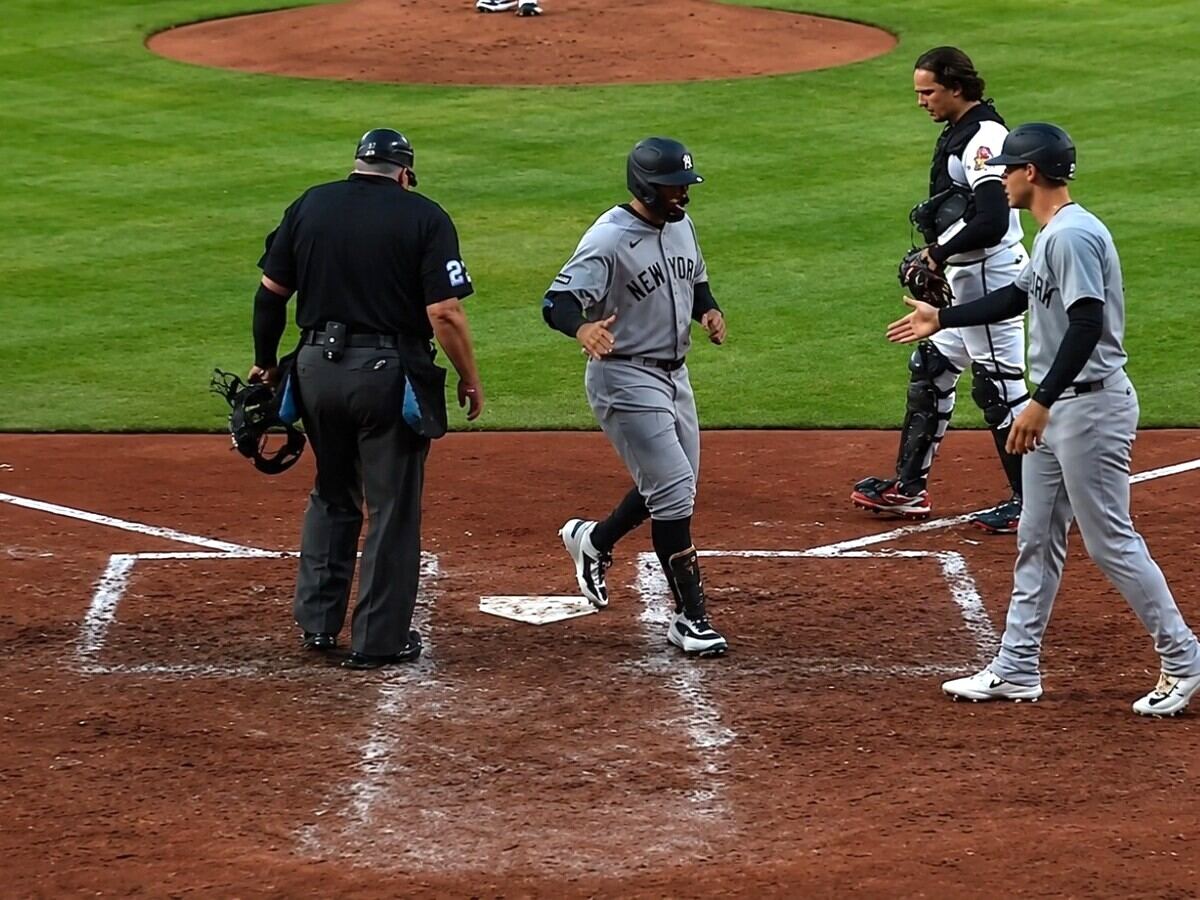
Tuesday night’s Yankees 6-2 win in Baltimore offered the clearest live evidence of what Grisham actually delivers when his luck levels out. With the Yankees already leading in the third inning, Grisham stepped up against Trevor Rogers with the bases loaded.
He turned on a fastball and drove it 397 feet to center field. Exit velocity of 103.5 mph. Launch angle of 22 degrees. Three-run home run. The Yankees lead grew to 6-0 and Camden Yards fell silent.
It was Grisham’s sixth home run of the year and his second off a left-handed pitcher. It was also a reminder that the contact quality showing up in his Savant page is real. He is not running hot in the Yankees metrics and cold in real life. He is producing exactly the kind of contact that should yield far more than a .178 average.
The Yankees have a hitter making contact as hard as anyone in their lineup. The results have not matched the quality yet. The advanced numbers say they will. Tuesday in Baltimore offered a preview of what it looks like when the ball finally stops finding gloves.
What do you think? Leave your comment below.