BALTIMORE — The Camden Yards scoreboard told a familiar story heading into Tuesday night. The Yankees had scored eight runs combined across four straight losses. A Yankees offense had gone cold at the worst possible moment on the road.
Then Paul Goldschmidt stepped in for the Yankees against left-hander Trevor Rogers. First pitch. Gone.
From that single swing, everything changed. The Yankees erupted for six unanswered runs. Will Warren turned in another strong start. Baltimore’s four-game winning streak was over.
The final score was 6-2 at Camden Yards. The Yankees moved to 27-16. For one Tuesday night, they looked like the team that arrived on this road trip with real American League East ambitions.
Goldschmidt sets the table on pitch one
Goldschmidt has made a habit of this. For the second time on this road trip, he took a first-pitch fastball from a left-handed starter and put it in the seats. This time the target was Rogers. The destination was left field. The result was a 1-0 Yankees lead before Baltimore’s crowd could settle in.
The moment carried weight well beyond the one run on the board. The Yankees had been passive and punchless for four games. Goldschmidt’s immediate aggression sent a message to the Yankees dugout and the bullpen that the offense was back with something to say.
Goldschmidt was reflective after the game about the mindset required to move past a tough stretch. He pointed to the team’s competitive edge as the constant thread, even when results go sideways.
“We know this game has a lot of ups and downs, so I think the mindset is just show up every day prepared and work hard and enjoy this game,” Goldschmidt said. “It’s called a game for a reason. We know there’s tough losses. It doesn’t take away any of the hard work or competitiveness, which is at an all-time high for myself and this team.”
A five-run third that refused to die
The Yankees had endured enough over four losses to know one run would not be enough. The third inning answered that concern in a hurry.
Austin Wells, who had been struggling, laced a single to get things started. Aaron Judge followed with a walk. Ben Rice drew another. The bases were loaded. Rogers was in trouble.
Then came the play Boone later called the turning point. Cody Bellinger faced a potential double play. He busted down the line and beat the throw. The hustle scored a run. The Yankees led 2-0. The inning stayed alive.
Boone was direct about what Bellinger’s instincts meant in that moment. He described it as the kind of play that separates a big inning from a wasted opportunity.
“To have that big inning, it could have been right there and the game could have went either way,” Goldschmidt said. “I think it just shows the kind of player Belli is, the hustle there and how one pitch, one little play can break open a game, good for us, or the other way if it doesn’t happen.”
Amed Rosario kept the pressure on with an infield single, a hard chopper down the third-base line that gave the Yankees a 3-0 lead. The bases remained loaded.
Grisham delivers the knockout punch
Trent Grisham has spent a fair portion of the 2026 season hitting the ball hard and coming away with nothing to show for it. The metrics said his approach was sound. The results had not caught up.
Tuesday night, they caught up all at once.
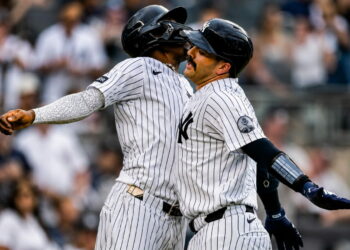
Grisham turned on a Rogers fastball and drove it to center field. Three-run home run. His sixth of the year. His second off a left-handed pitcher. The Yankees led 6-0. Camden Yards went quiet.
Boone credited the Yankees’ patience. They worked counts. They drew walks. They forced Rogers into trouble. That set the stage for Grisham’s decisive blow.
“I thought we had some good at-bats, we were patient with Rogers, made him work, couple good walks to set things up, Belli beating that out and then a big swing there by Grish,” Boone said.
Warren holds firm through defensive hiccups
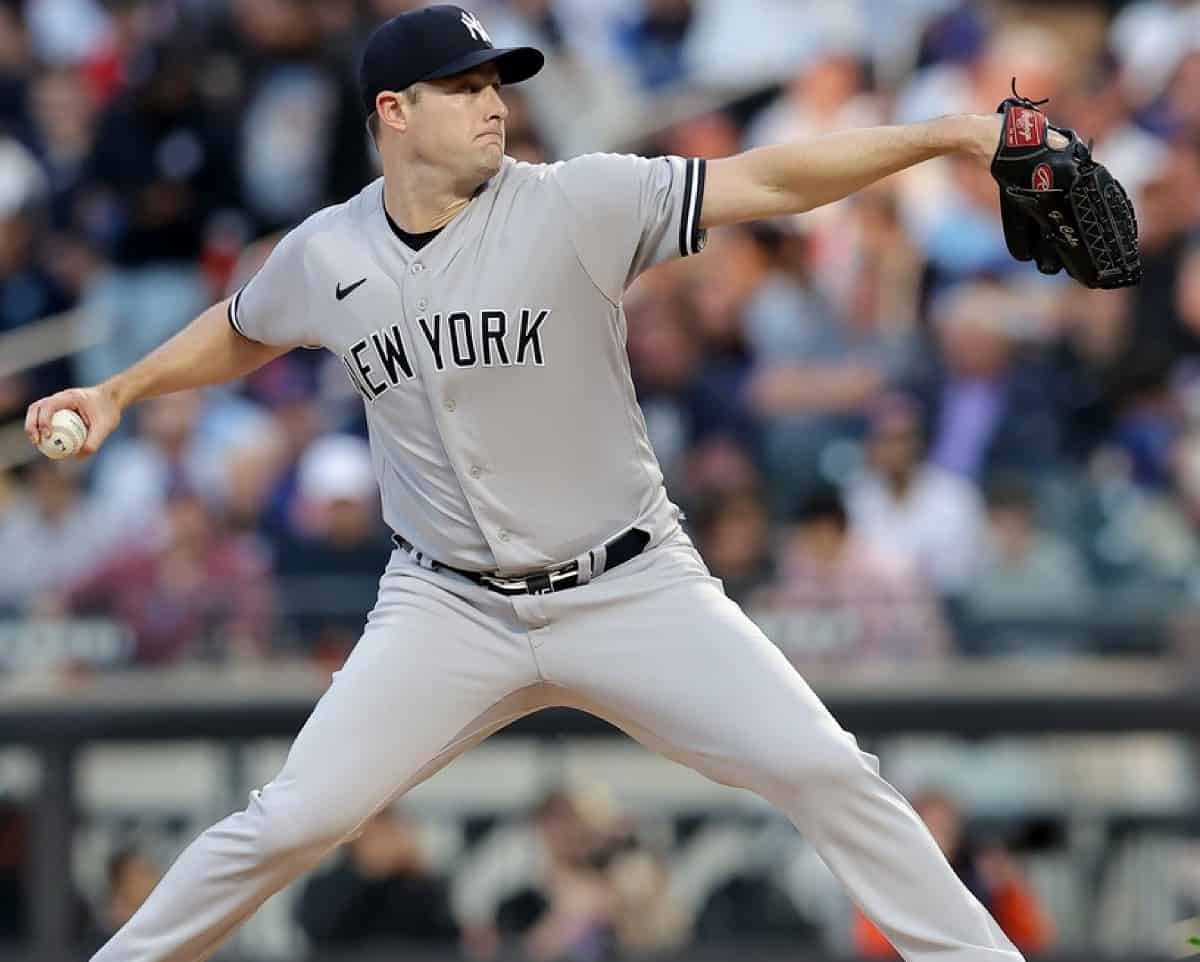
A night after Ryan Weathers made a strong case for rotation staying power, Warren matched that energy. He worked 5 2/3 innings. Four hits, one walk, six strikeouts. Two runs allowed, both in the sixth.
The runs he surrendered came in the sixth, long after the Yankees had built their cushion. By that point, 6-2 felt like a formality.
The road there was not smooth. In the bottom of the third, the Orioles loaded the bases without a hit. Shortstop Max Schuemann made a wild flip. Third baseman Ryan McMahon threw offline after a sliding play. Suddenly the Yankees had no outs and the bases full.
Will Warren did not blink. He induced a fly ball to right field that the Orioles could not test against Aaron Judge’s arm, then finished the inning with a ground ball double play.
Warren was candid about the mental side of pitching through miscues. He framed it as a shared accountability. Pitcher trusts fielders. Fielders make the plays. When they don’t, the pitcher finds a way out anyway.
“I think it’s a mentality thing,” Warren said. “I’m doing everything I can to throw strikes and stuff like that. You have to go in with the mindset that they’re going to make those plays. If they don’t, rarely, then you have to keep pitching and find a way out of it.”
Yankees rotation watch ahead of Cole’s return
The subtext behind Warren’s start is not subtle. Gerrit Cole is nearing a return from the injured list. The Yankees rotation will face hard decisions when he is ready.
Warren made that conversation harder to resolve. Two quality starts from Weathers and Warren on the same road trip send a clear message. The competition for that fifth rotation spot is real and unresolved.
The Yankees bullpen was equally sharp. After Warren exited in the sixth, New York’s relievers held Baltimore scoreless the rest of the way. The Yankees left Camden Yards with a split.
With the win, New York stopped a four-game skid. The AL East gap stayed intact. The offense woke up. The pitching held. For one night, the Yankees looked exactly like the team they entered May as. Whether that holds is a question for the next series. Tuesday, the Yankees had their answer.
What do you think? Leave your comment below.