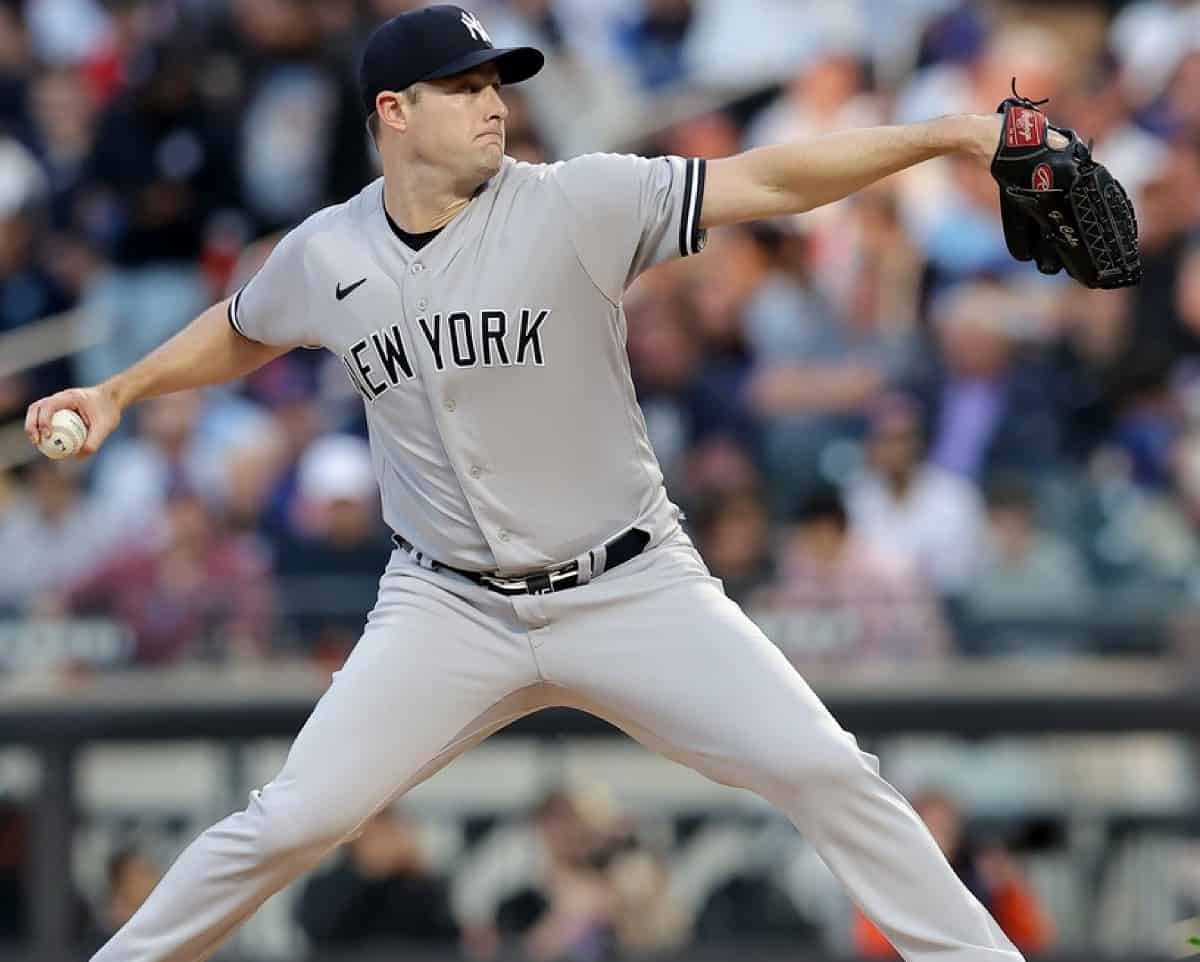
NEW YORK — The number that keeps coming up in conversations about Trent Grisham is .176. That is his batting average. It looks bad. It is not the full story.
The Yankees know it. The Yankees analytics staff knows it. And two doubles hit at 104.5 mph and 106.3 mph in the final game of the Baltimore series quietly made the case for everyone watching with the right tools.
Grisham is not slumping in any meaningful sense. He is hitting the ball hard and walking at an elite rate. The results are catching up. The only question is when.
The box score is misleading — the metrics are not
Grisham’s surface statistics through May 5 read as follows: .176 batting average, .311 on-base percentage, .380 slugging percentage and a .691 OPS with five home runs. Those numbers, viewed in isolation, would concern most front offices.
The Yankees’ front office is not looking at them in isolation.
Per Baseball Savant, Grisham ranks in the 91st percentile or better in whiff rate, chase rate, and squared-up contact percentage. His walk rate of 16.4% places him in the 92nd percentile league-wide. He is generating harder contact than 91% of hitters in baseball.
Those four metrics describe a Yankees hitter who is making excellent decisions, refusing to swing at bad pitches, and making quality contact when he does swing. The batting average does not reflect that player. It reflects a player whose well-struck balls have been finding gloves instead of grass.
This is what Baseball Savant’s expected statistics are designed to identify. Grisham’s expected batting average is significantly higher than his actual mark. The gap between process and outcome is real. It does not last.
Monday night’s doubles told the story
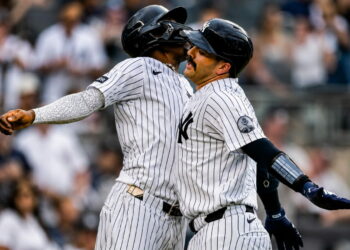
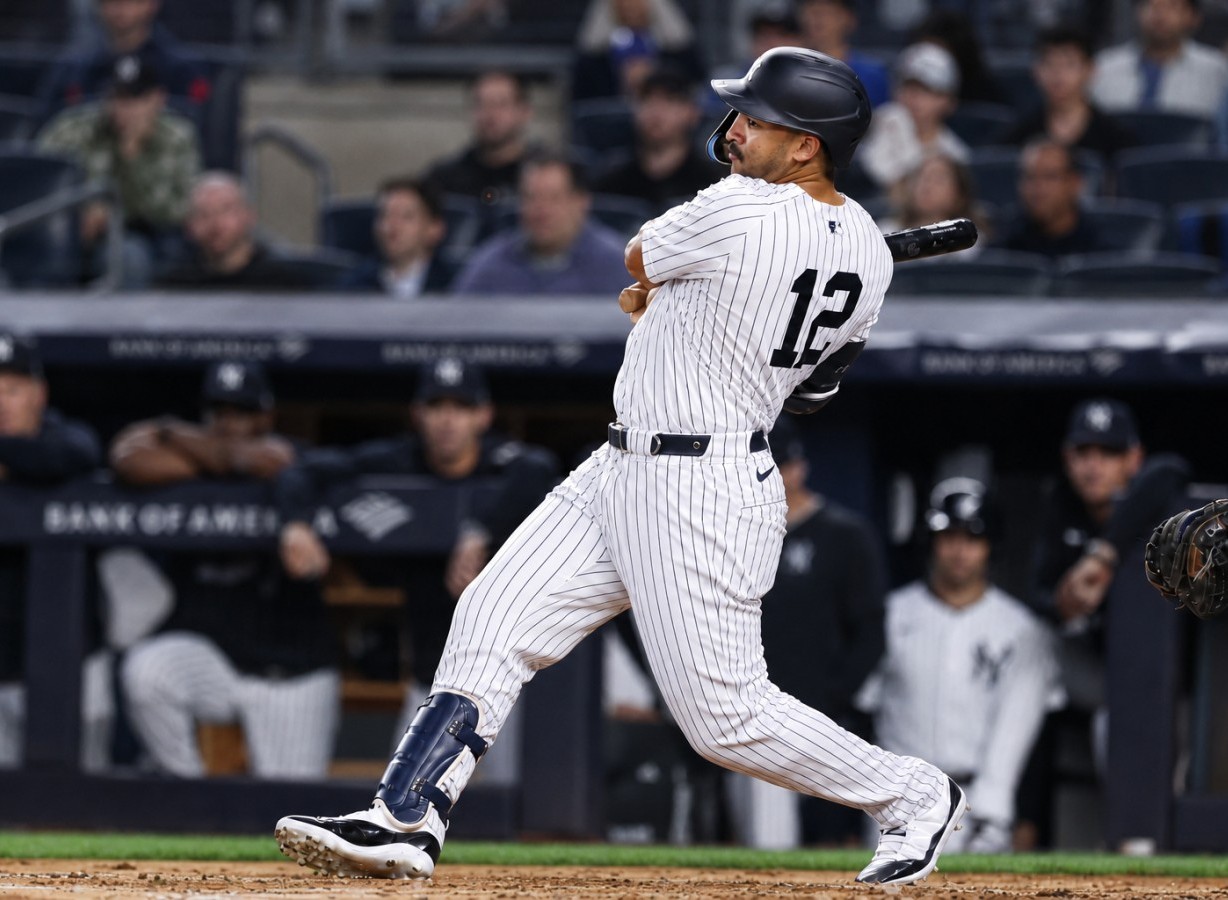
In the Yankees’ 12-1 win over the Orioles on Monday, Grisham hit two doubles. Both were ripped. The first left his bat at 104.5 mph. The second at 106.3 mph.
Those exit velocities place both hits in the category of what analysts call barreled contact. A hitter consistently producing that kind of force off the bat is not in a true slump. He is experiencing a results delay.
Grisham also contributed on defense for the Yankees that same night. He tracked a fly ball to the warning track off Adley Rutschman’s bat in the sixth inning and made the catch, banging into the wall. He sparked the first-inning rally by reaching on the first of his two doubles, setting the table for Aaron Judge’s two-run homer.
The Yankees won their 14th game in 16 tries. Grisham had a hand in it. Grisham was in the middle of it.
High-leverage numbers that reframe the conversation

The most striking data point in Grisham’s 2026 profile may be what he does when the game is on the line.
In high-leverage situations in 2026, Grisham is hitting .333 with a 1.400 OPS and a 273 wRC+. Two home runs and seven RBIs have come in those moments. A 273 wRC+ is not just good. It places him among the most productive hitters in baseball in pressure spots.
That number has context. In 2025, his high-leverage line was .308 with a 1.259 OPS and a 238 wRC+, with seven home runs and 27 RBIs in those situations. Grisham has been a reliable presence when games matter most for two consecutive seasons.
The Yankees signed him this past offseason knowing this. His value has never been entirely captured by batting average.
Why the Yankees remain committed
The Yankees’ organizational patience with Grisham is not blind. It is informed by the same metrics that analytics departments around baseball use to separate noise from signal. His walk rate and contact quality have remained elite throughout the early season. He has not chased more. He has not made worse contact. He has simply been unlucky.
He was acquired to be the Yankees’ leadoff option. A player who posts a .311 on-base percentage while hitting .176 is drawing nearly one walk per three strikeouts. That discipline is not easy to replace.
His defensive profile adds another layer. Grisham ranked in the top tier of center fielders by outs above average in 2025. Early in 2026, his reads and routes have been consistent with that track record.
The Grisham the numbers promise
The version of Grisham that the metrics project is a leadoff hitter capable of a .260 to .280 batting average with 15 to 18 home runs, a walk rate near 15% and above-average center field defense. That player has not appeared in the box score yet in 2026. He has appeared in virtually every underlying data point.
The Yankees swept four straight from the Orioles. The pitching was dominant. The offense produced runs from multiple sources. And Grisham, for all the surface-level noise around his average, hit two balls at better than 104 mph and scored twice in the final game.
The bat is loaded. The breakout has been announced by the numbers for weeks. The only thing missing is the box score catching up with the data.
Will he be able to give the Yankees 25 homers this season? What do you think?