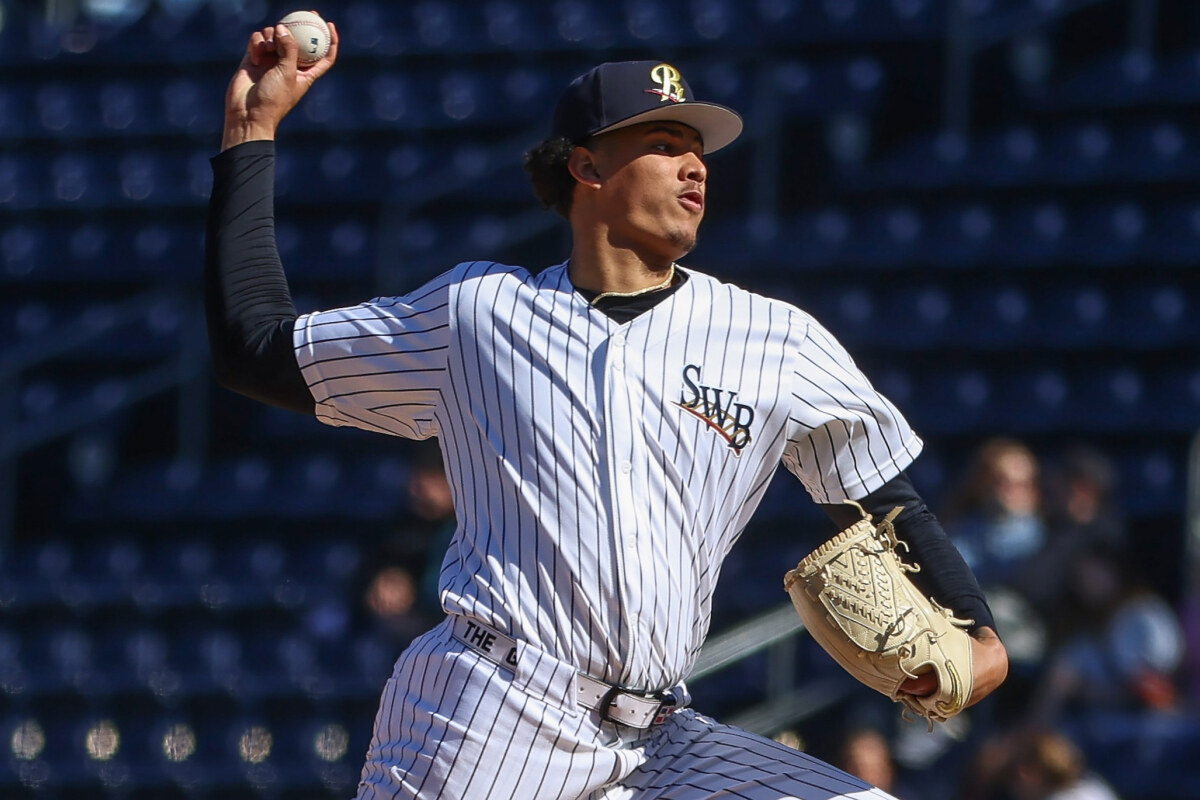
MOOSIC, Pa. — Nobody in Triple-A baseball threw a harder pitch in 2026 than Carlos Lagrange did Tuesday night. The radar gun said 102.8 mph. The box score said eight strikeouts. The walk column said something else entirely.
The Yankees No. 2 prospect delivered his most electric performance of the season at PNC Field. He struck out eight batters across five innings against the Syracuse Mets. He reached triple digits on his fastball 15 separate times. He was, at moments, unhittable.
102.8 mph and a record no one else is close to
Lagrange entered Tuesday night already holding the hardest-thrown pitch in Triple-A this season. He had touched 102.6 mph on April 23 against this same Syracuse club. Tuesday, he topped it.
The 102.8 mph reading came off the 6-foot-7, 248-pound right-hander’s frame and registered as the fastest pitch thrown at the Triple-A level in 2026. Only three active pitchers in all of professional baseball have thrown harder this year. Those three are all major leaguers: Mason Miller of the Padres, Jacob Misiorowski of the Brewers and Edgardo Henriquez of the Dodgers.
Lagrange also holds 13 of the top 25 fastest recorded pitches among all Triple-A starters this season. He owns that leaderboard essentially by himself.
The 22-year-old Dominican Republic native grew stronger as the night progressed. He recorded four of his eight strikeouts in the final two innings. In the fifth inning alone he struck out three batters, topping 100 mph three separate times including a 102.2 mph reading that ranked as his second-hardest pitch of the night.
It was an emphatic bounce-back. His previous outing had been his worst of the year, a start in which he gave up five runs on three home runs while walking three over 4.1 innings. Tuesday looked nothing like that.
The pitch mix tells a more complete story
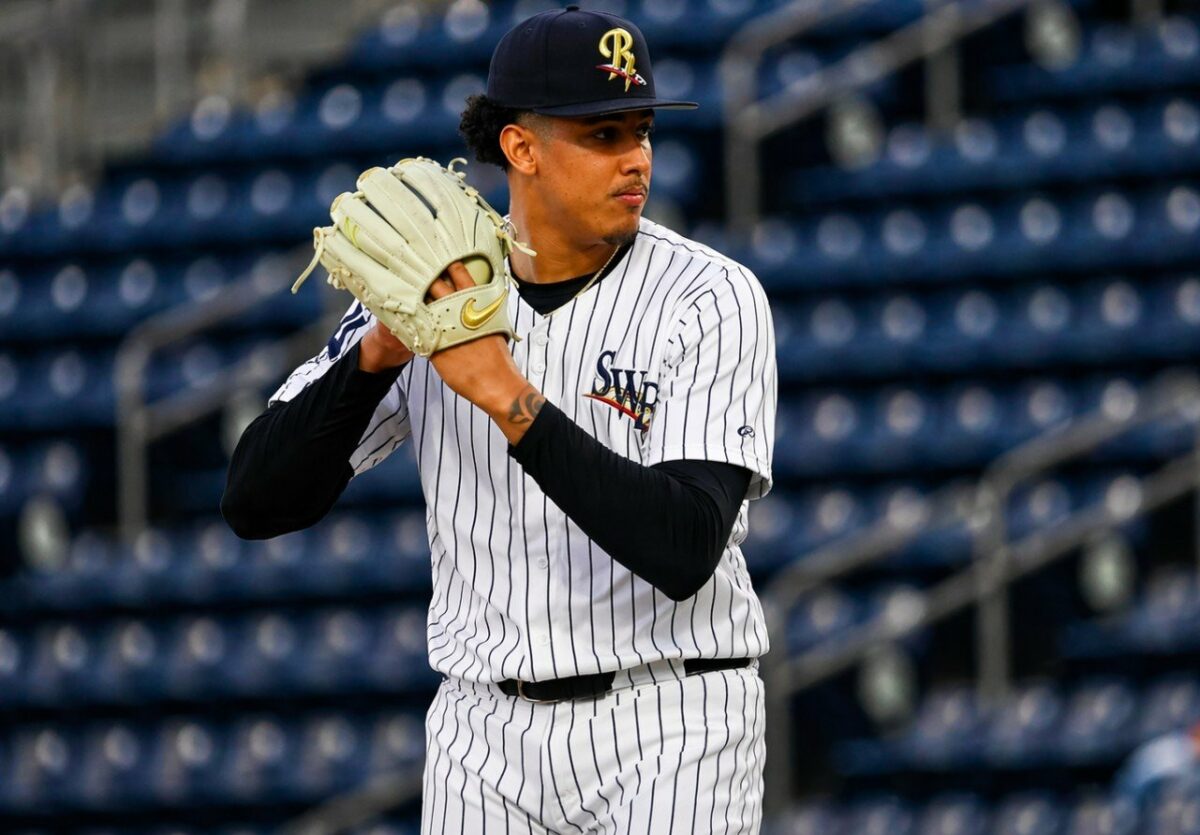
The raw velocity is the number that grabs attention. The pitch mix behind it is what tells the full story of who Lagrange is right now.
Of his 90 pitches on Tuesday, only 27 were fastballs. That is 30 percent. Despite owning the fastest arm in the minor leagues, Lagrange did not lean on his signature pitch. Instead he threw his slider 48 percent of the time, using it as his primary weapon throughout the start.
The slider has genuine bite. Paired with a triple-digit heater, it creates a combination that opposing batters in the International League have struggled to solve. Lagrange has struck out 46 batters in 33 1/3 innings this season, a rate of 12.4 per nine innings. Those are legitimate frontline starter numbers.
His ability to generate weak contact or empty swings has drawn attention across the Yankees organization and from national prospect analysts. MLB Pipeline rates him the No. 62 overall prospect and the No. 2 prospect in the Yankees farm system, behind only George Lombard Jr.
The walk rate that will not go away
Lagrange gave up three walks. There were 90 pitches to get through five innings. There was the familiar pattern that has followed Lagrange through eight Triple-A starts.
Through eight starts and 33 1/3 innings in 2026, Lagrange has issued 20 walks. That works out to 5.4 per nine innings. His career minor league walk rate is 5.2 per nine. In other words, the problem is not new. It is also not improving.
The three walks Tuesday cost him. Scranton/Wilkes-Barre lost the game 7-4 in extra innings. The walks drove up his pitch count and limited him to five innings despite his stuff being sharp. On a night when he threw the hardest pitch in Triple-A baseball and struck out eight, he could not get a sixth inning.
The ERA reflects the accumulated damage. Lagrange carries a 4.76 ERA through his eight starts. He has surrendered six home runs. Three of those came in a single start, the rough outing before Tuesday’s rebound. Walk totals feed high pitch counts. High pitch counts limit innings. Limited innings expose the bullpen. The chain of consequences from command issues is predictable and well-documented.
The arm is extraordinary. The command is not. That gap is what separates Lagrange from a Yankees big league rotation.
The Yankees are aware of all of it. The Yankees opted to send Lagrange to Triple-A rather than carry him on the Opening Day roster despite the buzz he generated in spring training. His velocity and swing-and-miss ability turned heads during camp. The walks were the reason the Yankees pumped the brakes.
A comparison the Yankees know well
Lagrange’s profile invites an obvious comparison within Yankees history. Dellin Betances stood 6-foot-8 and posted walk rates in the minor leagues that similarly alarmed evaluators. He eventually found enough command in the big leagues to become one of the more dominant relievers of his era, though control was never fully resolved.
The comparison matters because it raises a question the Yankees have not fully answered about Lagrange. Is he a Yankees starter who can fix his command? Or is he a reliever whose velocity and slider would play in shorter bursts, where a walk carries less weight?
For now the Yankees are keeping him in the rotation. The 22-year-old has not been in the Yankees system long enough to exhaust possibilities. He has not allowed more than two runs in six of his eight starts this season. The strikeout rate is genuine. The fastball is the best in Triple-A. Those are reasons to keep developing him as a starter.
But five professional seasons without meaningful command improvement is a number the Yankees front office cannot ignore. The ceiling on Lagrange remains as high as any arm in the Yankees organization. The floor depends entirely on one thing he has not yet solved.
What do you think? Leave your comment below.