BALTIMORE — Pete Alonso stood near home plate Wednesday night convinced he had changed the game against the Yankees. The Orioles slugger had driven Brent Headrick’s slider toward the left-field foul pole at Camden Yards, watched it carry beyond the wall and started down the line as Baltimore’s dugout reacted like the tie had been broken.
The call never followed the celebration. The ball was ruled foul, sending Alonso back to the box with two outs in the seventh and the score still 3-3. A crew chief review followed while both teams waited on a decision that could have changed the final two innings.
Replay did not declare the ball foul. MLB’s Replay Official said the angles could not definitively establish that it left the field in fair territory, so the original call stood. Alonso struck out two pitches later. The Yankees scored twice in the eighth and finished a 5-3 win, their third straight victory.
That sequence left two versions of the same moment. Alonso said Baltimore’s Hawk-Eye information showed the ball fair. Orioles manager Craig Albernaz questioned why MLB could not use more precise tracking technology. The Yankees had benefited from the same replay uncertainty that frustrates teams when video cannot produce enough evidence to overturn an on-field ruling.
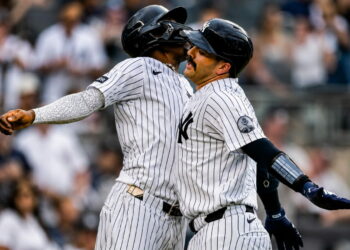
The disagreement mattered beyond one swing. Alonso had already homered earlier for No. 30, and another shot in the seventh would have put Baltimore ahead with six outs left for New York to answer. Instead, the at-bat ended with a strikeout, and George Lombard Jr. delivered the go-ahead infield single in the next half-inning. Even after the Yankees closed out the win, however, their own replay room was not finished with the play. The uncertainty lingered because the league’s ruling had preserved the call without actually validating it.
Yankees replay expert takes dispute back to field
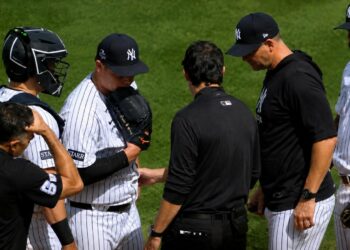
Aaron Boone said Brett Weber, who handles replay duties for the Yankees, went back onto the field after the game and examined the view from near the third-base line. He used the actual sight line to judge a drive that television perspectives had made difficult to read.
Weber came away believing the ball had gone foul. Boone accepted that assessment and gave Baltimore a concise answer when asked where the Yankees landed on the biggest disputed play of the night.
“We were unsure and then Webby looked out after the game. And he’s got a foul,” Boone said. “Sorry, Pete.”
The check did not change the official record, nor did it prove the Yankees’ interpretation was correct. Weber works for the team that benefited from the call. It did show that New York was uncertain enough to revisit the sight line after the outcome was secure.
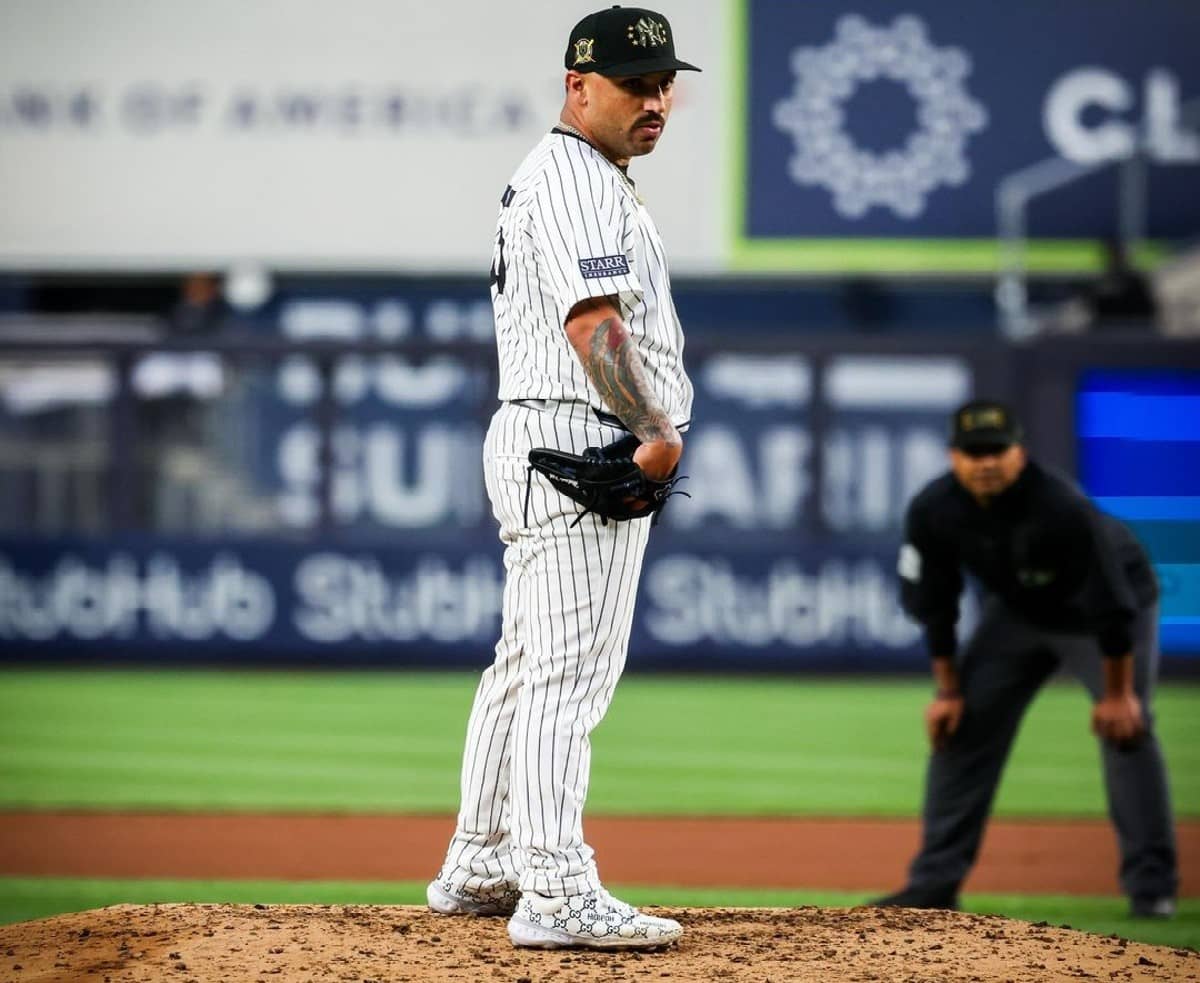
Headrick said his own view changed as he moved toward the line and watched the ball hook.
“When I went towards the line, I thought it was foul,” Headrick said. “You never know in that situation the way it’s hooking. You never know what’s going to be called. Obviously, we’re glad to see that it was foul. We’ll take it.”
Replay gave Orioles a ruling, not a confirmation
The distinction at the center of Baltimore’s frustration is important. MLB did not say replay confirmed the foul call. It said replay lacked enough evidence to change it.
“After viewing all relevant angles, the Replay Official could not definitively determine that the ball left the playing field in fair territory,” MLB’s Replay Command Center said. “The call stands, and it is a foul ball.”
Pete Alonso said the problem was the absence of a second useful camera angle. He also argued that MLB has enough technology to create a cleaner answer on balls that pass above a foul pole.
“We have Hawk-Eye. Like, football, you have the pylon camera with the plane where it shoots right across the goal line. And I feel like, for us, we could easily have a laser or a camera that shoots straight up. … I think having a camera or laser shooting straight up, we have all the technology, analytics and whatever and funds. I don’t see why we can’t do it,” Alonso said.
486 days later, Yankees land on other side of same replay result
A calculation shows Wednesday’s dispute came 486 days after the Yankees experienced an eerily similar sequence with Aaron Judge on April 20, 2025, against Tampa Bay.
Judge sent a drive over the left-field wall at George M. Steinbrenner Field. It was ruled foul. A crew chief review could not produce enough evidence to overturn the call, so the ruling stood. Judge then struck out later in the at-bat.
The parallel is unusually tight: apparent home run, foul call, inconclusive replay, call stands, strikeout. The biggest difference is which dugout was left angry. Boone watched video after the 2025 game and rejected that outcome.
“It’s a home run,” Boone said at the time.
However, the Yankees coach was ejected in that game.
This time, the Yankees were the beneficiary of the same replay standard. Their own postgame check gave Boone a reason to defend the ruling rather than protest it.
Disputed ball becomes the hinge in a 5-3 Yankees win
The Yankees still had to finish the game. Lombard’s two-out infield single in the eighth broke the 3-3 tie, and Jazz Chisholm Jr. scored on a wild pitch. The official box score credited Headrick with the win, Cam Sanders with the loss and David Bednar with his 29th save.
New York improved to 71-55. MLB’s standings entering Thursday left the Yankees five games behind Tampa Bay in the AL East and 3.5 games ahead of Boston for the top American League wild-card position.
Baltimore finished 0-for-6 with runners in scoring position, while the Yankees went 2-for-11. Alonso acknowledged the ruling hurt, but the Orioles still had to respond. The Yankees broke the tie in the next inning and Baltimore did not answer.
The replay debate remains unresolved in the narrowest sense. MLB could not establish that Alonso’s ball was fair, and Baltimore believes the technology should have produced a better answer. The Yankees took an extra step after the game, checked the geometry for themselves and left Camden Yards convinced the original foul call was right.
What do you think? Leave your comment below.