New York — The Yankees went into the season expecting their bullpen fix to come from inside the organization. A 6-foot-7 right-hander who touched 102 mph in spring training was supposed to be the answer waiting at Triple-A.
That plan collapsed on July 2. Carlos Lagrange, the club’s No. 4 prospect, landed on the minor-league injured list with a right capsule strain. The team’s official timeline now points to a possible September return, with a throwing program not resuming until the middle of August.
Brian Cashman put the situation plainly last week, saying it would be a close call for Lagrange to help at the major-league level at all this year. The Aug. 3 trade deadline will arrive well before the young flamethrower throws a competitive pitch.
So the Yankees need another arm, and the search has quietly turned toward a name almost nobody outside the organization knew in April. He was drafted in the 11th round last year and has spent the season making hitters look foolish at two levels.
A pitch shape that does not exist in the majors
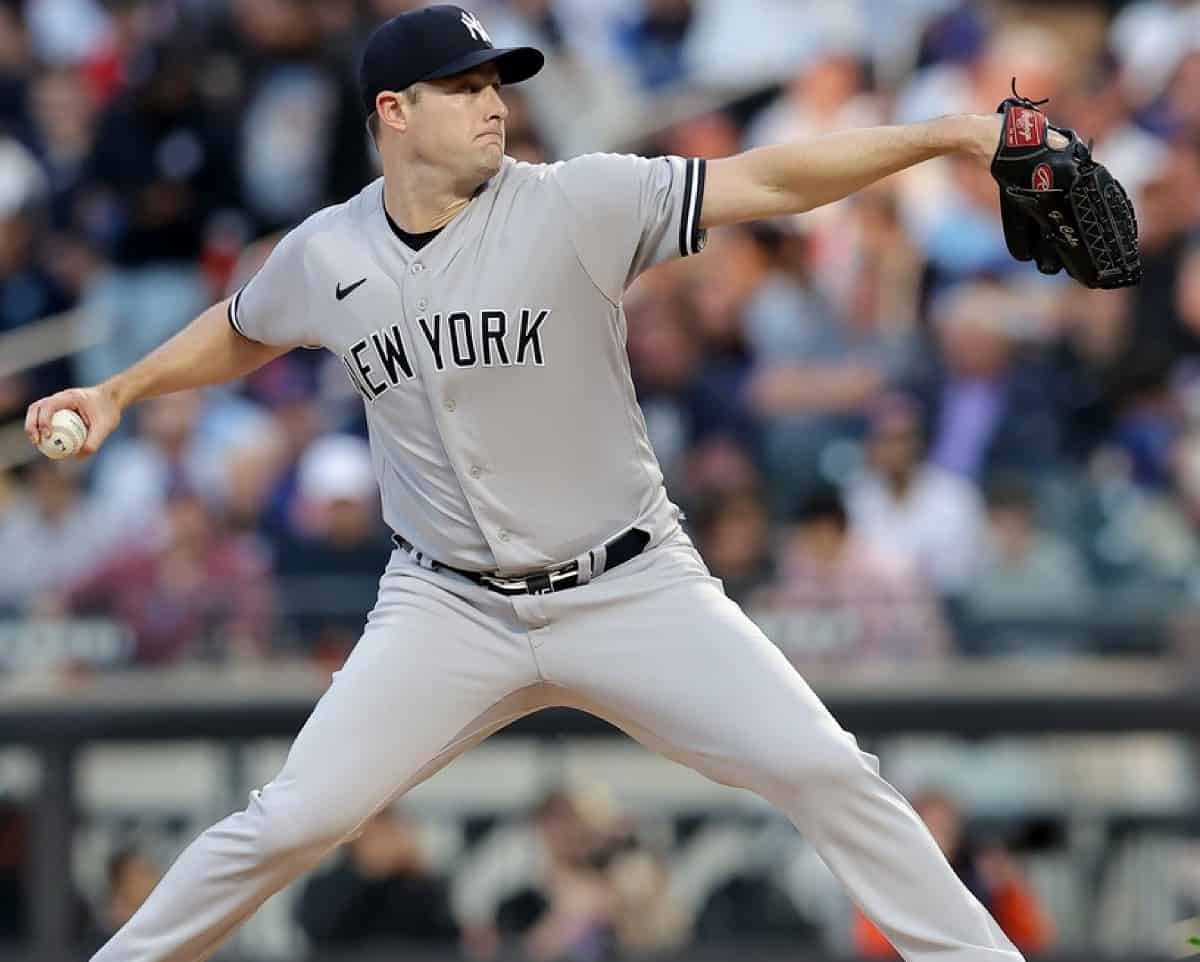
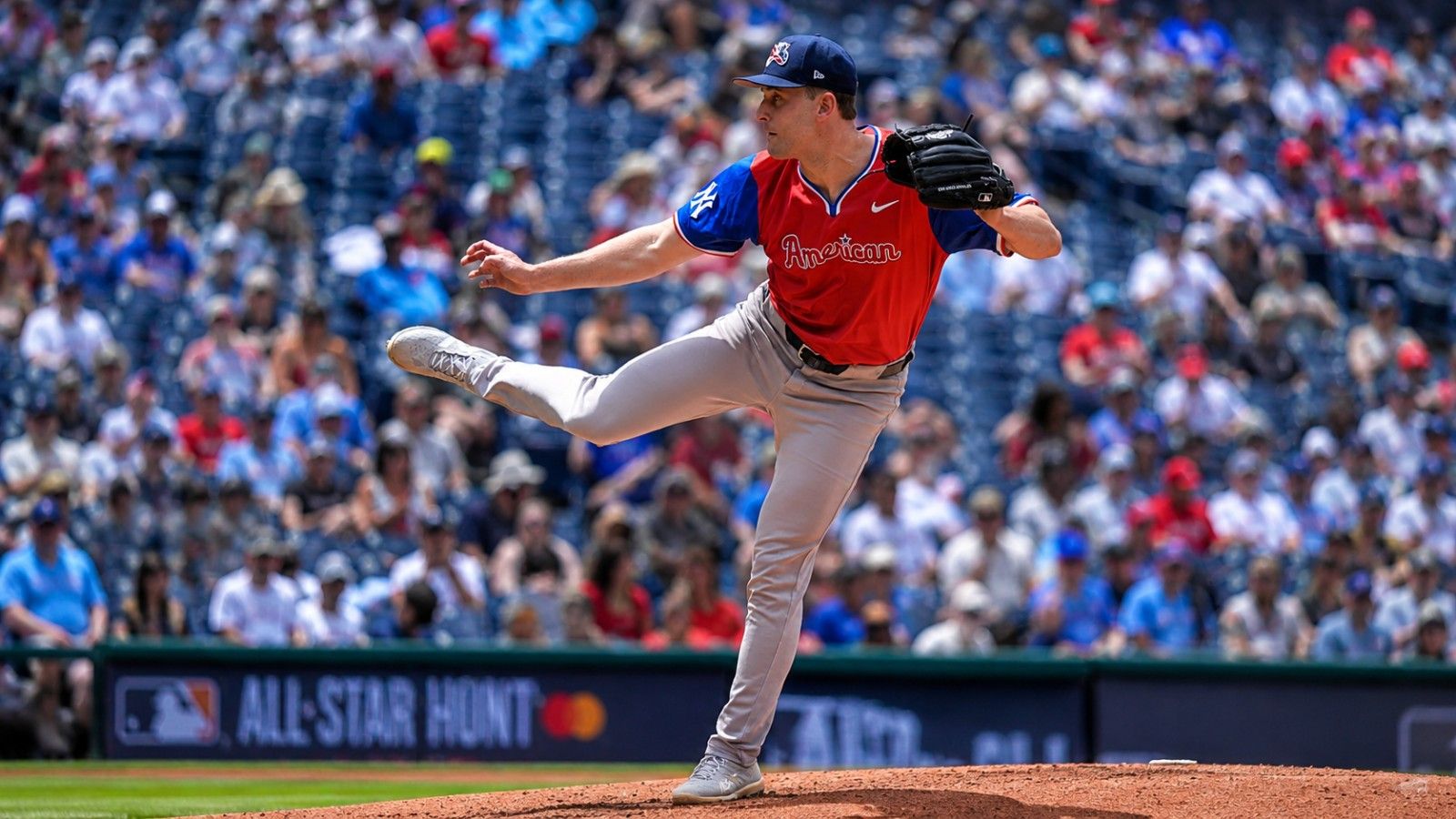
The pitcher is Ben Grable, a 6-foot-4 right-hander taken out of Indiana University in the 11th round of the 2025 draft. He replaced Lagrange on the American League roster for Sunday’s All-Star Futures Game, a late call-up that said plenty about how fast he has climbed the Yankees system.
What makes him unusual is not the velocity alone. Grable said he averages 96.1 mph with his four-seam fastball while generating roughly 20.5 to 21 inches of induced vertical break, the movement created by how the ball spins. More vertical break makes a fastball appear to resist gravity, and hitters swing beneath it.
The combination has no match at the highest level. Three qualified major leaguers average 20 inches of vertical break on their four-seamers, and none of them throws even 94 mph. Plenty of pitchers match Grable’s speed, but none pairs it with that kind of ride.
The closest comparison belongs to Padres reliever Jeremiah Estrada, whose fastball has averaged 95.8 mph with 19.8 inches of vertical break this season. Estrada has been close to unhittable in San Diego, with a 3.26 ERA over the past three years. That is the nearest company Grable has.
Grable did not fully grasp what he had until he joined the organization. He said the education began in college and finished in pinstripes.
“When I got to Indiana, they sort of taught us the metrics and all that,” Grable said. “I didn’t really know how good it was until I got into New York.”
Numbers that rank near the top of the minors
The results back the shape. Grable carried a 2.61 ERA across High-A Hudson Valley and Double-A Somerset, with 31 innings in 28 relief appearances. His peripheral numbers are the eye-catchers.
Among the 1,602 affiliated minor leaguers with at least 30 innings this season, Grable ranks fourth in WHIP at 0.77, eighth in opponents’ batting average at .127 and 16th in strikeout rate at 40.2 percent. He has walked 2.90 batters per nine innings. MLB Pipeline noted his 13.8 strikeouts per nine across the two levels and a fastball that touches 99 mph.
The path here was not smooth. A Southern California native, Grable pitched two seasons at Northwestern and one at Indiana, and he underwent Tommy John surgery in 2024. He posted a 4.31 ERA in his final college season, when his fastball sat around 92 mph. He was one of 10 pitchers the Yankees drafted last year, and the first to move this quickly.
The Yankees changed the pitcher. Grable cleaned up his mechanics, moved to working exclusively from the stretch and rebuilt a fastball the club believed could be far better. The velocity climbed several ticks.
A slider found on the internet
The secondary pitch arrived by an unlikely route. About six weeks ago, hunting for a better grip, Grable watched an online interview with Reds All-Star Chase Burns and paused on the slider grip. He copied it for a simple reason.
“I figured he’s got a pretty good slider, similar heater shape,” Grable said.
He tested it in a bullpen session the next day, then used it in a game that night and struck out three. The pitch turned a one-pitch profile into a two-pitch attack, and Somerset manager James Cooper watched the timing work in his favor.
“It’s a unique profile and shape in comparison to a lot of other fastballs out there,” Cooper said. “Just when teams were starting to figure that out, that’s when he started landing the secondary stuff, and I think that’s what’s been making him special.”
Cooper, who served as the AL’s third base coach at the Futures Game, summed up the effect in a sentence.
“He’s been able to dominate the game with those two pitches,” Cooper said.
Where the promotion case stands
Yankees history makes a jump plausible. Cam Schlittler and Ben Rice, both late-round finds, spent All-Star week in Philadelphia as first-time selections. The club has repeatedly pushed pitchers with elite stuff to the majors on modest minor-league workloads.
Grable has thrown only 31 innings this season, and he has never pitched above Double-A. That is the argument against him. The argument for him is a Yankees bullpen that needs swing-and-miss and an internal option whose fastball profile does not exist anywhere on the big-league roster.
His own framing leaves the role open. Speaking to reporters at the Futures Game, Grable made clear he is not counting innings.
“Ever since I was a kid, my goal has been to win a World Series,” Grable said. “Whether I throw one inning or 200 innings, it doesn’t matter. I just want a chance to compete at the highest level.”
For now, he returns to Somerset while the Yankees weigh outside help against what they already have. Lagrange will not throw again until August at the earliest, and the deadline will not wait. The 11th-round pick with the fastball no major leaguer can copy has made himself impossible to ignore.
What do you think? Leave your comment below.