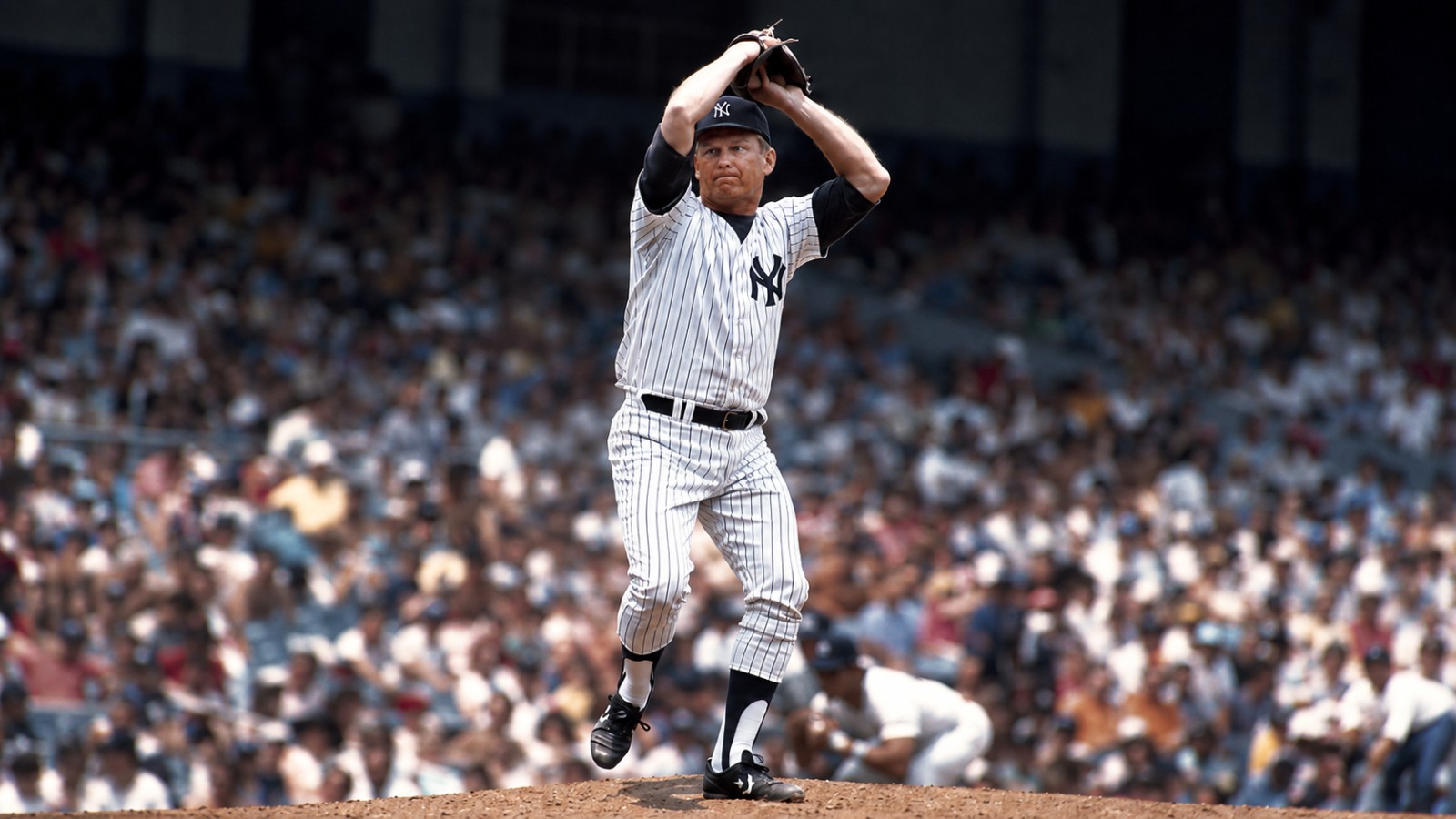
| Tommy John | Details |
| Full name | Thomas Edward John |
| Born | May 22, 1943 — Terre Haute, Indiana |
| Position | Pitcher |
| Bats / throws | Right / Left |
| MLB debut | Sept. 6, 1963 |
| Final MLB season | 1989 |
| MLB seasons | 26 |
| Teams | Cleveland Indians, Chicago White Sox, Los Angeles Dodgers, New York Yankees, California Angels, Oakland Athletics |
| Career record | 288-231 |
| Career ERA | 3.34 |
| Career starts | 700 |
| Career innings | 4,710⅓ |
| Career strikeouts | 2,245 |
| Career WAR | 61.6 (Baseball-Reference) |
| All-Star selections | 4 |
| Yankees seasons | 1979-82, 1986-89 |
| Yankees record | 91-60 |
| Yankees ERA | 3.59 |
| 20-win seasons | 3 |
| Post-surgery wins | 164 |
| Signature legacy | Pioneering patient for UCL reconstruction, now universally known as Tommy John surgery |
| Hall of Fame | Not inducted as of Aug. 11, 2026 |
The Bio
There may be no baseball player whose name means more after an injury than Tommy John’s.
John died at his home in Lakewood Ranch, Florida, on Aug. 15, 2026. He was 83.
On Aug. 8, 2026, John could not attend the Yankees’ 78th Old-Timers’ Day as he continued to deal with health issues from his home in Bradenton, Florida. He instead sent a message thanking the Yankees, their fans and Dr. Frank Jobe, the surgeon whose experiment more than half a century ago gave John something pitchers with his injury rarely possessed at the time: another chance.
Then baseball supplied a striking piece of symmetry. Gerrit Cole started for the Yankees that afternoon, while Chris Sale started for Atlanta. Both were star pitchers whose careers had been shaped by the elbow reconstruction that carries John’s name. Cole credited John with helping create the rehabilitation roadmap for pitchers who followed him.
That is Tommy John’s place in baseball history. He was a four-time All-Star, a 288-game winner and a pitcher who made 700 starts across 26 major-league seasons. He won 91 games for the Yankees. Yet those numbers tell only part of the story.
In 1974, an elbow injury threatened to erase the second half of his career. Instead, it created it.
John won 164 games after surgery — 40 more than the 124 he won before it — and pitched another 14 seasons. The procedure that began as an uncertain experiment became one of sports medicine’s most recognizable operations. For generations of pitchers, Tommy John became something greater than the name of a surgical procedure. He became baseball’s symbol of a second chance.
From Terre Haute to the major leagues
Before Tommy John became an operation, he was a pitcher.
Born in Terre Haute, Indiana, John excelled in baseball and basketball before entering professional baseball. He reached the major leagues with Cleveland in September 1963 at age 20 and soon developed into the sort of pitcher whose career depended more on movement, command and intelligence than overpowering velocity.
John moved to the Chicago White Sox in 1965 and became an established American League starter. His sinking fastball produced ground balls, while his curveball and command allowed him to survive without dominating hitters through strikeouts. His first All-Star selection came with Chicago in 1968.
The Los Angeles Dodgers acquired him before the 1972 season, a move that eventually changed far more than one pitching staff. John won 11 games in 1972 and 16 in 1973. By 1974, at age 31, he appeared to be reaching another level. He opened that season 13-3. Then one pitch changed baseball history.
Tommy John’s career timeline
| Year | Team / stage | What happened |
| 1943 | Terre Haute, Indiana | Born May 22 |
| 1961 | Cleveland organization | Began professional career |
| 1963 | Cleveland Indians | Made MLB debut |
| 1965 | Chicago White Sox | Joined Chicago in a three-team trade |
| 1968 | White Sox | Made first All-Star team |
| 1972 | Los Angeles Dodgers | Joined Dodgers |
| 1973 | Dodgers | Won 16 games |
| 1974 | Dodgers | Started 13-3 before catastrophic elbow injury |
| Sept. 25, 1974 | Los Angeles | Dr. Frank Jobe performed experimental UCL reconstruction |
| 1975 | Rehabilitation | Missed entire MLB season |
| 1976 | Dodgers | Returned; 10-10, 3.09 ERA |
| 1977 | Dodgers | 20-7, 2.78 ERA; Cy Young runner-up |
| 1978 | Dodgers | Won 17 games; All-Star |
| 1979 | Yankees | Won 21; AL Cy Young runner-up |
| 1980 | Yankees | Won career-high 22 |
| 1981 | Yankees | Reached World Series |
| 1982 | Yankees/Angels | Traded to California |
| 1986 | Yankees | Returned to New York at age 43 |
| 1987 | Yankees | Won 13 games at age 44 |
| 1989 | Yankees | Opening Day starter; final MLB season |
| 2026 | Yankees Old-Timers’ Day | Sent a message to the Yankees community while battling health issues |
The pitch that changed Tommy John — and baseball
On July 17, 1974, the Dodgers faced the Montreal Expos at Dodger Stadium. John entered the game leading the National League with 13 victories. During the third inning, his left elbow gave way.
The pain became severe enough that John left the mound and did not return. For pitchers of that era, catastrophic damage to the ulnar collateral ligament could amount to the end of a career. Rest did not solve the problem. That left Dodgers team physician Frank Jobe with a radical possibility.
Instead of simply trying to repair the ruined ligament, Jobe would reconstruct it.
What Frank Jobe did to Tommy John’s elbow
On Sept. 25, 1974, Jobe used a tendon from John’s wrist as a replacement for the damaged ligament in his pitching elbow. He drilled tunnels into the ulna and humerus and positioned the tendon graft through them in a figure-eight configuration.
Nothing resembling a proven rehabilitation roadmap existed for a major-league pitcher because the procedure had never been successfully used to return one to that level of competition. Jobe later described the odds as extraordinarily low. Without the operation, however, John’s major-league career was effectively finished.
John chose possibility over certainty.
The surgery nearly produced another disaster
The reconstruction itself did not immediately solve everything. John developed serious problems involving the ulnar nerve. His fingers lost function, threatening his ability even to grip a baseball.
Jobe performed another operation in December 1974 to reroute the nerve. John then began an exhausting rehabilitation process. There was no established Tommy John surgery rehabilitation program. Tommy John was the program.
He exercised relentlessly. Unable initially to control his fingers properly, he taped damaged fingers to working ones and threw baseballs repeatedly against a wall. By June 1975, movement began returning. By September, he was pitching in the Arizona Instructional League.
April 16, 1976: The second career begins
John returned to a major-league mound on April 16, 1976. The comeback itself represented medical history. What followed turned it into baseball history.
John started 31 games in 1976, threw 207 innings and finished 10-10 with a 3.09 ERA. He received the Hutch Award after the season. Then he got better.
In 1977, John went 20-7 with a 2.78 ERA and finished second to Steve Carlton for the National League Cy Young Award. He won 17 more games in 1978. By that point, the question was no longer whether his reconstructed elbow could survive major-league pitching. It was whether John had somehow entered the best portion of his career after doctors once feared it was over.
Before and after Tommy John surgery
| Period | Wins | Seasons | What followed |
| Before surgery | 124 | 1963-74 | Established starter; one All-Star selection |
| 1975 | — | Rehabilitation | Missed entire MLB season |
| After surgery | 164 | 1976-89 | Three 20-win seasons; three All-Star selections; two Cy Young runner-up finishes |
| Career | 288 | 26 MLB seasons | One of baseball’s longest pitching careers |
Tommy John becomes a Yankee
The surgery made John famous. The Yankees helped make the comeback undeniable.
After the 1978 season, John entered free agency and joined New York for 1979. He was 35 when the season began and already had 15 major-league seasons behind him. Yet his first season in pinstripes became one of his greatest.
John went 21-9 with a 2.96 ERA, completing 17 games across 276⅓ innings. He made the All-Star team and finished second in American League Cy Young Award voting. At age 36, the pitcher whose career had supposedly ended five years earlier had become one of the American League’s best starters.
Then he did it again. John went 22-9 in 1980, made another All-Star team and finished fourth in Cy Young voting. He threw 265⅓ innings with 16 complete games and six shutouts. His 43 victories during those first two Yankees seasons remain the clearest evidence that his historic operation did far more than allow him to hang around. It restored an elite major-league career.
A different kind of test in 1981
The most difficult chapter of John’s Yankees career had little to do with his elbow.
In August 1981, his two-year-old son Travis fell from a third-story window and suffered life-threatening injuries. John left the Yankees to be with his family. Travis spent 19 days in a coma before beginning a remarkable recovery.
John returned to the mound and eventually helped New York reach the World Series. He pitched effectively against his former Dodgers teammates, posting a 0.69 ERA across three appearances, including two starts, in that World Series, although Los Angeles ultimately won the championship. It was John’s third trip to the World Series — and his third defeat.
The Yankees traded him away, then brought him back
John remained with New York into 1982 before the Yankees traded him to the California Angels. He spent parts of four seasons with California and briefly pitched for Oakland in 1985. By then he was 42. Most careers would have ended there. John’s did not.
The Yankees gave him another opportunity in 1986. He returned at age 43 and went 5-3 with a 2.93 ERA in 13 appearances. The following year, at 44, John made 33 starts, threw 187⅔ innings and went 13-6. He added nine victories in 1988. Then came one final act.
At 45, Tommy John started Opening Day for the Yankees
John made the Yankees again in 1989. He started Opening Day against Minnesota at 45 years and 317 days old and earned the victory as New York won 4-2, making him one of the oldest Opening Day starters in major-league history.
His final season lasted 10 appearances. When his playing career ended, John was 46. He had pitched in the majors from 1963 through 1989. More importantly, he had pitched 14 seasons after an injury that once represented the likely end of his career.
Tommy John’s Yankees legacy
John’s Yankees career came in two distinct pieces. The first featured a veteran left-hander performing like an ace. The second featured a baseball survivor stretching the boundaries of pitching longevity.
Together, they produced 91 victories, a 3.59 ERA, eight Yankees seasons and 1,367 innings. He never won a championship in pinstripes and never became a Monument Park immortal. But his Yankees years supplied some of the most persuasive evidence for his broader legacy.
Tommy John did not merely survive surgery. He became an All-Star Yankee afterward.
Why the surgery is called Tommy John surgery
Dr. Frank Jobe developed the procedure. So why is it not known as Frank Jobe surgery? Because John became its living proof.
Medicine supplied the reconstruction. John supplied the risk, the rehabilitation and the major-league test. Jobe’s published work later documented UCL reconstruction in throwing athletes, but John had already demonstrated something even more extraordinary: he returned to the majors and stayed for 14 seasons.
That transformed the pitcher’s name into baseball shorthand for the operation itself.
How Tommy John surgery changed baseball
The contrast between 1974 and modern baseball is dramatic. John entered surgery facing almost no established precedent for a successful major-league return.
A 2020 systematic review of 29 studies found MLB pitchers returning to play after primary UCL reconstruction in 80% to 97% of cases, generally around 12 months after surgery. Returning to the same level was harder, with reported rates of 67% to 87% at roughly 15 months.
Those numbers should not turn the operation into mythology. The surgery does not guarantee a return to previous performance, and research has found that returning to prior workload and effectiveness is not automatic. That makes John’s own comeback even more exceptional. The operation did not magically create 164 victories. It gave him the physical possibility of trying to win them.
Tommy John and the meaning of a second chance
A second chance usually implies that someone already knows another opportunity exists. John did not know. That is what makes his story different.
In 1974, he chose an experiment without a successful major-league precedent. He then spent a year attempting to prove that his reconstructed arm could again perform one of the most violent repetitive motions in professional sports.
The operation supplied possibility. John turned possibility into evidence. His career after surgery included 164 victories, three 20-win seasons, three All-Star selections and two second-place Cy Young finishes.
Before Tommy John, a devastating UCL injury could close the door. After Tommy John, pitchers could at least see another one.
Is Tommy John a Hall of Famer?
Statistically, John occupies one of Cooperstown’s most fascinating borderlands. His supporters begin with 288 victories, 4,710⅓ innings and 700 starts. His case also includes three 20-win seasons, four All-Star selections and two runner-up Cy Young finishes.
The counterargument centers on peak dominance. John never won a Cy Young Award. He made only four All-Star teams across 26 seasons. Much of his statistical weight comes from exceptional longevity.
Then comes the question no ordinary Hall of Fame case contains: How much should changing the possibilities of the sport count?
John last appeared before the Classic Baseball Era Committee in December 2024. He received seven of 16 votes, or 43.8%. Election required 12. The committee is scheduled to consider Classic Baseball candidates again in December 2027 for the Hall’s Class of 2028.
As of August 2026, Tommy John is not a Hall of Famer. His name, however, may be spoken inside major-league clubhouses more often than those of hundreds of players already enshrined there.
Tommy John’s defining moments
| Moment | Why it matters |
| July 17, 1974 | His UCL injury threatens to end his career |
| Sept. 25, 1974 | Frank Jobe performs experimental reconstruction |
| 1975 rehabilitation | John helps create the roadmap because none exists |
| April 16, 1976 | Returns to MLB |
| 1977 | Wins 20 games and finishes second for NL Cy Young |
| 1979 | Joins Yankees; goes 21-9 |
| 1980 | Wins career-high 22 games |
| 1981 | Helps Yankees reach World Series amid a family crisis |
| 1986 | Returns to Yankees at age 43 |
| 1987 | Wins 13 games at age 44 |
| 1989 | Starts Opening Day at 45 |
| 2026 | His namesake surgery links John’s legacy to another generation of Yankees pitching |
FAQs about Tommy John
Who is Tommy John?
Tommy John is a former left-handed MLB pitcher who played 26 seasons from 1963 through 1989, won 288 games and became the pioneering patient for the elbow reconstruction now known as Tommy John surgery.
What is Tommy John famous for?
He is famous both for his 288-win pitching career and for successfully returning after the groundbreaking 1974 UCL reconstruction performed by Dr. Frank Jobe.
Why is it called Tommy John surgery?
The operation became associated with John because he underwent the pioneering reconstruction and proved a major-league pitcher could successfully return after it.
Who invented Tommy John surgery?
Dodgers team physician Dr. Frank Jobe developed and performed the landmark reconstruction on John.
When did Tommy John have surgery?
Jobe operated on John on Sept. 25, 1974.
What injury did Tommy John suffer?
John tore the ulnar collateral ligament in his left, pitching elbow.
When did Tommy John hurt his elbow?
The career-threatening injury occurred July 17, 1974, during a Dodgers game against Montreal.
How good was Tommy John before surgery?
He already had 124 major-league victories and an All-Star selection and was 13-3 in 1974 when his elbow failed.
What tendon was used in Tommy John’s surgery?
Jobe used a tendon harvested from John’s wrist to reconstruct the elbow ligament.
What were Tommy John’s chances of returning?
Jobe described the odds of a successful return as extremely low; the historic gamble became one of baseball medicine’s defining success stories.
Did Tommy John miss the entire 1975 season?
Yes. He spent 1975 rehabilitating and did not pitch in a major-league game.
When did Tommy John return to MLB?
He returned for the Dodgers on April 16, 1976.
How did Tommy John perform in his comeback season?
John went 10-10 with a 3.09 ERA and threw 207 innings in 1976.
How many games did Tommy John win after surgery?
He won 164 major-league games after the operation.
Did Tommy John win more games before or after surgery?
After. He won 124 before the operation and 164 afterward.
How many seasons did Tommy John pitch after surgery?
He pitched another 14 major-league seasons, from 1976 through 1989.
How many years did Tommy John play in MLB?
John played 26 major-league seasons.
What was Tommy John’s career record?
He finished 288-231.
What was Tommy John’s career ERA?
His lifetime ERA was 3.34.
How many strikeouts did Tommy John have?
He recorded 2,245 career strikeouts.
How many innings did Tommy John pitch?
John threw 4,710⅓ major-league innings.
How many career starts did Tommy John make?
He made 700 starts.
Which MLB teams did Tommy John play for?
He pitched for Cleveland, the Chicago White Sox, Los Angeles Dodgers, New York Yankees, California Angels and Oakland Athletics.
When did Tommy John join the Yankees?
John joined the Yankees for the 1979 season after leaving the Dodgers as a free agent.
How many seasons did Tommy John play for the Yankees?
Eight: 1979-82 and 1986-89.
What was Tommy John’s Yankees record?
He went 91-60 with a 3.59 ERA for New York.
How many games did Tommy John win for the Yankees?
He won 91 games in pinstripes.
Did Tommy John win 20 games for the Yankees?
Yes. He went 21-9 in 1979 and 22-9 in 1980.
What was Tommy John’s best Yankees season?
His 1979 and 1980 seasons both have strong cases. He posted a 2.96 ERA and finished second in Cy Young voting in 1979, while his 22 wins in 1980 represented his career high.
How many All-Star teams did Tommy John make?
Four — 1968, 1978, 1979 and 1980. Three came after his elbow reconstruction.
Did Tommy John ever win the Cy Young Award?
No. He finished second in NL voting in 1977 and second in AL voting as a Yankee in 1979.
Did Tommy John win a World Series?
No. He appeared in the World Series with the Dodgers in 1977 and 1978 and the Yankees in 1981, but his teams lost all three.
How old was Tommy John when he last pitched?
John was 46 during his final MLB season in 1989.
How old was Tommy John when he started Opening Day for the Yankees?
He was 45 years and 317 days old and won the Yankees’ 1989 opener.
Is Tommy John in the Baseball Hall of Fame?
No. As of Aug. 11, 2026, John has not been inducted.
How close has Tommy John come to the Hall of Fame?
On the December 2024 Classic Baseball Era ballot, he received seven of 16 votes, or 43.8%. Twelve were required.
When can Tommy John next be considered for the Hall of Fame?
The Classic Baseball Era Committee is scheduled to meet again in December 2027 for the Class of 2028.
How successful is Tommy John surgery today?
A 2020 systematic review found MLB pitcher return-to-play rates of 80% to 97% after primary UCL reconstruction, while 67% to 87% returned to the same level.
Does Tommy John surgery make pitchers better?
Not necessarily. The purpose is to restore elbow stability, and research shows returning to previous workloads and performance levels is not guaranteed.
Why does Tommy John remain important to Yankees fans?
New York saw the proof of his comeback at its highest level. John won 43 games in his first two Yankees seasons, became a two-time Yankees All-Star and eventually accumulated 91 victories for the franchise after undergoing an operation once thought unlikely to save his career.
The Stats
The season-by-season table deliberately keeps 1975 as a blank rehabilitation line. It makes the interruption — and the scale of the comeback — visible at a glance.
| Year | Age | Team | W | L | ERA | G | GS | CG | SHO | IP | SO | WHIP |
| 1963 | 20 | CLE | 0 | 2 | 2.21 | 6 | 3 | 0 | 0 | 20⅓ | 9 | 1.43 |
| 1964 | 21 | CLE | 2 | 9 | 3.91 | 25 | 14 | 2 | 1 | 94⅓ | 65 | 1.40 |
| 1965 | 22 | CWS | 14 | 7 | 3.09 | 39 | 27 | 6 | 1 | 183⅔ | 126 | 1.20 |
| 1966 | 23 | CWS | 14 | 11 | 2.62 | 34 | 33 | 10 | 5 | 223 | 138 | 1.13 |
| 1967 | 24 | CWS | 10 | 13 | 2.47 | 31 | 29 | 9 | 6 | 178⅓ | 110 | 1.07 |
| 1968 | 25 | CWS | 10 | 5 | 1.98 | 25 | 25 | 5 | 1 | 177⅓ | 117 | 1.04 |
| 1969 | 26 | CWS | 9 | 11 | 3.25 | 33 | 33 | 6 | 2 | 232⅓ | 128 | 1.38 |
| 1970 | 27 | CWS | 12 | 17 | 3.27 | 37 | 37 | 10 | 3 | 269⅓ | 138 | 1.31 |
| 1971 | 28 | CWS | 13 | 16 | 3.61 | 38 | 35 | 10 | 3 | 229⅓ | 131 | 1.32 |
| 1972 | 29 | LAD | 11 | 5 | 2.89 | 29 | 29 | 4 | 1 | 186⅔ | 117 | 1.14 |
| 1973 | 30 | LAD | 16 | 7 | 3.10 | 36 | 31 | 4 | 2 | 218 | 116 | 1.16 |
| 1974 | 31 | LAD | 13 | 3 | 2.59 | 22 | 22 | 5 | 3 | 153 | 78 | 1.14 |
| 1975 | 32 | REHAB | — | — | — | — | — | — | — | — | — | — |
| 1976 | 33 | LAD | 10 | 10 | 3.09 | 31 | 31 | 6 | 2 | 207 | 91 | 1.29 |
| 1977 | 34 | LAD | 20 | 7 | 2.78 | 31 | 31 | 11 | 3 | 220⅓ | 123 | 1.25 |
| 1978 | 35 | LAD | 17 | 10 | 3.30 | 33 | 30 | 7 | 0 | 213 | 124 | 1.33 |
| 1979 | 36 | NYY | 21 | 9 | 2.96 | 37 | 36 | 17 | 3 | 276⅓ | 111 | 1.21 |
| 1980 | 37 | NYY | 22 | 9 | 3.43 | 36 | 36 | 16 | 6 | 265⅓ | 78 | 1.23 |
| 1981 | 38 | NYY | 9 | 8 | 2.63 | 20 | 20 | 7 | 0 | 140⅓ | 50 | 1.24 |
| 1982 | 39 | NYY/CAL | 14 | 12 | 3.69 | 37 | 33 | 10 | 2 | 221⅔ | 68 | 1.25 |
| 1983 | 40 | CAL | 11 | 13 | 4.33 | 34 | 34 | 9 | 0 | 234⅔ | 65 | 1.43 |
| 1984 | 41 | CAL | 7 | 13 | 4.52 | 32 | 29 | 4 | 1 | 181⅓ | 47 | 1.54 |
| 1985 | 42 | CAL/OAK | 4 | 10 | 5.53 | 23 | 17 | 0 | 0 | 86⅓ | 25 | 1.68 |
| 1986 | 43 | NYY | 5 | 3 | 2.93 | 13 | 10 | 1 | 0 | 70⅔ | 28 | 1.25 |
| 1987 | 44 | NYY | 13 | 6 | 4.03 | 33 | 33 | 3 | 1 | 187⅔ | 63 | 1.38 |
| 1988 | 45 | NYY | 9 | 8 | 4.49 | 35 | 32 | 0 | 0 | 176⅓ | 81 | 1.51 |
| 1989 | 46 | NYY | 2 | 7 | 5.80 | 10 | 10 | 0 | 0 | 63⅔ | 18 | 1.71 |
| Career | — | 6 teams | 288 | 231 | 3.34 | 760 | 700 | 162 | 46 | 4,710⅓ | 2,245 | 1.28 |
Tommy John’s Yankees pitching record
| Year | Age | W | L | ERA | G | GS | CG | SHO | IP | SO | WHIP |
| 1979 | 36 | 21 | 9 | 2.96 | 37 | 36 | 17 | 3 | 276⅓ | 111 | 1.205 |
| 1980 | 37 | 22 | 9 | 3.43 | 36 | 36 | 16 | 6 | 265⅓ | 78 | 1.229 |
| 1981 | 38 | 9 | 8 | 2.63 | 20 | 20 | 7 | 0 | 140⅓ | 50 | 1.240 |
| 1982 | 39 | 10 | 10 | 3.66 | 30 | 26 | 9 | 2 | 186⅔ | 54 | 1.200 |
| 1986 | 43 | 5 | 3 | 2.93 | 13 | 10 | 1 | 0 | 70⅔ | 28 | 1.245 |
| 1987 | 44 | 13 | 6 | 4.03 | 33 | 33 | 3 | 1 | 187⅔ | 63 | 1.380 |
| 1988 | 45 | 9 | 8 | 4.49 | 35 | 32 | 0 | 0 | 176⅓ | 81 | 1.514 |
| 1989 | 46 | 2 | 7 | 5.80 | 10 | 10 | 0 | 0 | 63⅔ | 18 | 1.712 |
| Yankees total | — | 91 | 60 | 3.59 | 214 | 203 | 53 | 12 | 1,367 | 483 | — |
Hall of Fame status
| Hall of Fame status | Tommy John |
| BBWAA / Era status | Not elected |
| 2025 Classic Era vote | 7 of 16 |
| Percentage | 43.8% |
| Required | 12 of 16 |
| Next Classic Era election | December 2027 |
| Election class | 2028 |
Why Tommy John still matters
Baseball remembers plenty of players for what they accomplished before their bodies failed. Tommy John became immortal because of what happened afterward.
The injury came at 31. The surgery came with almost no precedent. The rehabilitation came without a roadmap. Then came 164 victories. Then came two 20-win seasons for the Yankees. Then came pitching at 46.
And eventually came generations of pitchers walking into operating rooms knowing the end of one ligament did not automatically mean the end of a career.
Frank Jobe created the bridge. Tommy John proved a pitcher could cross it. More than half a century later, that may be the most enduring second chance baseball has ever been given.