ST. PETERSBURG, Fla. — The Yankees left Tropicana Field with a loss that was ugly enough to make every defensive decision worth revisiting. Tampa Bay won 5-2 Monday night, pushed New York to the edge of elimination in the American League Division Series and turned routine execution into the defining issue of Game 2.
The Yankees committed four errors, including three in the first inning, and repeatedly forced Cam Schlittler to work around extra traffic. Their first-inning total tied the MLB postseason record for errors in an opening frame, last matched by Oakland in Game 1 of the 1975 AL Championship Series. New York’s four errors also tied the second-highest total in franchise postseason history, behind five in Game 2 of the 1976 ALCS.
A defensive collapse changes the stakes
The night produced another strange moment for rookie Spencer Jones. In the second inning, his towering fly ball struck a Tropicana Field catwalk and dropped into the glove of Rays right fielder Victor Mesa Jr. Umpires confirmed the out under the stadium ground rules. It was an unusual break, but it was not the play that ultimately defined Jones’ night.
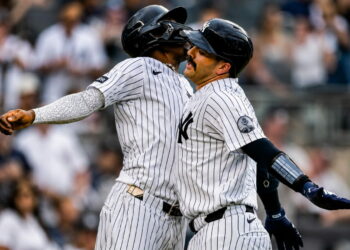
By the fifth, the Yankees had briefly recovered. Ben Rice’s fourth-inning home run tied the game, and New York loaded the bases with two outs in the top of the fifth before Cody Bellinger’s 405-foot drive died in center field. Tampa Bay answered immediately. Jonathan Aranda opened the bottom half with a hard single to right, Junior Caminero doubled, and the Rays eventually scored four runs to take control.
The sequence left the Yankees trailing 5-1 and shifted the focus back to their defense. Liam Hicks’ groundout brought home the go-ahead run. Chandler Simpson followed with a run-scoring fielder’s choice, and Richie Palacios later delivered a two-run single off Brent Headrick. By then, New York’s margin for another questionable read had disappeared.
Boone and Jones see the same play differently
That is where an unusual postgame contradiction emerged. Boone defended Jones on Aranda’s leadoff single, saying the ball was not realistically catchable. Jones took a different view of his own read and said he should have made the play after hesitating on what he described as a difficult read.
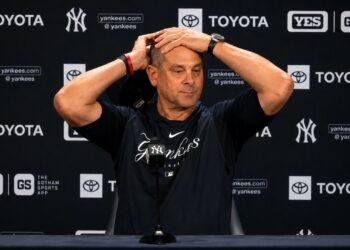
Boone was emphatic when asked whether Spencer Jones could have prevented the hit that started Tampa Bay’s decisive inning. The manager separated it from the Yankees’ more obvious mistakes and pushed back on placing blame on his rookie right fielder.
“It was a bullet single to right. There are plenty of others to pick on tonight. That wasn’t one of them,” Boone said.
The distinction matters because Aranda later scored the go-ahead run. The hit was not charged as an error, and it came off the bat at 109.4 mph. But Jones’ own assessment did not match his manager’s defense. The rookie acknowledged that he hesitated and believed he should have caught it.
The 13.4-foot gap adds another layer
Statcast provides a sharper way to examine the disagreement. Jones’ jump on Aranda’s ball was measured at 13.4 feet below average. MLB defines outfielder jump as the number of feet a player covers in the correct direction during the first three seconds after pitch release, compared with the expected movement on similar plays.
That does not automatically make Aranda’s ball an error or prove a catch was routine. Exit velocity matters, as do angle, positioning and reaction time. But the number shows why Jones’ hesitation is relevant. On a play decided by a rapidly closing window, 13.4 feet of below-average initial movement is substantial. It supports Jones’ explanation that the read, rather than pure speed, left him short.
The contrast also exposes a larger issue for the Yankees after a night when defensive accountability became unavoidable. Boone had warned before the series that Tampa Bay’s contact and athleticism would punish mistakes. In Game 2, the Rays did exactly that. New York’s defense gave them extra opportunities in the first inning and again failed to shut down the fifth.
Yankees return home with no margin left
The Yankees‘ pitching staff could not erase every mistake. Schlittler took the loss after allowing four runs, two earned, in 4 1/3 innings. Cam Booser earned the win for Tampa Bay, and Bryan Baker recorded his second save of the series. Rice supplied all of New York’s scoring with two solo home runs, while the Yankees finished with four hits.
The 5-2 defeat leaves the Yankees down 0-2 in the best-of-five ALDS. MLB postseason data shows teams taking a 2-0 lead in a best-of-five series have advanced 83 of 93 times. Teams winning the first two games at home in the current Division Series format have advanced 33 of 36 times.
New York now returns to Yankee Stadium for Game 3 on Wednesday night with Max Fried scheduled to start. A loss ends the Yankees’ season. A win would extend the series and put Carlos Rodón in line for a potential Game 4.
Before the Yankees can worry about extending the series, the Game 2 tape leaves a more immediate question. Boone saw Aranda’s single as one play that did not belong on the list of failures. Jones saw an opportunity he missed. On a night when New York’s defense repeatedly broke down, that difference in judgment became part of the story itself.
What do you think? Leave your comment below.