NEW YORK — The Yankees finally found a way to win a game that spent most of Friday night looking like another exhibit in their prolonged offensive slump.
They struck out 15 times. They stranded 13 runners. They finished 2-for-11 with runners in scoring position and did not hit a home run. For eight innings at Yankee Stadium, New York could not score against an Atlanta staff that kept escaping traffic.
The Braves did not need sustained rallies. Austin Riley broke a scoreless tie with a solo homer off Fernando Cruz in the eighth, and Matt Olson added another solo shot off Tim Hill in the ninth. That left the Yankees three outs from a shutout loss despite another strong start from Max Fried.
Then the bottom of the lineup changed the game. George Lombard Jr. reached on an infield single and raced to third on Raisel Iglesias’ throwing error. After Ryan McMahon struck out, Austin Wells doubled Lombard home with two outs. Amed Rosario walked, and Ben Rice followed with a two-out RBI single off the right-field wall to tie the score.
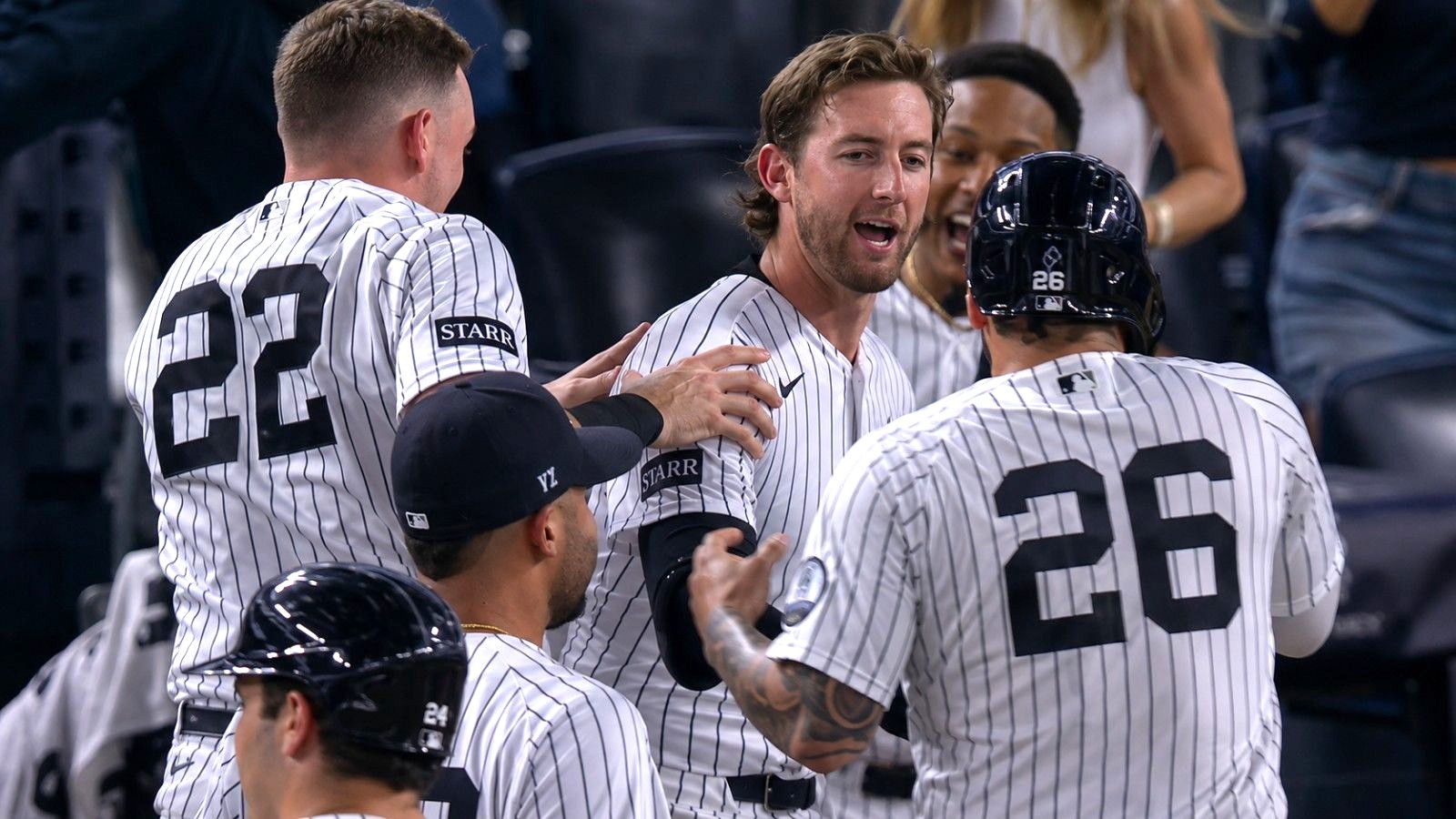
The Yankees eventually won 3-2 in 10 innings when McMahon lifted a bases-loaded sacrifice fly to right, scoring automatic runner Luis García Jr. It was New York’s first extra-inning walk-off win of the season and only its second victory in 10 extra-inning games.
The ending delivered relief without changing what came before it. The Yankees needed their final four outs to produce all three runs after another night of empty opportunities. Their pitching staff and defense again kept the margin small enough for one late sequence to matter.
That contrast was especially important with the Yankees trying to hold second place in the AL East while Boston surged behind them. New York escaped with a win, but the performance left the same offensive question that has followed the club for weeks.
McMahon says Yankees still have to solve offense
McMahon had two hits before his sacrifice fly and finished as the player credited with the winning RBI. His postgame assessment, however, centered on the eight scoreless innings that forced the Yankees into another narrow finish.
“We gotta figure that out. We gotta get going a little bit more, but it’s not from a lack of work or effort. But we gotta figure a way to get going,” McMahon said.
Mahle, making his Braves debut, worked six scoreless innings, allowing three hits and two walks while striking out nine.
The larger problem has followed the Yankees since Aaron Judge suffered a fractured rib May 31. Through Wednesday, New York was 28-28 without him. Over that span, the Yankees ranked 30th in MLB in batting average and on-base percentage while averaging 3.9 runs per game.
The trouble was not limited to RISP. Entering Friday, the Yankees also ranked at the bottom of MLB in batting average with the bases empty since Judge went down. The situational failures have been part of a broader hitting problem.
Late situational hitting changes the result
Friday offered a different scoring formula for the Yankees. Atlanta got both of its runs on homers. New York got none of its three that way.
Instead, Wells delivered a two-out double, Rice supplied a two-out single and McMahon produced the winning sacrifice fly. The Yankees entered Friday with 26 sacrifice flies, tied for the fifth-fewest in MLB.
Lombard created the ninth-inning opening with his speed after Iglesias’ error. Wells cut the deficit in half, and Rice tied the game after beginning August without a hit.
The bottom third of the Yankees lineup carried much of that work. Lombard batted seventh, McMahon eighth and Wells ninth. Together they produced four hits, two walks, two RBIs and two of New York’s three runs.
Yankees question remains
The Yankees’ offensive collapse without Aaron Judge is bigger than a failure to hit with runners in scoring position. Judge was placed on the injured list June 5, retroactive to June 2, after doctors diagnosed a stress fracture in his right first rib. Since June 5, New York has gone 28-26 through Friday’s 3-2, 10-inning win over Atlanta, leaving the Yankees 65-51 and 4.5 games behind Tampa Bay entering Aug. 8.
The broader numbers explain why the lineup has become such a concern. Through the Aug. 5 game, the Yankees had hit only .220 with a .285 on-base percentage, .389 slugging percentage and .674 OPS since Judge’s absence began. MLB analyst Mike Petriello highlighted an even more revealing split: New York ranked 30th in batting average with runners in scoring position — but also 30th with the bases empty. In other words, this is not simply a “clutch hitting” problem. The Yankees have struggled to create offense in virtually every game state.
Friday’s comeback against the Braves did little to erase that concern. New York managed seven hits in 35 at-bats, went 2-for-11 with runners in scoring position and stranded 13. The Yankees were scoreless through eight innings before Austin Wells and Ben Rice tied the game in the ninth and Ryan McMahon delivered the walk-off sacrifice fly in the 10th.
Judge’s absence has also exposed regression elsewhere. Trent Grisham, Jazz Chisholm Jr., Ryan McMahon and others have struggled with either contact quality or swing decisions, while Cody Bellinger’s hamstring injury further reduced the lineup’s margin for error.
There is progress with Judge: he has been cleared for light activity and remains confident he will return this season. Until then, the evidence points to a lineup-wide problem, not merely poor execution with runners in scoring position.
Win keeps pressure on offense
MLB’s postgame standings left the Yankees at 65-51 and in second place in the AL East, 4 1/2 games behind Tampa Bay and a half-game ahead of Boston. The Red Sox had won nine straight and 32 of 37, tightening the postseason race around New York.
The Yankees also ended Atlanta’s eight-game winning streak.
New York survived 15 strikeouts, 13 stranded runners and another poor night with runners in scoring position because its pitching and defense kept the game close long enough for the lineup to break through.
McMahon’s sacrifice fly changed the result. His postgame message made clear the Yankees still do not view the offense as fixed.
What do you think? Leave your comment below.