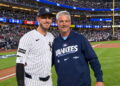
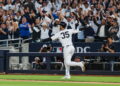
CINCINNATI — The Yankees spent nearly a decade developing Oswaldo Cabrera, watched him become one of the clubhouse’s most adaptable players and then reached the point this week when one 40-man roster spot mattered more than organizational history.
The Cabrera DFA decision was difficult to understand. Clarke Schmidt had finished a 14-month recovery from Tommy John surgery and needed to come off the 60-day injured list. The Yankees, already preparing their pitching staff for October, chose to preserve an arm they believe can help the bullpen rather than keep another utility infielder on the 40-man roster.
What made the choice uncomfortable was everything surrounding Cabrera. He had returned from the severe left ankle fracture that ended his 2025 season, spent most of 2026 rebuilding at Triple-A Scranton/Wilkes-Barre and produced enough there to make his next step less predictable than a typical September roster casualty.
Cabrera hit .288 with a .790 OPS, 19 home runs and 69 RBIs in 122 Triple-A games. Yet his major league opportunity amounted to nine at-bats across three Yankees games. He also carried a $1.2 million salary, defensive experience at seven positions and two more seasons of club control, all traits that can make a waiver claim relatively easy for another organization to justify.
Aaron Boone made clear Wednesday that the Yankees did not view the designation as a verdict that Cabrera could no longer help a major league team. He openly left room for the possibility that Cabrera might clear waivers and remain in the organization that signed him out of Venezuela in 2015.
“The good thing is Oswaldo’s come back from a very difficult injury and had a really good year down in Triple-A,” Boone said. “He’s playing really well. So hopefully this is just one of those things, and I’m confident that Oswaldo will go on to have a very good career. Hopefully it’s still with us.”
Cincinnati sees more than a September fill-in
That possibility disappeared Friday. The Cincinnati Reds claimed Cabrera off waivers, ending his Yankees tenure after 304 major league games over five seasons and immediately framing the acquisition as more than a late-season depth move.
Reds manager Terry Francona said reports on Cabrera’s makeup were “off the charts.”
He added that Cincinnati felt it “can’t pass this one up.”
That language creates the sharpest contrast with the Yankees’ decision. New York saw a roster squeeze and accepted the risk of losing Cabrera for nothing. Cincinnati saw enough versatility, character and remaining control to use a 40-man spot on him immediately.
Former Yankees catcher Jose Trevino was among the people who supplied positive feedback. Francona said people were “raving” about Cabrera, reinforcing a reputation that followed him throughout his time in the Bronx.
Roster math makes Cincinnati’s risk unusually small
The Reds did not surrender a prospect or cash in a trade. They assumed Cabrera’s contract through a waiver claim and inherited control through 2028. He also has a minor league option remaining after 2026, giving Cincinnati flexibility if he does not immediately secure a major league bench role.
There is also a performance clue beneath the roster mechanics. Cabrera hit 19 home runs in 122 Triple-A games this season, just one fewer than the 20 he hit across 304 major league games for the Yankees. The levels are not directly comparable, but the contrast helps explain why Cincinnati can reasonably investigate whether his 2026 power growth will translate.
His major league track record remains modest. Cabrera hit .232 with a .635 OPS, 20 home runs and 95 RBIs during his Yankees career. But the Reds are not paying for established everyday production. They are evaluating a 27-year-old switch-hitter who can move around the diamond and still has roster flexibility.
Yankees chose October pitching over Cabrera’s versatility
The Yankees made the move because Schmidt needed a 40-man place after his second Tommy John rehabilitation. That turns the transaction into a direct organizational choice between postseason pitching depth and retaining a controllable utility player.
Schmidt returned Wednesday and is expected to work out of the bullpen after making only two minor league rehab appearances. The Yankees have already clinched a postseason berth, so keeping as many usable arms as possible has obvious October value.
Still, Cabrera’s departure removes inexpensive coverage from a roster that has repeatedly needed positional flexibility. He played every infield position except catcher and both corner-outfield spots for the Yankees. Cincinnati now gets to test that same versatility without giving up a player in return.
Francona’s words leave Yankees with uncomfortable part
Cabrera is expected to join Cincinnati over the weekend, and the Reds will need another 26-man roster move when he is activated. Francona has already described him as someone who could remain with the club next season.
For the Yankees, the transaction is finished. Their calculation can still prove sensible if Schmidt becomes an important postseason arm and Cabrera settles into a reserve role elsewhere. But Boone’s hope that Cabrera might clear waivers lasted only two days.
That is what makes Francona’s reaction notable. Cincinnati did not sound like a club merely taking a September flier. The Reds sounded like an organization that saw a low-cost 2027 and 2028 asset in a player the Yankees decided they could risk losing.
What do you think? Leave your comment below.