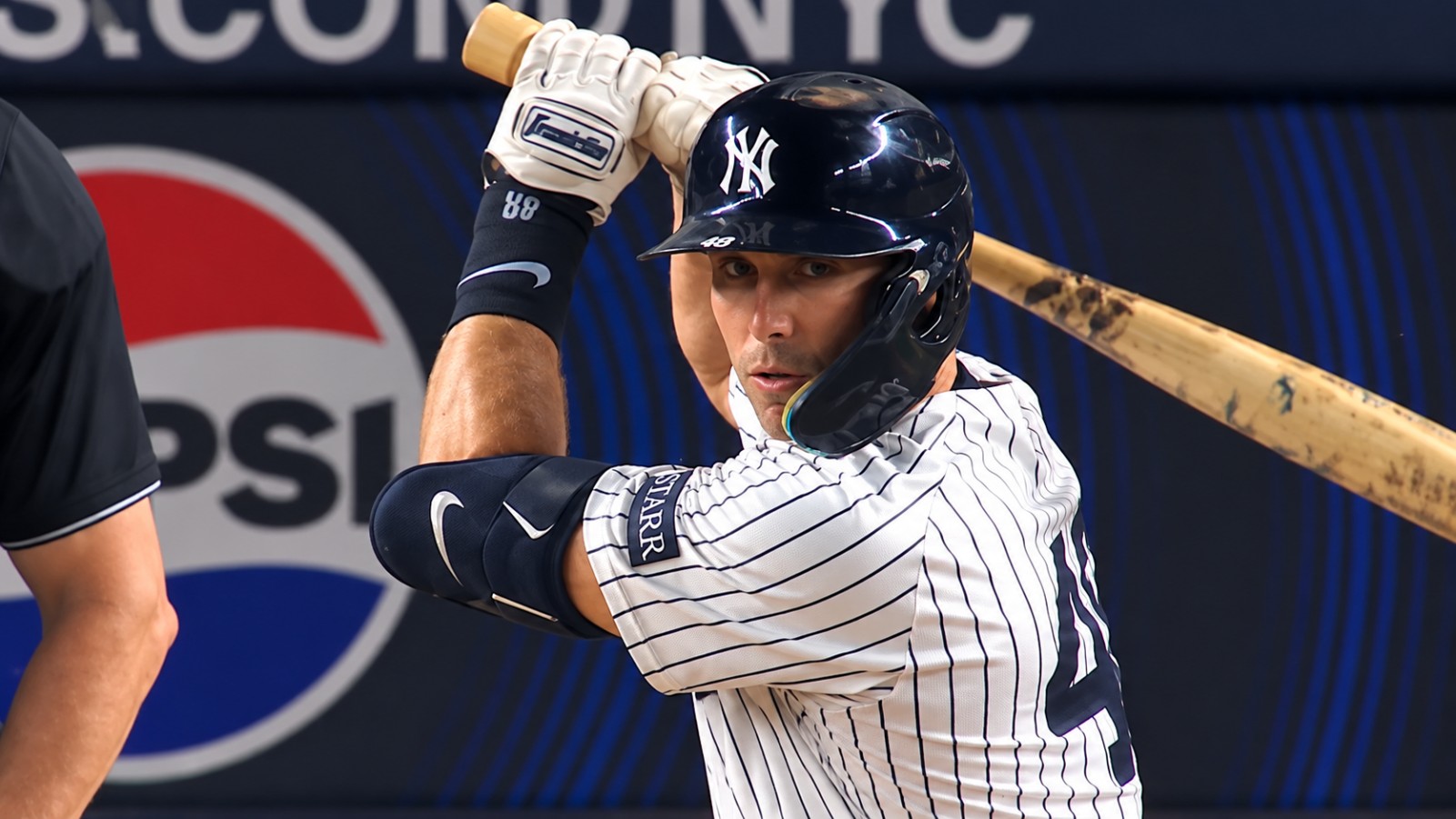
NEW YORK — Paul Goldschmidt entered Thursday night in an unfamiliar place for a former MVP. His name was no longer guaranteed a central spot in the Yankees lineup, his September at-bats had thinned, and every appearance looked increasingly tied to Aaron Boone’s postseason decisions rather than an everyday role.
The game against Tampa Bay sharpened that pressure. The Yankees had one hit through five innings against left-hander Ian Seymour and trailed 4-0 at Yankee Stadium. Austin Wells homered in the sixth. George Lombard Jr. doubled home Ben Rice in the seventh, then scored on a wild pitch to pull New York within one.
Goldschmidt came up with two outs and the Yankees still trailing 4-3. Seymour was gone, and right-hander Brody Hopkins had the ball. Goldschmidt lined a single to center, scoring Wells and moving Jose Caballero to third. Lombard’s two-run homer off Steven Matz in the eighth completed a 6-4 comeback against the AL East champion Rays.
The Yankees improved to 92-67. Goldschmidt finished 2-for-4 with a double and an RBI on a night when his shrinking role still produced a high-leverage answer.
The Yankees are no longer asking the 39-year-old to carry first base every day or reproduce the force that made him the 2022 National League MVP. They are deciding which situations can still make his present skill set matter in a short series, where one favorable plate appearance can outweigh a week of regular-season volume.
That is the tension behind the final roster choices. Goldschmidt’s season is no longer about whether he deserves everyday status. It is about whether Boone can isolate the version of the veteran that still changes innings, then protect that advantage when an opposing manager starts moving pieces.
Yankees built this role into roster in February
The Yankees knew the role could narrow when they brought Goldschmidt back on a one-year contract in February. Ben Rice had established himself as a core bat, and Boone acknowledged that another first baseman made the roster fit less clean.
The Yankees still valued Goldschmidt’s specific skill. Boone framed the decision as choosing the player over the perfect positional fit.
“But to finish off our roster with a really good player, we felt like we had to do it,” Boone said.
The 2025 season supplied the blueprint. Goldschmidt hit .336/.411/.570 with a .981 OPS against left-handers. The advanced split comparison was similarly strong: a 169 wRC+ with a .440 xwOBA in 2025, followed by a 175 wRC+ and .379 xwOBA in 2026.
The expected-production figure has declined, but the matchup damage remains strong enough to shape a postseason lineup. Goldschmidt is now a specialized Yankees roster piece whose value rises when the opposing pitching plan leans left.
The hidden split is bigger than home runs
The power gap is obvious. Goldschmidt has hit 11 homers in 153 at-bats against left-handers, one every 13.9 at-bats. Against right-handers, he has seven in 184 at-bats, one every 26.3.
He also has 22 walks in 179 plate appearances against lefties but only seven in 192 against righties. His on-base percentage is 168 points higher against left-handed pitching.
For the Yankees, that means Goldschmidt against a lefty is not simply a home-run gamble. He creates traffic and forces pitchers to navigate a veteran who still controls those matchups.
Goldschmidt’s reduced Yankees role has one clear October lane
The clearest lane remains left-handed pitching. Through Thursday, Goldschmidt was batting .307 with a .402 on-base percentage and .588 slugging percentage against lefties, a .990 OPS across 179 plate appearances. He had 11 home runs and 24 RBIs in those matchups, with a 175 wRC+.
Against right-handers, Goldschmidt was hitting .207/.234/.342, a .576 OPS in 192 plate appearances. Seven of his 18 homers came against righties.
That is the October value Boone can exploit. Goldschmidt can start or come off the bench against a difficult left-hander, then remain useful long enough to survive the opponent’s first counter move.
Thursday supplied the wrinkle. His tying hit came after Tampa Bay switched to Hopkins, a right-hander. One single does not erase the split. It does show that using Goldschmidt for the initial matchup does not automatically require removing him when the opposing manager changes arms.
Thursday gave Boone a counter to the counter
The practical question is what happens after Goldschmidt gets the matchup the Yankees want. Opponents can answer with a right-handed reliever, and his numbers say that usually reduces New York’s advantage.
Thursday showed the escape route. Boone let the plate appearance play out after Tampa Bay changed the matchup, and Goldschmidt produced the tying run. The Yankees needed one competitive swing after the original advantage disappeared.
That is the role Goldschmidt carries toward October. The Yankees can use him to attack left-handed pitching without pretending his splits are balanced, while game state and bench options decide whether he stays in after a pitching change.
New York closes the regular season against Baltimore before the Wild Card Series begins Tuesday. Goldschmidt’s overall line, .255 with 18 home runs and 51 RBIs, no longer tells the most useful part of his Yankees story. The matchup does, and Thursday showed Boone may have slightly more room to exploit it than the platoon numbers alone suggest.
What do you think? Leave your comment below.