NEW YORK — Luis Garcia Jr.’s swing lit up Yankee Stadium, But it was not the most telling thing he did on his Yankees debut.
The newcomer went 2 for 4 with two RBIs, batted third in a lineup that had gone cold, and briefly handed the Yankees the lead in a game they would lose 13-7. The bat did its job on the first night. The glove did something the Yankees did not advertise when they made the trade.
In the first inning, Garcia turned a clean double play at first base, taking a feed and firing across to retire Cardinals shortstop Masyn Winn. It was a routine-looking play with an unusual backstory. Garcia spent years as a middle infielder before this season, and that footwork showed up on the pivot.
Manager Aaron Boone noticed. Most of the postgame attention landed on the homer, a two-run drive off George Soriano into the right-center-field bullpen. Boone kept circling back to the defense.
The Yankees acquired Garcia from the Washington Nationals on Sunday and threw him into the fire a day later, and his all-around debut answered an awkward question the front office created at the trade deadline. New York already had two left-handed-hitting first base and designated hitter options in Ben Rice and Paul Goldschmidt. Then it added a third in Garcia, another left-handed bat at the same crowded spots.
For one night, the fit looked seamless. The Yankees got production, defense and a middle-of-the-order presence from a player who had joined the clubhouse hours earlier.
The glove was the overlooked part of the deal
Luis Garcia Jr.‘s defensive ease at first base is not a small detail. He came up through the Nationals system as a second baseman and shortstop, and only recently shifted across the diamond. That infield background gave him tools most first basemen do not have, and it surfaced in his first game.
Boone singled out the double-play turn as the kind of play few first basemen make cleanly. The praise stood out because it had nothing to do with the offense the Yankees traded for.
“Very few guys are turning those double plays,” Boone said. “And then, good at-bats, too. So, excited for him. Cool that he came in, first day you get settled in and have a big night. Hopefully that goes a long way in getting him acclimated where it’s normal and routine for him.”
The Yankees had marketed the deal as an offense-first move. The defense was a quiet bonus, and it showed up before Garcia ever came to the plate in a big spot.
A four-pitcher price for an offense-first bet
The Yankees paid a real price to add Garcia. They sent four right-handed pitchers to Washington: Yovanny Cruz, Jake Bird, Jack Cebert and Ben Grable. Cebert had ranked as the Yankees’ No. 14 prospect and Grable as their No. 25, per MLB Pipeline.
The return was a hitter in the best season of his seven-year career. Garcia carried a .283/.313/.560 line with an .873 OPS at the time of the trade, and he led the National League in slugging percentage entering Sunday. His debut homer and two RBIs pushed his season totals to 24 home runs and 78 RBIs, both career highs.
General manager Brian Cashman brushed aside the idea that Garcia and Rice cancel each other out. He framed the move as added depth rather than redundancy.
“We went into the trade deadline looking to find ways to improve our offense, and quite simply, he does do that. He improves our offense,” Cashman said. “He gives us more flexibility, more choices, and more impact. It makes us deeper and it makes us better, period.”
Garcia also arrived with team control through 2027, giving the Yankees more than a two-month rental as they push for position in the American League East.
Power built to travel, not a short-porch trick
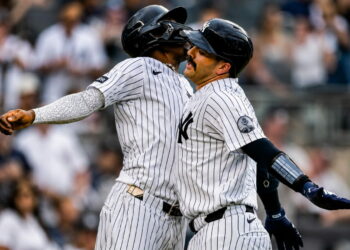
The homer itself carried a message. Garcia did not loop a fly ball down the short right-field line at Yankee Stadium. He drove a 2-2 pitch to right-center and cleared the bullpen, a swing that would leave many parks.
That distinction matters for a player joining a ballpark famous for cheap home runs to right. Garcia has pulled the ball in the air at a career-high 18.5% rate this season, a trait the Yankees believe the stadium will reward without turning his power into an illusion.
His platoon profile is the one caveat. Garcia has punished right-handed pitching for a .918 OPS this season, which is why the Yankees valued his bat over their stated search for right-handed balance. He has been weaker against left-handers, hitting .247 against lefty starters, up from .195 a year ago.
Boone has said he sees Garcia mainly at first base or designated hitter against right-handers, with Goldschmidt drawing most of the starts against lefties. That split is the framework, at least until the lineup gets healthier.
A debut that reshapes the Yankees’ lineup math
The strong first night created the Yankees’ preferred kind of problem. Garcia, Rice and Goldschmidt are all first base and designated hitter types, and Boone now has to divide a limited number of spots among them once Aaron Judge and Cody Bellinger return from injury.
The offense needed the jolt. The Yankees had scored just seven runs across their previous four games and 35 over their previous 12 before Garcia arrived. His debut hinted at the middle-order presence they have lacked.
Garcia, a New York native who grew up rooting for the Yankees, said the homecoming and the home run made the night one he will hold onto. He kept the ball from his first Yankees homer.
“It means a lot to be able to do that, hit a home run in Yankee Stadium and to be able to get the ball back,” Garcia said through an interpreter. “It’s a great moment there, a great memory. So I’ll keep that in my heart.”
The Yankees lost the game, but they may have found a piece. Garcia returns to the lineup Tuesday, and the early evidence suggests his breakout can survive the move from Washington to the Bronx. The bat made the highlight. The glove made the point.
What do you think? Leave your comment below.