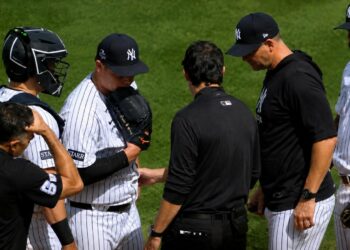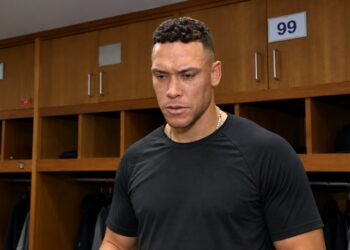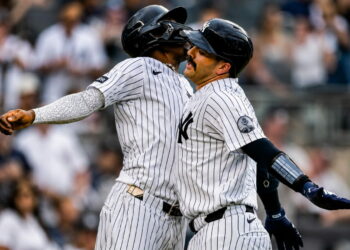
SAN DIEGO — Aaron Boone gave Jazz Chisholm Jr. a breather in a 5-1 Yankees win over the San Diego Padres at Petco Park, one day after Chisholm went hitless in the series opener.
For Chisholm, the night off arrived in the middle of a debatable season. MLB’s official statistics list him at .229 with a .310 on-base percentage and .403 slugging percentage entering Sunday, with 19 home runs and 55 RBIs. His 40 stolen bases lead the American League. The Yankees, meanwhile, are 81-61, four games behind Tampa Bay in the AL East and holding the league’s top wild-card position with 20 games remaining.
Chisholm is approaching the end of his Yankees season. He is making $10.2 million in 2026, and the decision over what comes next is moving closer even as the Yankees keep their attention on October.
The contract question carries more weight because of what came before it. Chisholm finished 2025 with 31 home runs and 31 stolen bases, producing the fourth 30-30 season in Yankees history. That raised expectations for another power-speed showcase. Instead, 2026 has mixed elite baserunning with diminished offense, making the Yankees’ next valuation less automatic.
The four words that set the tone
Then came the moment that framed the entire conversation. After hearing the names ahead of him on the open market, Jazz Chisholm Jr. did not talk about a record contract or a bidding war. He said something plainer, and more revealing, about where he wants to be.
“I want to stay a Yankee, by any means kind of,” Chisholm told Randy Miller of NJ.com.
It was not a slip. Asked directly whether he badly wants to remain in New York, Chisholm did not hedge. He returned to the theme again and again, describing the Bronx as the place that fits him.
“This is the best place for me, the Yankees,” Chisholm said.
What happened to the extension talk
The wrinkle is that the two sides are not talking. Chisholm said his last real conversation with the Yankees on his future came back in spring training, and it went nowhere. Asked when he had spoken with the team about an extension, his answer was blunt.
“Not since spring,” he said.
Pressed on what happened in Florida, Chisholm relayed the message he says he received about a long-term deal. The organization, he indicated, was not interested in that path.
“It was just like, ‘We don’t do extensions.'”
He did not describe a formal pitch. Asked whether he had reached out to Yankees general manager Brian Cashman, Chisholm painted it as an informal, almost accidental encounter rather than a negotiation.
“I would not say I reached out,” he added. “It was more of a mutual thing. It was me walking around saying something to Cash. He walked past me.”
The lockout math nobody else is running
The collective bargaining agreement expires Dec. 1, and a lockout is widely expected to follow almost immediately.
Chisholm has clearly thought about the timing. He noted, correctly, that free agents can technically sign before a lockout begins. He pushed on whether a deal could get done in that narrow window, even as most around the game assume no marquee player will commit before the new economic rules are set.
“Free agents can sign before that lockout happens,” he said.
The more realistic bridge is a qualifying offer, the one-year tender teams can extend to keep a player. It is set at the average salary of the 125 highest-paid players and is projected near $23 million for 2027, though the next CBA could raise it, lower it or scrap it. For Chisholm, who is earning $10.2 million this season, that would be more than double his pay to bet on himself for another year.
He is already gaming out the risk out loud, raising a scenario that has no clean answer yet.
“Let’s say I do sign a qualifying offer and we lose the whole season in a lockout?” Chisholm asked. “Do I get that money or am I a free agent in a new CBA?”
There is precedent for the qualifying-offer route in this clubhouse. Center fielder Trent Grisham accepted the Yankees‘ $22.025 million qualifying offer last winter rather than test a market projected in the three-year, $54 million to four-year, $66 million range. The Yankees made that offer partly out of fear that a rival would price them out on Cody Bellinger.
The suitors, and a Yankees budget already stretched
If the Yankees do move on, Chisholm has floated where he might land. He spoke warmly of the Philadelphia Phillies, in large part because of a familiar face. Don Mattingly, the Yankees legend, managed Chisholm in Miami from 2020 to 2022 and could return to Philadelphia in 2027. Chisholm made clear the bond runs deep, while framing it as admiration rather than a recruiting pitch.
“Me and Donny are like this,” Chisholm told while holding his thumb and index finger a sliver apart to emphasize just how small the margin was. “Me and his son, his wife … all of us are tight. I love Don Mattingly. The Phillies got (Kyle) Schwarber and (Bryce) Harper. They got pitching. They got Arraez at second base. They’re trying to win for sure.”
A 100-point OPS drop complicates the contract case
The timing would have looked far different a year ago. Chisholm finished 2025 with a .242/.332/.481 slash line, 31 home runs, 80 RBIs and 31 stolen bases in 130 games, according to MLB. He became the fourth Yankee to post a 30-homer, 30-steal season.
His 2026 season has split in two directions.
Chisholm’s .713 OPS is exactly 100 points below the .813 mark he produced last season. He has 19 homers after hitting 31 in 2025. Yet he has already stolen 40 bases, nine more than last year, in just two more games. That combination gives the Yankees a more complicated valuation than a simple down-year label would suggest.
The speed remains elite even as the power, batting average and on-base percentage have slipped. His baserunning remains one of the lineup’s most distinctive weapons.
Where the story stands now
Chisholm insists his season has been about pushing the Yankees toward October, not lining up a dream contract, and that his slump gnawed at him more than any free-agency pressure.
“The only thing that matters is helping the Yankees win the World Series,” he said. “That’s what I’m thinking about. That’s what I want.”
The final call will likely wait until after the labor dust settles, when Hal Steinbrenner and Cashman decide whether to spend big on a hugely talented second baseman coming off a down year. Chisholm knows the offer, if it comes, may depend on a strong finish and a deep playoff run.
“Of course, of course,” he replied to a question if he is ready to pass on long-term deals for another Yankees year. “I want to be in New York, so definitely. But I think the only way they send that is if the playoffs come and I play super. If I do that …”
The sentence trailed off, unfinished. For now, so does his future with the Yankees in the Bronx.
What do you think? Leave your comment below.