BRONX, N.Y. — A defensive mistake Thursday night didn’t trigger the Yankees’ decision to demote Jasson Dominguez. The manager has made his choice earlier, even before the first pitch.
With Aaron Judge getting a scheduled recovery day, Dominguez started in right field and batted third against the Colorado Rockies at Yankee Stadium. It was only the 20th time in his major league career that he had occupied the No. 3 spot.
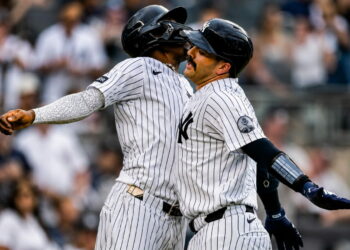
The Yankees won 10-3, completed a three-game sweep and improved to 84-62. Anthony Volpe drove in a career-high five runs, including a grand slam in a six-run seventh inning. Luis García Jr. hit his 30th homer, Spencer Jones collected three hits and John Schreiber earned the win in relief.
Dominguez’s night moved in the opposite direction. He went 0-for-4 with a walk and two strikeouts. In the eighth inning, he mishandled Adael Amador’s single to right off Luis Gil, allowing Zac Veen to score from first. It was his third error of the season and his second costly outfield misplay in three games.
The opportunity itself showed how unusual his roster position had become. Dominguez had been recalled only five days earlier when Trent Grisham went on the injured list, yet the Yankees already had Cody Bellinger established in left field, Jones taking over much of the work in center and Heliot Ramos available as another matchup option.
Judge’s return added another layer. The Yankees activated their captain Sept. 7, but Dominguez remained on the roster and then received Thursday’s high-profile assignment when Judge rested. That did not erase the larger question of where regular at-bats would come from once the outfield was closer to full strength.
By the time Thursday ended, the answer had become clearer. The final mistake drew the attention. The roster logic had been building for days.
Rockies error was the final push, not the whole case
Shortly after the victory, the Yankees optioned Dominguez to Triple-A Scranton/Wilkes-Barre. No corresponding move was immediately announced, leaving open the possibility that New York could add a pitcher before Friday’s Subway Series opener against the Mets.
The timing naturally tied the demotion to Thursday’s error. The larger timeline points to a decision that had been building well before that ball got past him.
When the Yankees recalled Dominguez on Sept. 5 after Grisham went on the injured list with a right hamstring strain, the New York Post already described him as a likely short-term fill-in with Judge nearing a return and Jones expected to receive most of the work in center field.
That was before Dominguez made another defensive mistake against San Diego on Sept. 6, failing to field Dustin Harris’ single cleanly and turning it into a two-base error. Gerrit Cole escaped the inning without allowing the run to score.
Boone did not frame that mistake as grounds for a roster move. He described it as a play Dominguez simply had to finish.
“Obviously, it’s a play you’ve got to make,” Boone said then. “Fortunately, we were able to get out of that inning, but he just didn’t make the play. … Errors happen. You’ve got to catch the ball.”
The next day, the Post again reported that Dominguez was likely headed back to Triple-A once Judge returned.
Judge’s return did not immediately send him down
The Yankees activated Judge from the 60-day injured list Sept. 7 but did not option Dominguez. Right-hander Elmer Rodríguez went to Triple-A instead.
Dominguez stayed long enough to pinch-run in Wednesday’s 6-1 win over Colorado and then received the unexpected No. 3 assignment Thursday while Judge rested.
That makes it too strong to say the Yankees had formally decided the exact date of Dominguez’s demotion before his latest error. Their actions show they were still willing to use him when the roster required it.
They also show why one fielding play cannot explain the outcome. The organization had already signaled that his place in the Yankees outfield had narrowed considerably.
Roster math had already turned against Dominguez
Judge’s return restored the Yankees’ everyday right fielder. Bellinger has remained established in left. Jones has moved ahead in center, while Ramos has carved out a role, particularly against left-handed pitching.
That left Dominguez fighting for irregular at-bats as the Yankees chased Tampa Bay in the AL East and protected the American League’s top wild-card spot. After Thursday, New York was three games behind the Rays and 4 1/2 games ahead of Boston.
His production made that squeeze harder to overcome. Dominguez ends this stint hitting .229/.269/.376 in 56 games, with six home runs, 14 RBIs, 12 doubles and a .644 OPS in 205 at-bats. He struck out 46 times against nine walks in 217 plate appearances.
Triple-A offers regular work the major league roster no longer could. After his August option, Dominguez hit .306/.404/.471 over a 99-plate-appearance stretch at Scranton/Wilkes-Barre, strengthening the case for everyday development time.
One gaffe exposed a problem Yankees already knew
Thursday’s misplay mattered because it arrived during a rare start in Judge’s spot, with Dominguez batting in the heart of the order and trying to force his way into a crowded postseason picture.
But the Yankees did not discover his defensive questions in the eighth inning. They already knew the offensive line, and they already had Judge, Bellinger, Jones and Ramos competing for outfield work.
Those factors existed when Dominguez was recalled and remained after Judge returned. The second error in three games gave the existing roster problem a sharper ending.
For Dominguez, the demotion sends him back to Scranton/Wilkes-Barre with a familiar challenge: turn his tools and flashes into consistent major league production.
For the Yankees, the move is less about punishing one mistake than acknowledging where their outfield hierarchy now stands as the postseason race tightens.
What do you think? Leave your comment below.