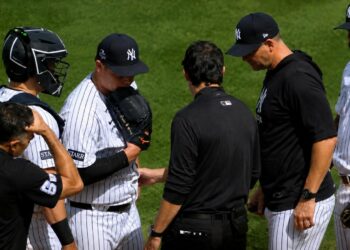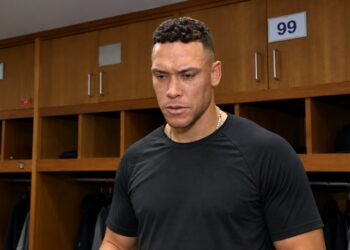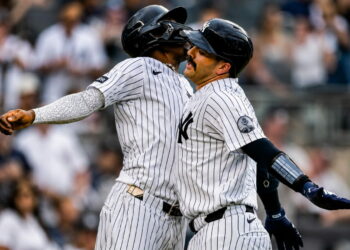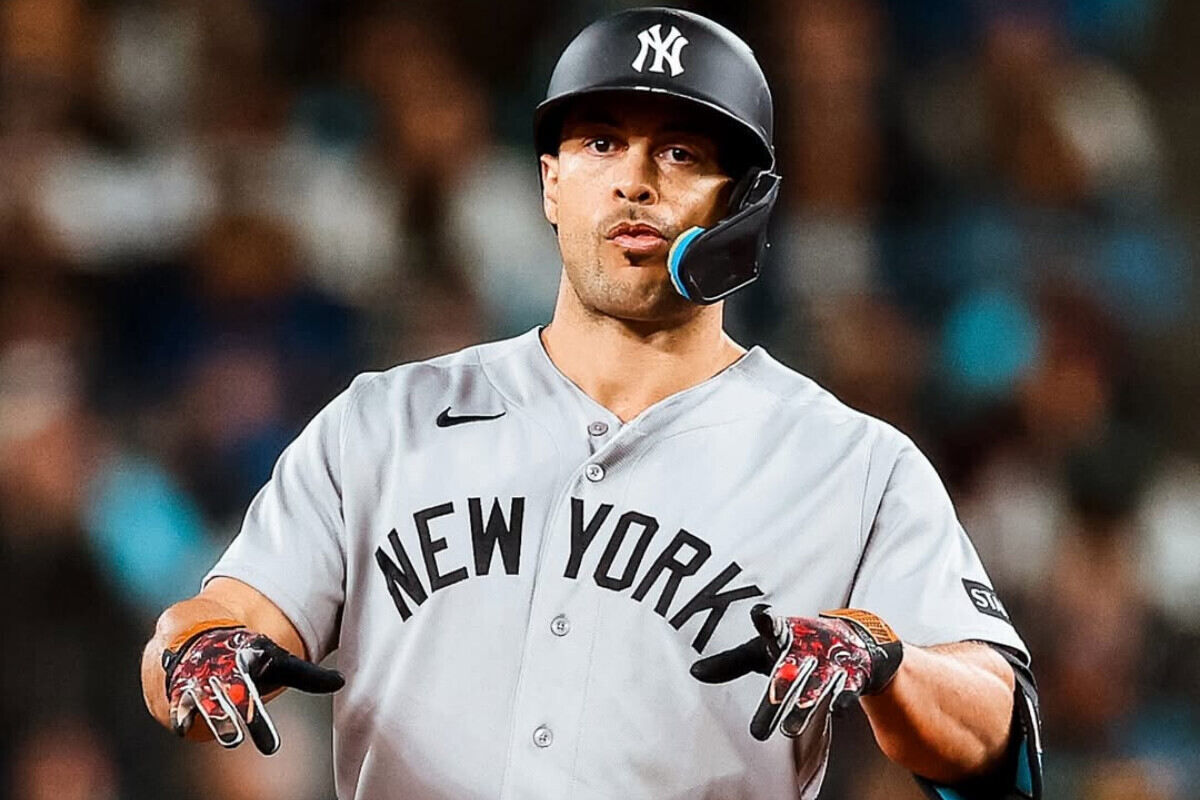
NEW YORK — The play looked harmless. Giancarlo Stanton was jogging the bases this week, doing the one thing that has repeatedly betrayed him, when his body gave out again. This time it was the left calf.
It was almost too on-brand to believe. Stanton had spent months rehabbing a right calf strain, and the final hurdle before his return was a simple baserunning progression. He fell. He grabbed the other leg. The comeback collapsed on the runway.
For a player whose Yankees tenure has become a grim study in soft-tissue breakdowns, it was the cruelest possible repeat, and it forced an uncomfortable question back into the open, one Yankees fans have circled for years without quite saying out loud.
The question is not really about one calf. It is about a decade, a fortune and a number that keeps climbing.
Stanton suffered a moderate-grade left calf strain after falling while running the bases, manager Aaron Boone announced Saturday, and his 2026 season is now in serious doubt.
“We’re not ruling anything out,” Boone said before Saturday’s 4-3 loss to the Blue Jays at Yankee Stadium. “He’ll obviously continue to work to try to get it right and hopefully be available. Obviously we’re at a point in the calendar where it gets challenging. But you also never know.”
The injury pushes his career total on the Yankees’ injured list to 467 regular-season games, all of them since 2019, and renews a debate that has trailed his contract for years: whether Stanton has become the biggest albatross in modern Yankees history.
It is a debate, not a verdict. Stanton was the MVP of the 2024 American League Championship Series and one of the most feared October hitters of his generation. But the injury ledger has grown so long, and the dollars so large, that even a longtime Yankees broadcaster has reached for the word. The case is now impossible to ignore.
The number that jumps off the page: 467 games on the IL
From the start of Stanton’s Yankees tenure through Aug. 22, 2026, he has spent 467 regular-season games on the injured list, and every one of them has come since 2019. Broken down season by season, the pattern is relentless.
| Season | Games played | Team games missed on IL | Primary injury |
| 2018 | 158 | 0 | Played through hamstring tightness |
| 2019 | 18 | 141 | Left biceps; right knee (PCL) |
| 2020 | 23 | 32 | Left hamstring strain |
| 2021 | 139 | 13 | Left quadriceps strain |
| 2022 | 110 | 37 | Right ankle; left Achilles |
| 2023 | 101 | 43 | Left hamstring strain |
| 2024 | 114 | 28 | Left hamstring strain |
| 2025 | 77 | 70 | Both elbows (epicondylitis) |
| 2026 | 24 | 103 | Right calf and rehab setbacks |
| Total | 764 | 467 |
The framing that lands hardest comes after his healthy first year. Since the beginning of 2019, Stanton has missed 467 of the Yankees’ 1,161 regular-season games on the injured list, or 40.2 percent. More than two out of every five Yankees games since 2019 have been played with Stanton unavailable and on the IL.
A career-long pattern of soft-tissue breakdowns
The injuries are not random. Since 2019, almost all of them have clustered in the lower body, the calf, quadriceps, knee, hamstring, ankle and Achilles, often more than once. The full Yankees-era timeline shows how little rest the pattern has allowed.
| Year | Injury | Status |
| 2019 | Left biceps strain | IL April 1-June 18 |
| 2019 | Right knee (PCL) sprain | IL June 26-Sept. 18 |
| 2020 | Left hamstring strain | IL Aug. 9-Sept. 15 |
| 2021 | Left quadriceps strain | IL to May 28; 13 games |
| 2022 | Right ankle inflammation | IL May 25-June 4 |
| 2022 | Left Achilles tendinitis | IL July 24-Aug. 25 |
| 2023 | Left hamstring strain | IL April 16-June 1 |
| 2024 | Left hamstring strain | IL June 23-July 29 |
| 2025 | Both elbows (epicondylitis) | Missed first 70 games |
| 2026 | Right calf, then left calf | IL April 25-present |
Why the ‘albatross’ word keeps coming up
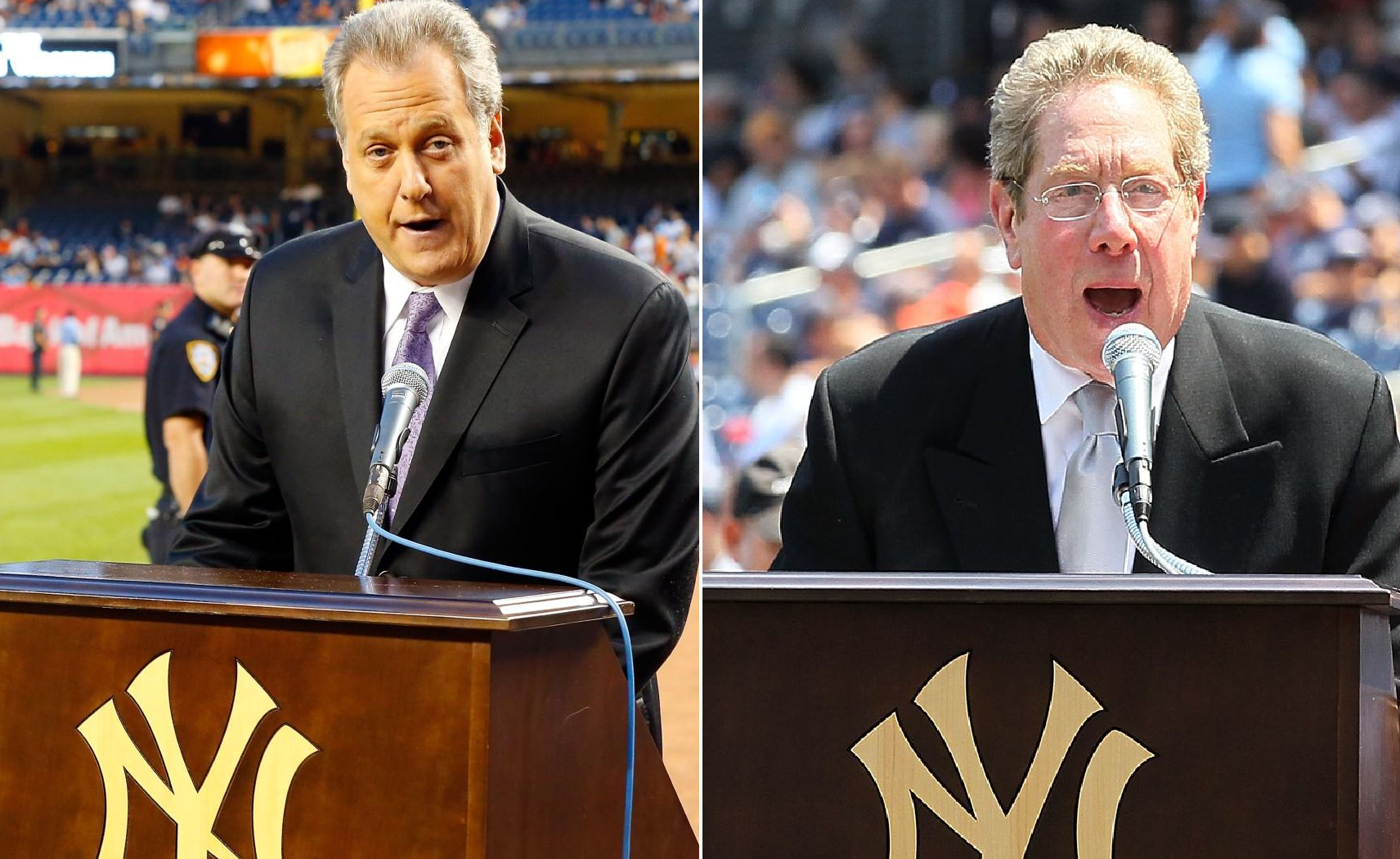
The label did not originate with critics on social media. Yankees broadcaster Michael Kay said this year that the Stanton trade would be an absolute albatross unless the club wins a World Series during his tenure, a striking admission from inside the building.
The dollars explain the anxiety. Stanton is earning $29 million this season and is owed $25 million in 2027, with a $25 million club option for 2028 that carries a $10 million buyout. One point the numbers often get wrong: this is not a $325 million Yankees contract. Miami signed the original 13-year, $325 million deal; the Yankees assumed about $265 million of the remaining obligation in the December 2017 trade, with Miami offsetting $30 million more across 2026 through 2028.
Bleacher Report recently listed the deal among the worst in the majors. Analyst Joel Reuter did not mince words about a player who has done little to justify his salary in 2026.
“He has not played since April 24 after suffering a calf strain and then a setback in his recovery in June,” Reuter wrote. “He has resumed running and taking batting practice as he looks to return for the stretch run, but thus far he has done little to earn his salary.”
Cost per home run: Stanton’s rank among Yankees contracts
The money looks different through another lens. Measured by dollars paid per Yankees home run, Stanton is not close to the worst contract the club has handed out this century, because the power, when healthy, has been elite. He has hit 189 regular-season home runs as a Yankee against about $265 million, or roughly $1.40 million per homer.
| Player | Yankees HR | Money paid/owed | Cost per HR |
| Kevin Youkilis | 2 | $12.0M | $6.00M |
| Jacoby Ellsbury | 39 | $153.0M | $3.92M |
| Josh Donaldson | 25 | ~$50.0M | $2.00M |
| Giancarlo Stanton | 189 | ~$265.0M | $1.40M |
| DJ LeMahieu | 77 | ~$106.4M | $1.38M |
| Anthony Rizzo | 60 | ~$72.5M | $1.21M |
| Chase Headley | 43 | ~$45.7M | $1.06M |
| Brian McCann | 69 | ~$62.0M | $0.90M |
| Alex Rodriguez | 351 | ~$317.4M | $0.90M |
The takeaway is nuanced. Stanton’s contract is enormous and his availability has been dreadful, but on a production-for-dollars basis the power has kept him off the bottom of the list. The truest albatrosses, by this measure, gave the Yankees almost no home runs for their money.
The case for defense: October, and better albatross candidates
Any honest version of this debate has to reckon with what Stanton did two Octobers ago. In the Yankees’ 2024 run to the World Series, he was the best hitter on the roster, launching four home runs in the ALCS against Cleveland to earn series MVP honors. For his Yankees career he owns 18 home runs and 44 RBIs in 48 postseason games, the kind of October production front offices spend fortunes chasing.
That résumé is what separates Stanton from the two names usually cited as the franchise’s worst contracts. Against them, the ‘worst deal’ label actually fits others better.
| Player | Yankees deal | Yankees output | Why it’s infamous |
| Giancarlo Stanton | Assumed ~$265M | 764 G, 189 HR, 511 RBI; 467 IL games | Huge injury volume and cost, but real October value |
| Jacoby Ellsbury | 7 yrs, $153M | 520 G, 39 HR; last played 2017 | No games in final two seasons; little postseason legacy |
| Carl Pavano | 4 yrs, $39.95M | 26 starts, 9-8, 5.00 ERA | Barely pitched across the whole deal |
Stanton has given the Yankees far more baseball value than Ellsbury or Pavano, which complicates the ‘worst contract’ claim.
Jacoby Ellsbury has the stronger worst-contract argument. The Yankees signed him directly for seven years and $153 million, and he played just 520 games, hit 39 home runs and never appeared after the 2017 ALCS. Carl Pavano remains the gold standard for catastrophic availability: 26 starts across a four-year deal. Stanton has at least delivered 189 homers and a pennant-caliber October.
Three questions, three different answers
The honest conclusion is that there is no single answer, because there are really three questions. On biggest raw injury-and-dollar burden, Stanton has a compelling case: 467 IL games and a $265 million commitment is staggering, though no authoritative all-time Yankees database ranks injury-caused absences across eras, so it cannot yet be called a record. On worst contract, Ellsbury has the better argument. On worst availability relative to investment, Pavano stands alone.
The path forward is mostly about money and the calendar. The guaranteed portion of Stanton’s deal runs through 2027, and the Yankees are widely expected to decline the 2028 option. A negotiated buyout is unlikely, leaving an unusual salary-dump trade as the only creative exit before the contract expires on its own.
For now, the Yankees will carry him and hope the bat returns for October, even if this injury does not allow it. They sit three games behind Tampa Bay in the AL East after Saturday’s loss snapped a five-game winning streak, still in the postseason race, and still picturing the version of Stanton who terrorized pitchers two autumns ago. Whether he is the biggest albatross in Yankees history is a question each fan will answer differently. What is certain is that the debate is louder than it has ever been, and Stanton’s latest fall on the basepaths is the reason why.
What do you think? Leave your comment below.