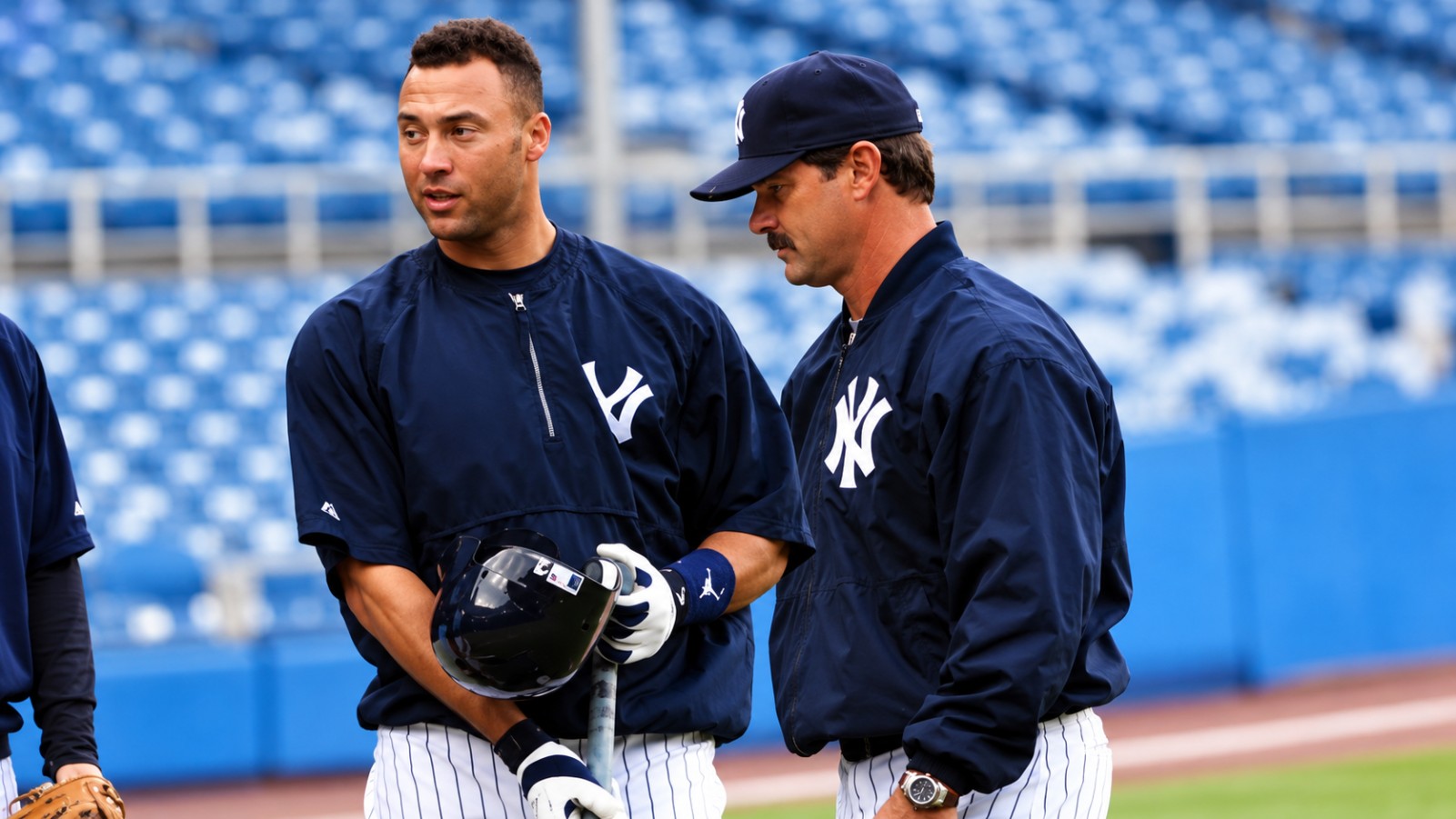
NEW YORK — Derek Jeter’s Yankees career left a record of championships, milestones and October performances. One of the lessons he carried through it came in a far smaller setting, with Don Mattingly beside him and no game on the line.
Before Jeter became captain, he was a young shortstop learning what established Yankees players expected of him. Mattingly supplied an example at a point when Jeter’s identity in the organization was still taking shape. Their connection would outlast their brief time as teammates.
The transition also coincided with the end of another Yankees career. Don Mattingly, the club’s captain and longtime first baseman, was finishing his final season. His last months in uniform overlapped with the first steps of a player who would eventually inherit much of the responsibility Mattingly had carried.
The Yankees were approaching a transition that would reshape the franchise. Jeter would become the everyday shortstop in 1996 and help end an 18-year World Series title drought. Mattingly’s influence belonged to the period before those achievements made the young infielder a familiar name.
Mattingly’s quiet instruction became Jeter’s daily habit
The decisive lesson came during the 1996 spring training in Fort Lauderdale, Florida, when Mattingly noticed Jeter walking while they left a back field. He quietly urged him to run because someone might be watching. Mattingly later explained that the person on his mind was Steinbrenner, whose viewing box overlooked the complex.
“Let’s run not walk , you never know who’s watching,” Mattingly said, according to that recollection.
Jeter initially thought Mattingly meant fans. Mattingly had George Steinbrenner in mind. The young player took a broader lesson from the moment about how to carry himself in a Yankees uniform.
Mattingly later recalled that Jeter immediately increased his pace. He said he never again saw the legendary shortstop walk onto or off the field, describing a practice that continued through workouts and games throughout his career.
“Derek picked up his pace that day, and I never saw him walk onto or off the field again,” Mattingly said.
For Jeter, the reminder became something he could apply every day. It did not depend on getting a hit or making a difficult play. Running between the field and the dugout was a visible choice he could repeat.
Mattingly’s quiet instruction became Jeter’s daily habit
Jeter initially interpreted the advice as a reminder about fans or children who might be watching. Mattingly’s concern was more immediate: the Yankees owner could be observing their effort even during routine work.
Looking back in a 2014 first-person recollection, Mattingly described how quickly Jeter responded and how completely the small adjustment became part of his routine.
“Derek picked up his pace that day, and I never saw him walk onto or off the field again,” Mattingly said.
Mattingly said the habit continued through practices and games after Jeter secured his spot.
Mattingly credited Jeter, rather than the conversation, for turning advice into his own standard.
A second recommendation helped secure Jeter’s place at shortstop
The lesser-known part of Mattingly’s influence involved a direct conversation with Steinbrenner as the Yankees prepared for 1996. The owner asked the retiring veteran whether Jeter was ready to play shortstop every day.
Mattingly’s response was about patience rather than a guarantee of immediate success. He believed the Yankees needed to give the young infielder room to develop instead of repeatedly moving him in and out of the job.
“If you take him, live with him there, if you think he is going to be great,” Mattingly said, recalling his message to Steinbrenner in 2014.
Mattingly had also identified a specific defensive adjustment in 1995. He thought Jeter was taking too long to release throws on balls hit directly at him or into the hole. He pointed the rookie toward the ready footwork used by established shortstops such as Alan Trammell.
Mattingly said Jeter was already making the adjustment when he watched him take ground balls the next day. That response gave the departing captain another reason to trust the rookie’s capacity to learn.
The numbers show what trusting the rookie produced
Jeter became the Yankees’ regular shortstop in 1996 and hit .314 with 183 hits, 10 home runs and 78 RBIs. He won the American League Rookie of the Year Award as New York claimed its first World Series title in 18 years.
Across 20 major league seasons, all with the Yankees, he collected 3,465 hits, earned 14 All-Star selections and won five championships. He became captain in 2003 and was elected to the Baseball Hall of Fame in 2020.
The chronology is significant. Mattingly’s last season ended in 1995, Jeter’s first full season came in 1996, and the Yankees did not appoint another captain until 2003. The example remained relevant after Mattingly retired.
The Yankees most-beloved star also played all 2,674 of his major league defensive games at shortstop. That unusually consistent positional record makes Mattingly’s advice to leave the rookie at shortstop especially striking in retrospect. The Yankees ultimately gave Jeter the job Mattingly believed he deserved to grow into.
The Yankees lesson lasted beyond the Bronx
The example later resurfaced beyond the Yankees. During the 2020 spring training period, Miami Marlins players were observed running between their clubhouse and practice fields while Jeter led the organization and Mattingly managed the team. The practice echoed the original lesson.
It remains part of Jeter’s Yankees legacy: visible effort that set a standard. The rookie chose to keep that expectation.
For the Yankees, the historical result is clear. Mattingly left after 1995 without a championship ring. The player he advised became the shortstop on five title teams, turning a veteran’s practical guidance into a signature part of a Hall of Fame career.
What do you think? Leave your comment below.