


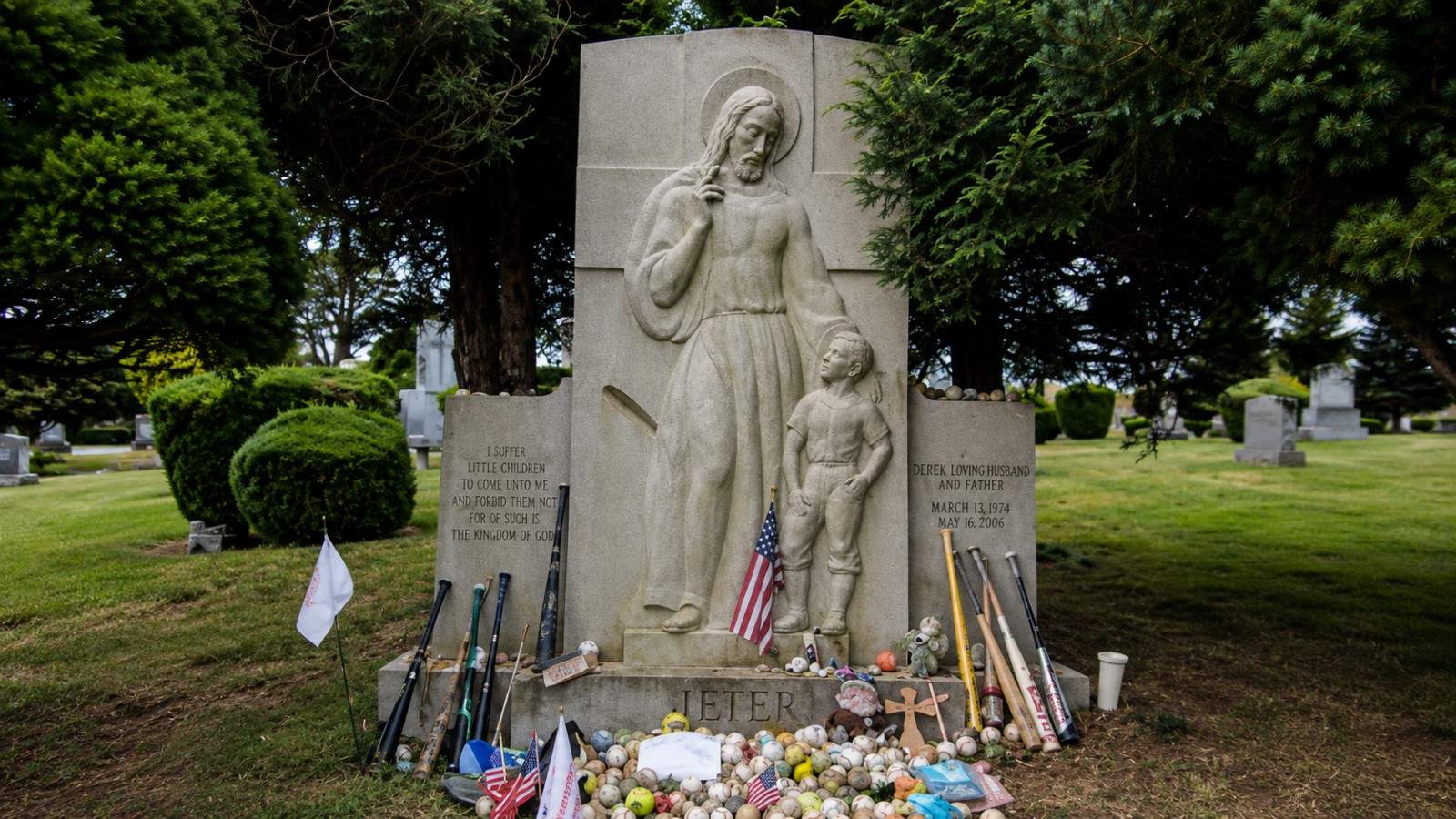
HAWTHORNE, N.Y. — Seventy-eight years after Babe Ruth died, the pilgrimage has not ended. At his grave in Gate of Heaven Cemetery, Yankees fans have turned remembrance into something distinctly Ruthian: baseballs and bats share space with beer, whiskey, cigars and food.
Ruth died Aug. 16, 1948, at 53, but his burial site in suburban Westchester County has remained a destination for generations of baseball fans. Visitors have left caps, T-shirts and other memorabilia, but the more unusual tributes reflect the outsized appetites and personality that became inseparable from the legend of the Yankees’ first great superstar.
Among the offerings documented over the years are hot dogs, beer, whiskey and cigars. One visitor even brought an entire sausage, pepper and onion pizza, according to cemetery officials quoted in an Associated Press report on the 70th anniversary of Ruth’s death. Workers have periodically had to clear the grave because the tributes accumulate so quickly.
The custom remains one of the more unusual ways Yankees history lives outside the Bronx. Ruth’s grave is not treated merely as the resting place of a former player. For fans, it has functioned almost like a baseball shrine.
A grave covered in baseball, beer and food
Ruth is buried with his second wife, Claire, at Gate of Heaven Cemetery in Hawthorne. The grave’s monument depicts Jesus standing over a young baseball player, but what visitors place around it often draws just as much attention.
Baseballs sometimes carry handwritten messages. Bats, Yankees caps and small American flags have appeared there. Then there are the offerings that would look unusual at almost any other cemetery: empty beer containers, liquor, cigars and the foods associated with Ruth’s famous appetite.
The tradition was already well established decades ago. In 2018, cemetery field superintendent John Garro told The Associated Press that workers tidied the site every other week and conducted larger cleanups every few months because the items kept accumulating.
“We like to keep some stuff there,” Garro said, “because it keeps the whole thing going.”
The grave’s attraction has also crossed rivalry lines. During Boston’s 2004 postseason run, when the Red Sox were trying to end the 86-year championship drought associated with the so-called Curse of the Bambino, traffic became so heavy that the cemetery assigned two employees to watch over the site, according to the AP account. One person even asked for permission to spend the night there. The request was denied.
Ruth’s death stopped New York
The continuing visits mirror the extraordinary public response that followed Ruth’s death. He died in New York after a battle with cancer, only two months after making an emotional final appearance at Yankee Stadium for the retirement of his No. 3.
His body then lay in state at the original Yankee Stadium for two days. Contemporary accounts and later histories estimate that roughly 80,000 to 100,000 people came to say goodbye. Thousands more gathered for his funeral Mass at St. Patrick’s Cathedral, with enormous crowds standing outside in the rain and lining the route to his burial in Hawthorne.
The family had initially asked mourners not to send flowers. A 1948 United Press report said Ruth had often expressed the view that making a child happy was a better way to honor someone. The request did little to diminish the scale of the public mourning.
That reaction reflected what Ruth had become by the end of his life. He was no longer simply a retired ballplayer. He had become one of the most recognizable American sports figures of the 20th century.
The Yankee who changed the franchise
Ruth’s arrival from the Boston Red Sox after the 1919 season altered the Yankees’ trajectory. His power and popularity helped transform a franchise without a World Series title into baseball’s dominant brand.
In 15 seasons with the Yankees, Ruth hit 659 home runs and helped the club win seven American League pennants and four World Series championships. Yankee Stadium opened in 1923 as his drawing power reshaped the economics and scale of the franchise. He homered on opening day and helped the Yankees win their first championship that fall.
His 60 home runs in 1927 stood as the major league single-season record until Roger Maris hit 61 in 1961. Ruth retired with 714 career home runs, a mark that survived until Hank Aaron passed him in 1974.
Those numbers explain part of the enduring fascination. They do not fully explain why fans still bring a beer or cigar to his grave.
Why the offerings fit Babe Ruth
Ruth’s mythology has always extended beyond statistics. Stories about his eating, drinking, nightlife, generosity, humor and enormous celebrity became part of the Babe Ruth character while he was still alive. That makes the objects left in Hawthorne unusually personal. A baseball honors the player. A hot dog, cigar or bottle nods to the personality fans believe they know.
The practice also shows how Ruth remains connected to the modern Yankees. His records have been chased by Maris, Aaron and, more recently, Aaron Judge. His artifacts remain on display at Yankee Stadium and the National Baseball Hall of Fame. A Ruth Yankees jersey connected to the 1932 World Series sold for $24.12 million in 2024, setting a record for sports memorabilia.
Yet one of the most durable Ruth traditions costs almost nothing. Fans make the trip to a quiet cemetery roughly 40 kilometers north of Yankee Stadium, find the monument in Section 25 and leave behind something that reminds them of the Bambino.
Seventy-eight years after New York lined the streets for his funeral, the offerings keep arriving. For most baseball legends, flowers would be enough. For Babe Ruth, apparently, fans still think a baseball, a beer and maybe a hot dog make more sense.
What do you think of the unusual tradition at Babe Ruth’s grave? Leave your comment below.











Have been there numerous times when working at a funeral home. Amazing what people leave. They also bring things to Billy Martin’s grave and leave them which is near the Bambino’s