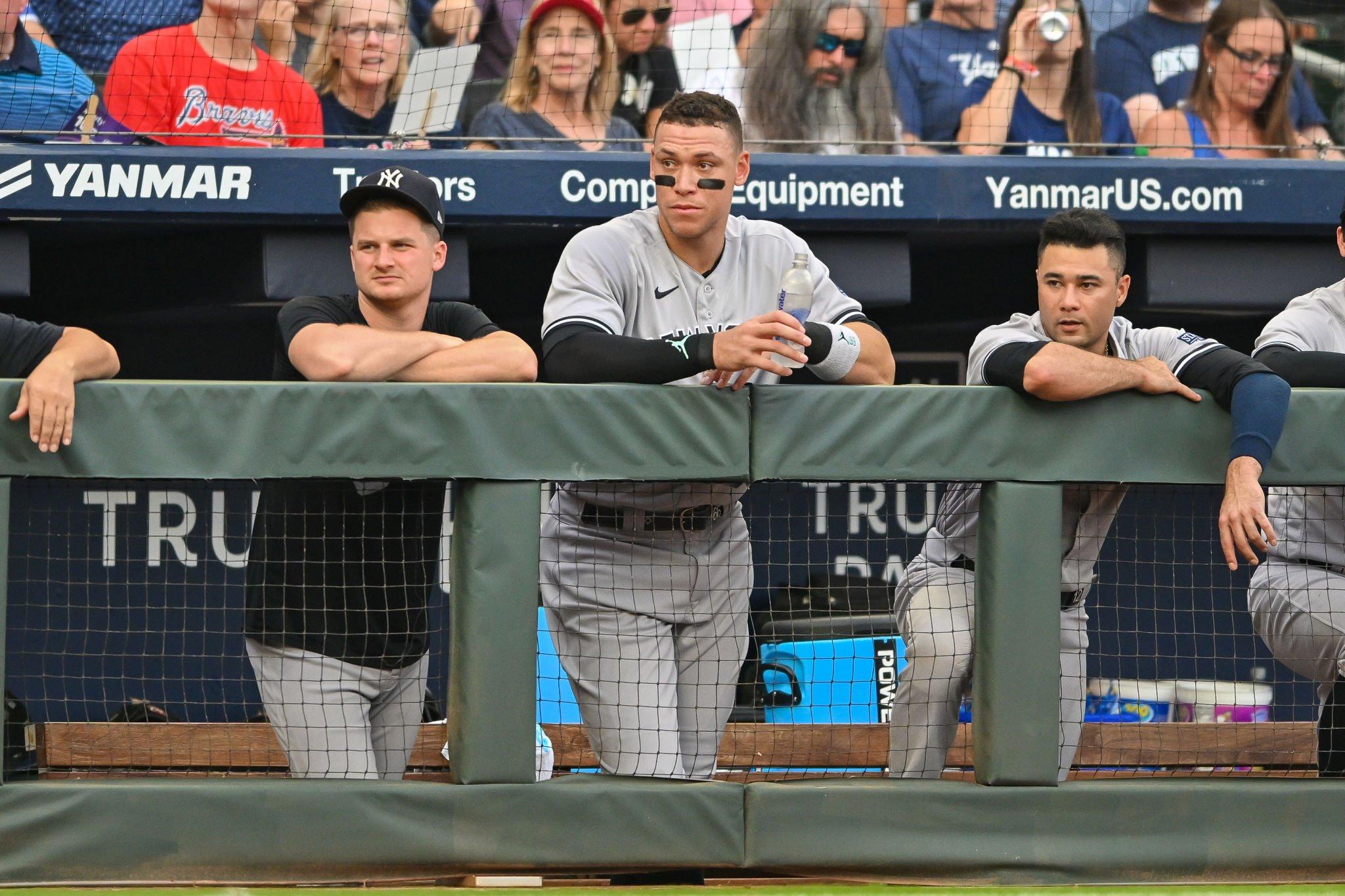
NEW YORK — The captain wanted the New York Yankees to hear his frustration after another failed October. Now, his Aaron Judge‘s message appears to have struck a nerve inside the organization’s highest offices.
The Yankees captain’s public demand for greater commitment to winning a championship has reportedly irritated members of the team’s leadership, creating an unexpected disagreement between the franchise’s biggest star and those controlling its finances.
According to an Oct. 15 report by the New York Post, Yankees decision-makers were surprised and somewhat upset by Judge’s insistence that the organization go all-in following its American League Division Series elimination against the Tampa Bay Rays.
The reaction reportedly stems from two issues: the Yankees’ already substantial payroll and their expensive decision to retain Cody Bellinger, a move Judge strongly supported.
The disagreement is not believed to threaten Judge’s relationship with the organization. However, it raises questions about whether the Yankees captain and team ownership share the same understanding of what a championship-level financial commitment should look like.
Yankees bosses reportedly unhappy with Judge’s spending message
Judge delivered his pointed remarks Oct. 7 after Tampa Bay completed a three-game ALDS sweep with a 4-3 victory at Yankee Stadium.
The three-time American League MVP, who missed the entire postseason because of a calf injury, challenged managing general partner Hal Steinbrenner and general manager Brian Cashman to address the roster’s shortcomings.
“We’re the Yankees,” Judge said. “I feel like they should go all in and do what they need to do.”
Judge made clear that he expected the organization to pursue whatever personnel changes were necessary to compete for a championship.
“That’s why I signed back here to play with the Yankees, to fight for a championship every single year, to go all in,” he said.
Those comments reportedly did not land well with everyone in the front office.
According to the Post, Yankees officials believe a payroll around $300 million represents a considerable investment, one that should be sufficient to field a championship contender.
The organization’s position is understandable from a financial standpoint. New York already operates with one of baseball’s most expensive rosters and has repeatedly made major commitments to established stars.
But Judge’s argument reflects a different measurement of success. For the Yankees captain, assembling a competitive regular-season team is not necessarily the same as doing everything possible to win the World Series.
Asked directly whether the front office had done enough, Judge offered a revealing response: “It’s tough to say.”
He acknowledged that signing or trading for every desirable player was unrealistic before emphasizing that consistently producing winning seasons was insufficient for the Yankees.
That distinction appears to sit at the center of the disagreement.
Cody Bellinger’s $162.5 million deal adds another twist
The reported irritation also involves a significant financial decision the Yankees made earlier this year.
New York re-signed Cody Bellinger to a five-year, $162.5 million contract in January, ending a prolonged negotiation that required considerable involvement from Steinbrenner and Cashman.
The agreement included a $20 million signing bonus, a full no-trade clause and opportunities for Bellinger to opt out after the 2027 and 2028 seasons.
Judge had strongly supported keeping Bellinger in the Bronx.
The Post reported that Yankees officials viewed the expensive reunion as evidence of their willingness to invest in players their captain wanted alongside him.
That makes Judge’s subsequent spending demands particularly sensitive.
From management’s perspective, the organization had already committed substantial resources toward preserving a roster Judge believed could contend.
Bellinger’s return was not a minor transaction. It was among the club’s defining financial decisions of the previous offseason.
The Yankees also retained much of their established roster rather than pursue a sweeping reconstruction. Yet the result remained familiar.
New York won 93 regular-season games and swept the Boston Red Sox in the Wild Card Series, only to lose three consecutive games against Tampa Bay in the next round.
Judge’s absence complicated the team’s postseason outlook. But the elimination also exposed weaknesses that spending alone had not resolved.
Judge’s championship urgency creates difficult question for Steinbrenner
The reported disagreement arrives at an especially sensitive point for the franchise.
The Yankees have not won a World Series since 2009, extending their championship drought to 17 consecutive seasons.
Judge, who turns 35 next April, has five seasons remaining on the nine-year, $360 million contract he signed after his historic 2022 campaign.
Despite his individual accomplishments, including three MVP awards and more than 500 career home runs, he has yet to celebrate a World Series championship.
The pressure to win during the remaining years of his prime is becoming increasingly difficult to ignore.
But New York’s latest postseason failure also presents a more complicated financial question.
The Yankees have spent heavily without finding the combination of talent, roster balance and postseason execution needed to finish the job.
Their 2026 offense struggled without Judge for much of the season. The ALDS brought further attention to defensive mistakes, inconsistent hitting and questionable decisions.
Simply adding another expensive player would not automatically solve those problems.
The front office now faces decisions involving pending free agents Jazz Chisholm Jr., Trent Grisham and David Bednar, along with broader questions about the team’s construction.
Cashman’s contract is also set to expire this offseason, adding another layer of uncertainty.
Judge publicly supported manager Aaron Boone following the elimination, making clear that his demand for improvement did not amount to a call for a managerial change.
The reported disagreement with ownership, meanwhile, should not be mistaken for a complete breakdown in relations. The Post indicated that Judge maintains a strong relationship with the Yankees’ leadership and that the irritation is unlikely to produce lasting damage.
Still, the episode exposes an important difference in expectations.
For Steinbrenner and the Yankees’ executives, the organization’s enormous payroll is evidence of commitment.
For Judge, the only convincing evidence might be the championship that has continued to elude him.
With another offseason beginning earlier than expected, the captain’s challenge has become a potentially uncomfortable issue for the people making the Yankees’ biggest decisions.
What do you think? Leave your comment below.