NEW YORK — The Yankees spent the winter searching for bullpen upside. Nine months later, a small January transaction has become a striking example of how quickly a roster calculation can change.
New York’s postseason ended against the Tampa Bay Rays with questions surrounding its depth, execution and player development. Decisions that appeared relatively minor before spring training now invite closer examination.
One such decision involved a left-handed hitter coming off a productive Triple-A season. The Yankees had limited room for another first baseman, and their front office chose a young pitcher with a powerful arm and several years of team control.
The logic was straightforward. Pitching depth can disappear quickly, and a controllable reliever offered an opportunity to strengthen the organization without surrendering one of its most prominent prospects.
But the returns have been unusually lopsided through one season. One player became a fixture in a major league lineup. The other spent much of the year outside the Yankees’ big league bullpen. Their sharply different workloads now give New York another difficult offseason question.
Former Yankees prospect lands among Gold Glove finalists
T.J. Rumfield was named one of three National League Gold Glove finalists at first base after a breakout rookie season with the Colorado Rockies. The other finalists are Atlanta’s Matt Olson and San Diego’s Ty France. The award winners are scheduled to be announced Nov. 1.
The Yankees traded Rumfield to Colorado on Jan. 28 for right-handed reliever Angel Chivilli. What began as an exchange of organizational depth now looks considerably different after Rumfield’s first full major league season.
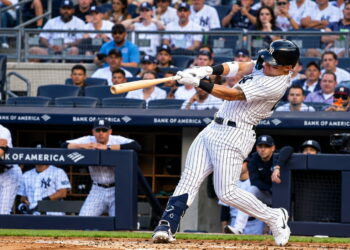
Rumfield hit .300 with 164 hits, 16 home runs, 73 RBIs and a .390 on-base percentage across 155 games. His .843 OPS added an offensive dimension to a Gold Glove candidacy built on steady work around first base.
He committed seven errors over more than 1,150 innings at the position and finished with six Defensive Runs Saved. According to the Rockies’ published historical comparison, only four other rookies since 1901 had logged at least 1,150 innings at first with seven or fewer errors in one season.
Rumfield has not won the award. Olson and France have strong defensive credentials of their own. Still, simply reaching the final three is an important milestone for a player New York moved before he reached the majors.
Cashman saw bullpen upside in Chivilli
The Yankees had identifiable reasons to make the trade. Rumfield was their No. 22 prospect in MLB Pipeline’s rankings at the time, but he played a position where major league opportunities appeared uncertain.
Chivilli entered the organization after two seasons in Colorado, where he had posted a 6.18 ERA over 90⅓ innings. His high-velocity fastball and secondary offerings made him an intriguing developmental target despite his uneven results.
General manager Brian Cashman outlined the attraction when the deal was completed. He emphasized Chivilli’s arsenal, experience and roster flexibility.
“He’s a 23-year-old power arm that’s got a tool package that’s pretty exciting,” Cashman said.
The Yankees’ immediate payoff was limited. Chivilli went 1-1 with a 3.78 ERA and 16 strikeouts over 16⅔ innings in 15 major league outings in 2026. He allowed four home runs and walked seven batters.
Those numbers do not prove Chivilli lacks a future role. At 24, he remains a developmental arm, and his major league ERA improved considerably from the 7.06 mark he recorded with Colorado in 2025. But the contribution was modest compared with what Rumfield delivered in Denver.
One trade, two very different kinds of value
The contrast extends beyond batting average and ERA. Rumfield supplied 155 games and 631 plate appearances for the Rockies, according to published 2026 batting totals. Chivilli faced 73 batters in the majors for New York.
That is more than eight times as many plate appearances for Rumfield as major league batters faced by Chivilli. The measures describe different jobs, not interchangeable player value, but they illustrate the gap in immediate opportunity and impact.
Rumfield also drew 72 walks against 86 strikeouts, supporting a .390 on-base percentage. His plate discipline helps explain why his rookie production extended well beyond an isolated hot streak.
The Yankees had reasons to prioritize pitching, particularly given the pressures on Aaron Boone’s bullpen during a postseason race. Yet Rumfield’s emergence underscores the cost of moving an MLB-ready bat before learning whether his minor league production would translate.
It is not a direct argument that Rumfield would have received 155 games in New York. Playing time, roster construction and development opportunities would have been different. His Colorado performance, however, establishes that the talent had meaningful major league value.
Yankees enter offseason with trade under new scrutiny
Rumfield’s nomination arrived just as the Yankees began assessing another disappointing October finish. His name now belongs in a wider accounting of which internal options the organization kept and which it moved.
New York also has Gold Glove finalists of its own in Cody Bellinger, Austin Wells and José Caballero. That distinction matters: Rumfield’s candidacy does not, by itself, mean the Yankees lacked defensive ability throughout the roster.
The trade instead raises a narrower question about the price New York paid for a bullpen project. Rumfield established himself as a productive everyday first baseman, while Chivilli has yet to claim a permanent major league role with the Yankees.
Both players remain young enough for the assessment to change. For now, Rumfield is awaiting the Nov. 1 Gold Glove announcement, and Chivilli enters the winter still trying to convert his arm talent into a larger Yankees role.
What do you think? Leave your comment below.