


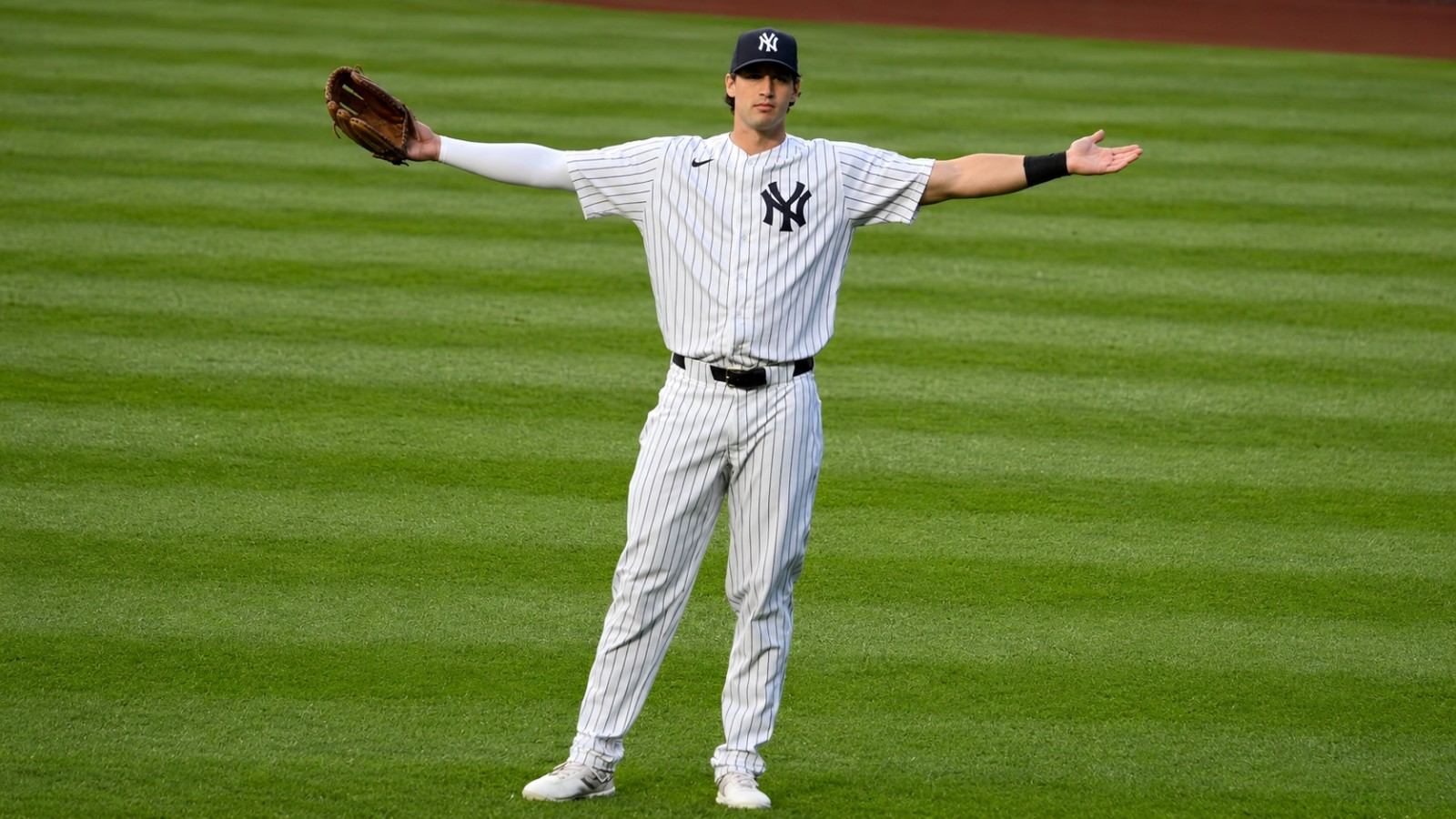
NEW YORK — Five months ago, the New York Yankees believed they were watching the early days of a future star. A 6-foot-7 outfielder with a left-handed swing engineered for the short porch, base-stealing speed and center-field range does not come along often.
Inside the clubhouse and across the industry, Spencer Jones was the prospect the Yankees did not want to give up.
The spring hype was loud. Some evaluators floated a comparison that would make any fan lean in, describing Jones as a version of Aaron Judge who batted from the other side. The organization guarded him at the deadline last summer, reportedly unwilling to move him for anything short of a front-line arm. Patience, the Yankees insisted, would be rewarded.
That patience is now being tested. Jones sits at Triple-A Scranton/Wilkes-Barre, optioned there earlier this month after a second stint in the majors produced the same problem that has shadowed him for years. The Yankees, at 54-43 and chasing the first-place Tampa Bay Rays in the American League East, must decide what he is before the calendar forces their hand. (Record and standings current through July 18, 2026, per MLB.)
The tools have never been the question. The swing is. And with the Aug. 3 trade deadline closing in, the people paid to judge talent are no longer whispering their doubts. They are putting them in writing.
A blunt verdict from inside the game
The clearest signal came not from the front office but from rival evaluators, relayed by veteran columnist Bob Klapisch of NJ.com. Multiple scouts told him the Yankees should consider selling before Jones’ value slips further. One went further, invoking a name Yankees fans would rather forget.
The remark landed hard because it tied Jones to a recent, painful memory in the Bronx. Asked how the Yankees should handle him, the evaluator did not hedge.
“Trade Jones while he still has some value,” one talent evaluator told NJ.com. “He’s Joey Gallo 2.0.”
The comparison needs little translation. Joey Gallo arrived with prodigious left-handed power and left as a cautionary tale, done in by strikeouts that swallowed everything else. Yankees fans watched it once. The scout is warning they may be watching it again.
The hole pitchers keep finding
The mechanics behind the worry are specific. Jones’ uppercut swing, the same path that launches baseballs into orbit, leaves him exposed to velocity up and in. Opposing pitchers have found the soft spot and kept pounding it.
One scout described the flaw as glaring and, more damning, unaddressed. That word, adjustment, is the crux. Raw power buys a prospect chances. Failing to counter a known weakness spends them.
“It’s a pretty glaring hole,” another scout told NJ.com. “(Opposing teams) have figured that out and Jones hasn’t made an adjustment.”
The batted-ball evidence backs the scouting reports. In two call-ups this season, Jones hit .233 with two home runs and seven RBIs across 73 at-bats, a .687 OPS. More telling was the miss rate: 34 strikeouts in 82 plate appearances, a whiff rate near 42 percent, among the highest of any Yankee with real playing time, per NJ.com and Baseball Savant.
Why the Judge comparison only goes so far
Jones’ defenders lean on history. Judge himself struck out often as a young player, fanning at roughly 30 percent in his first two full seasons before becoming the sport’s most feared hitter. Give Jones time, the argument goes, and the strikeouts will follow the same downward path.
Scouts cited by NJ.com push back on the parallel with one distinction. Judge never carried this level of swing-and-miss through the minors. Jones has. His professional strikeout rate has hovered around a third of his plate appearances for years, and his swinging-strike rates at the upper levels have exceeded marks that would have ranked among the worst in the majors. In parts of the last two Triple-A seasons he has posted swinging-strike rates near 19 to 20 percent.
The counterpoint is that the bat, when it connects, is special. Jones has crushed balls in the International League at exit velocities topping 117 mph and has ranked among the level’s home run leaders. He is a career .272 hitter in the minors, which is why nobody inside the organization is ready to call him a bust.
A crowded outfield forces a choice
The decision does not exist in a vacuum. The Yankees are deep in the outfield, with Cody Bellinger, Jasson Domínguez and Trent Grisham logging the everyday work and a designated-hitter rotation eating at-bats that might otherwise go to Jones. There is simply no clean path to regular playing time in the Bronx.
That logjam sharpens the question facing general manager Brian Cashman. With Grisham able to reach free agency after the season, the Yankees must weigh whether Jones or Domínguez is the better long-term answer in center field for 2027. Many inside and outside the organization believe Domínguez, the more polished contact hitter, wins that competition.
Jones has kept the debate alive with his glove and his production at Scranton/Wilkes-Barre, where regular at-bats were always the point of the demotion. If he hits, a third call-up remains possible as New York pushes toward the postseason. If he does not adjust, the deadline offers an exit.
For now Jones waits, one option away from the majors and one phone call away from a new address. The Yankees have until Aug. 3 to decide whether the swing that once promised the future is a problem they can fix or a risk they should hand to someone else.
What do you think? Leave your comment below.









If other teams are saying adjustments need to be made, what the hell is the Yankee brain trust not addressing this. He’s got to much talent to give up on.